



18
Jun
What Is High Frequency Trading? A Clear Guide
TL;DR:
- High-frequency trading uses advanced algorithms to execute thousands of trades per second, exploiting small market inefficiencies. It is mainly conducted by large institutions with significant infrastructure, making it inaccessible to retail traders. HFT benefits markets through tighter spreads and better price discovery but also poses risks of volatility and market manipulation.
High-frequency trading (HFT) is defined as an automated trading method that uses sophisticated algorithms to execute thousands of trades per second, exploiting tiny price differences across financial markets. HFT firms trade at speeds as fast as 10 milliseconds or less, a pace no human trader can match. Banks, hedge funds, and proprietary trading firms use HFT to capture small but consistent profits across enormous trade volumes. According to Wikipedia, HFT accounted for 10–40% of equity trading volume in 2016, which shows just how dominant this approach has become in modern markets. Understanding HFT helps you see why markets move the way they do and why liquidity conditions change so fast.
What is high frequency trading and how does it work?
High-frequency trading works by combining real-time market data, ultra-low latency infrastructure, and algorithmic decision-making into a single automated system. The algorithm scans price feeds from multiple exchanges simultaneously, identifies a brief pricing inefficiency, and places an order before the gap closes. The entire process, from data intake to order execution, happens in microseconds.

Speed is the defining competitive advantage in HFT. Firms invest heavily in co-location services, which means placing their servers physically inside or adjacent to exchange data centers. Co-location reduces latency and gives traders a measurable speed edge over competitors operating from remote locations. A few milliseconds of advantage translates directly into profitability at scale.
The technology stack behind HFT includes:
- Custom hardware: Field-programmable gate arrays (FPGAs) process data faster than standard CPUs
- Direct market access (DMA): Bypasses traditional broker routing for faster order placement
- Co-location services: Server proximity to exchange matching engines cuts transmission delay
- High-speed fiber and microwave networks: Some firms use microwave towers to transmit data faster than fiber optic cables allow
Pro Tip: If you want to understand HFT mechanics at a deeper level, study how exchange matching engines work. The matching engine is where speed advantages are won or lost.
HFT systems do not rely on human judgment during execution. The algorithm makes every decision based on pre-programmed rules and live data. This removes emotional bias but also means the system reacts to bad data just as fast as good data.
What strategies do high-frequency traders use?
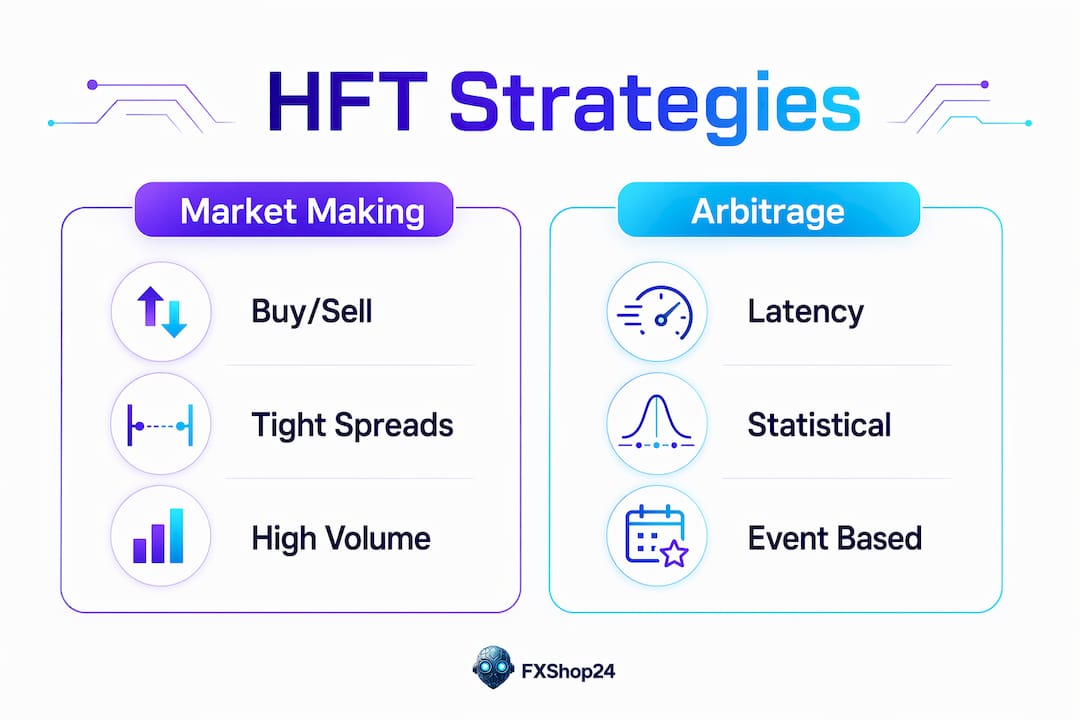
Common HFT strategies include market making, event arbitrage, statistical arbitrage, and latency arbitrage. Each strategy targets a different type of market inefficiency, but all share the same core requirement: speed.
Market making is the most common HFT strategy. The firm simultaneously posts a buy order and a sell order for the same asset, profiting from the bid-ask spread. By doing this thousands of times per second across many securities, firms generate consistent small profits. This strategy also provides liquidity to other market participants.
Latency arbitrage exploits the tiny time gap between when price data reaches different market participants. An HFT firm with faster data access can act on a price move before slower participants even see it. Competition in HFT largely revolves around execution speed rather than fundamentally new trading ideas, which is why firms spend millions on microwave networks and co-location.
Statistical arbitrage uses quantitative models to identify correlated assets that have temporarily diverged in price. The algorithm bets on the prices converging again, entering and exiting positions within seconds. Event-driven arbitrage reacts to news releases, earnings announcements, or economic data, executing trades the instant new information hits the market.
| Strategy | Core Mechanism | Typical Holding Period | Primary Goal |
|---|---|---|---|
| Market Making | Post bid and ask simultaneously | Seconds or less | Capture bid-ask spread |
| Latency Arbitrage | Act on data before slower traders | Milliseconds | Speed-based price edge |
| Statistical Arbitrage | Trade correlated asset divergence | Seconds to minutes | Mean reversion profit |
| Event-Driven Arbitrage | React to news or data releases | Milliseconds to seconds | News-based price move |
Pro Tip: HFT strategies often aim to end the trading day near flat positions, avoiding overnight exposure entirely. This is a deliberate risk management choice, not a limitation.
What are the advantages and risks of high frequency trading?
HFT delivers real benefits to financial markets, but it also carries serious risks that regulators and investors continue to debate. The honest answer is that both sides of this argument are correct.
Advantages worth knowing
HFT’s increased trade volume has lowered bid-ask spreads and improved price discovery for all market participants. Tighter spreads mean lower transaction costs for retail investors buying stocks or ETFs, even if those investors never interact with an HFT firm directly. HFT also improves price efficiency by rapidly correcting mispricings across exchanges.
- Liquidity provision: HFT market makers ensure buyers and sellers can transact quickly at competitive prices
- Price discovery: Algorithms incorporate new information into prices faster than human traders
- Lower trading costs: Tighter spreads reduce the cost of every trade for all participants
- Market efficiency: Arbitrage strategies eliminate persistent price gaps between related assets
Risks and controversies
HFT can contribute to market volatility and major market dislocations. The 2010 Flash Crash, where the Dow Jones Industrial Average dropped nearly 1,000 points in minutes before recovering, is the most cited example. Automated systems reacting to the same signals simultaneously can amplify price moves rather than stabilize them.
Rapid order cancellations and certain HFT techniques have raised regulatory and ethical concerns about market manipulation. Critics argue that some firms use order flow data to front-run slower participants, creating an uneven playing field.
“HFT simultaneously improves market efficiency and introduces potential instability, making it a complex market force rather than purely beneficial or harmful.” — Investopedia
The fairness debate is real. Retail investors benefit from tighter spreads but cannot compete on speed. Institutional investors face a market structure shaped by firms whose primary edge is technological, not analytical.
Who uses HFT and why can’t retail traders access it?
HFT is predominantly used by banks, financial institutions, hedge funds, and proprietary trading firms. Citadel Securities, Virtu Financial, and Jane Street are among the most recognized names in this space. These firms have the capital and technical resources to build and maintain HFT infrastructure.
Retail traders are effectively excluded from true HFT for several concrete reasons:
- Infrastructure cost: Co-location fees, custom hardware, and high-speed network access cost millions of dollars annually
- Technology expertise: Building and maintaining HFT algorithms requires teams of quantitative developers and engineers
- Regulatory requirements: HFT firms must meet strict compliance standards, including real-time reporting and risk controls
- Capital requirements: Executing thousands of trades per second requires substantial capital buffers to absorb execution risk
- Data access: Institutional-grade market data feeds cost far more than retail data subscriptions
Retail investors do benefit indirectly from HFT through tighter spreads and faster price updates. When you buy a stock through a retail brokerage, the competitive pricing you see is partly a result of HFT market makers competing for order flow. The benefit is real, even if the mechanism is invisible to most investors.
A common misconception is that algorithmic trading and HFT are the same thing. They are not. Algorithmic trading covers any rule-based automated system, including automated trading systems for MT4/MT5 used by retail forex traders. HFT is a specific subset defined by extreme speed and volume, not just automation.
How is HFT shaping the future of financial markets?
HFT is evolving fast. Artificial intelligence and machine learning are being integrated into trading algorithms to improve pattern recognition and adapt to changing market conditions. The 2026 trends in automated trading show firms moving beyond simple rule-based systems toward models that learn from live market data.
| Trend | Description | Market Impact |
|---|---|---|
| AI Integration | Machine learning models replace static rules | Faster adaptation to market regime changes |
| Crypto Market Expansion | HFT firms entering digital asset exchanges | Tighter spreads and higher liquidity in crypto |
| Regulatory Tightening | New reporting and latency floor rules | Reduced speed advantages, higher compliance costs |
| Microwave and Laser Networks | Faster-than-fiber data transmission | Continued latency arms race between firms |
| Forex and Futures Growth | HFT expanding beyond equities | More efficient pricing in currency and commodity markets |
Regulators in the United States and European Union are actively reviewing HFT practices. The SEC and ESMA have both proposed rules targeting order cancellation rates and co-location fairness. These rules aim to reduce the speed advantage without eliminating the liquidity benefits HFT provides.
The expansion of HFT into forex, futures, and cryptocurrency markets is already underway. Crypto exchanges like Coinbase and Binance now see significant algorithmic and high-speed trading activity. This brings tighter spreads to those markets but also imports the same volatility risks seen in equities.
Key takeaways
High-frequency trading improves market liquidity and price efficiency but remains inaccessible to retail traders due to its extreme infrastructure and capital requirements.
| Point | Details |
|---|---|
| HFT defined by speed | Algorithms execute trades in milliseconds, far beyond human capability. |
| Four core strategies | Market making, latency arbitrage, statistical arbitrage, and event arbitrage drive HFT profits. |
| Liquidity benefit is real | Tighter bid-ask spreads lower transaction costs for all investors, including retail. |
| Retail access is blocked | Co-location, custom hardware, and capital costs make true HFT institutional-only. |
| AI is reshaping HFT | Machine learning integration is making algorithms more adaptive and harder to predict. |
HFT is more nuanced than the headlines suggest
Most coverage of high-frequency trading falls into one of two camps: either it is a predatory system rigging markets against ordinary investors, or it is a pure efficiency engine that benefits everyone. After spending years working with automated trading systems and studying market microstructure, I find both positions too simple.
The real picture is that HFT is a technology-driven arms race with genuine winners and losers. Retail investors win on spreads. Slower institutional investors sometimes lose on execution. Market stability is genuinely at risk during stress events. None of these outcomes are permanent or universal.
What I think readers consistently underestimate is how much the HFT debate is really a debate about market structure, not trading strategy. The question is not whether algorithms should trade fast. The question is whether exchange rules and regulatory frameworks are designed to keep the playing field functional for all participants.
If you are exploring automated trading for forex or futures, do not confuse HFT with the expert advisor and algorithmic trading tools available to retail traders. Those tools operate on entirely different time scales and serve different purposes. They are genuinely useful. HFT, as practiced by Citadel Securities or Virtu Financial, is a different category entirely.
The most useful thing you can take from understanding HFT is this: speed and automation are not inherently good or bad. The outcome depends entirely on how they are deployed and regulated.
— Fxshop24
Explore automated trading tools built for real traders
If reading about HFT has sparked your interest in algorithmic and automated trading, you are in the right place. Fxshop24 offers a full catalog of automated futures trading systems designed for MT4 and MT5 platforms, including expert advisors, AI-powered trading robots, and professional indicators built for forex and gold markets.
These tools bring the logic of automated, rule-based execution to retail traders without the institutional price tag. Whether you are looking for a scalping EA, a trend-following system, or a full forex automation workflow, Fxshop24 has tested, prop-firm-ready solutions available for instant download. Explore the full range and find the system that fits your trading style.
FAQ
What is the simplest definition of high-frequency trading?
High-frequency trading is an automated trading method that uses algorithms to execute large numbers of trades in milliseconds, profiting from tiny price differences across markets.
Is high-frequency trading profitable?
HFT is profitable for firms with the right infrastructure, but margins per trade are extremely small. Profitability depends on volume, speed, and consistent execution across thousands of daily trades.
What are the biggest risks of high-frequency trading?
The main risks include contributing to flash crashes, potential market manipulation through rapid order cancellations, and systemic instability when many algorithms react to the same signal simultaneously.
Can retail traders use high-frequency trading strategies?
Retail traders cannot access true HFT due to infrastructure and capital costs. However, retail algorithmic trading using expert advisors on MT4 or MT5 applies similar rule-based logic at accessible time scales.
How does HFT affect everyday investors?
HFT tightens bid-ask spreads, which lowers transaction costs for retail investors buying stocks or ETFs. The benefit is indirect but measurable across millions of daily trades.