
17
Jun
Step by Step Trading System Setup for Forex & Gold
TL;DR:
- A trading system is a rules-based framework that replaces guesswork with specific criteria for entry, exit, risk, and performance review. Proper setup involves six phases, including market selection, platform configuration, backtesting, forward testing, and live deployment, with omission risking capital loss. Effective risk management, simplicity, and disciplined testing are vital for realistic, robust trading systems.
A trading system is a rules-based framework that replaces guesswork with defined criteria for every entry, exit, position size, and performance review. The step by step trading system setup process covers six distinct phases: market selection, platform configuration, strategy definition, backtesting, forward testing, and live deployment. Traders who skip any phase typically discover the gap during live trading, where it costs real capital. Platforms like TradingView and MetaTrader 4 (MT4) or MetaTrader 5 (MT5) form the technical backbone of most retail systems, while the 1–2% risk rule per trade forms the financial backbone. This guide walks you through every phase with the specificity that actually matters.
What are the essential components of a trading system setup?
A complete trading system is more than a set of entry signals. A full system integrates risk controls, exit rules, and performance review to function under real market conditions. Traders who treat entry signals as the whole system are the ones who blow accounts during drawdowns.

Before you write a single rule, you need the right infrastructure in place.
Markets and instruments: Choose your primary market first. Forex pairs like EUR/USD and USD/JPY offer deep liquidity and tight spreads. Gold (XAU/USD) adds volatility and responds strongly to macroeconomic events. Mixing both without a clear rationale creates noise, not opportunity.
Platform selection: MT4 and MT5 remain the industry standard for retail forex and gold trading. TradingView works well for charting and strategy visualization. A basic TradingView environment takes 3–5 minutes to configure with a regulated broker, but full system integration requires ongoing work. MT5 offers more order types and a broader asset range than MT4, which matters when you scale.
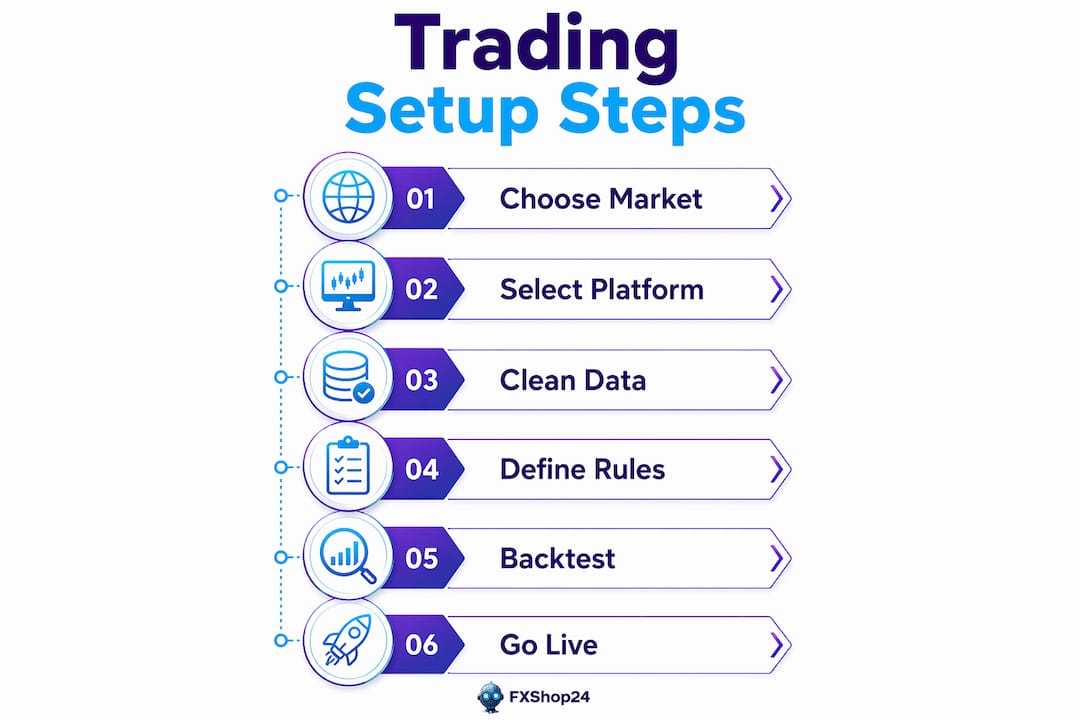
Data hygiene: Clean historical data is non-negotiable for backtesting. Survivorship bias and data gaps invalidate backtests before you even run them. Use tick data or high-quality OHLCV data from your broker or a verified data provider.
Here is a quick comparison of the two primary platforms:
| Feature | MT4 | MT5 |
|---|---|---|
| Asset coverage | Forex, CFDs | Forex, CFDs, stocks, futures |
| Order types | 4 pending order types | 6 pending order types |
| Strategy tester | Single-threaded | Multi-threaded, faster |
| EA compatibility | Broad legacy support | Newer, expanding ecosystem |
| Best for | Forex-focused automation | Multi-asset, advanced testing |
Timeframe selection: Match your timeframe to your lifestyle and strategy type. Scalpers work on M1 to M15. Swing traders use H4 to D1. Gold traders often use daily charts for trend context before dropping to H1 for entries. Using daily charts for context prevents over-analysis on lower timeframes where market noise dominates.
How do you define and develop a trading strategy?
Strategy development starts with a testable hypothesis, not a feeling. A hypothesis sounds like this: “Gold trends upward during the London session open after a higher low forms on the H4 chart.” That statement is specific, measurable, and falsifiable.
Once you have a hypothesis, define your rules with zero ambiguity:
- Entry rule: State the exact condition that triggers a trade. For example, enter long on XAU/USD when price closes above the previous H4 high after forming a higher low, confirmed by RSI above 50.
- Exit rule: Define both your take profit and stop loss before entering. A 1:2 risk-to-reward ratio on gold means a 50-pip stop targets a 100-pip gain.
- Position sizing: Calculate lot size based on account balance and risk percentage, not gut feel.
- Setup catalog: Limit yourself to 2–3 repeatable setups. Professional guidance recommends a maximum of 2–3 specific setups per day to prevent emotional trading and random entries. More setups create decision fatigue, not more profit.
Three setups that work well across forex and gold markets:
- Trend continuation: Enter in the direction of the dominant trend after a pullback to a key moving average (20 EMA or 50 EMA).
- Range reversal: Identify a defined range on XAU/USD or EUR/USD, then enter at support or resistance with a tight stop beyond the level.
- Breakout retest: Wait for price to break a key level, pull back to retest it, then enter in the breakout direction.
Pro Tip: Write your strategy rules on one page. A simple, one-page trading plan consistently outperforms complex, multi-condition systems when markets move fast and decisions must be made in seconds.
What are the critical testing phases before going live?
Testing is where most traders cut corners and pay for it later. Building a trading system requires a 7-phase cycle from hypothesis to iterative optimization to ensure real-world robustness. Skipping phases does not save time. It just moves the losses from the testing phase to your live account.
The three core testing phases are:
- Backtesting: Run your rules against historical data on MT4 or MT5 using the Strategy Tester. Account for slippage (typically 1–3 pips on forex), spread costs, and latency. A backtest that ignores these factors produces results that will never appear in live trading. Aim for at least 200 historical trades to get statistically meaningful results.
- Forward testing (paper trading): Apply your rules to live market data without risking capital. Run at least 30 setups before drawing conclusions. This phase reveals whether your rules hold up under current market conditions, not just historical ones.
- Small-capital live testing: Deploy a micro account with real money. Execution psychology changes when real capital is at risk. This phase surfaces issues that paper trading never will, including hesitation on entries and premature exits.
The performance drop between phases is real and predictable. Backtests showing a 65% win rate often degrade to 48% in live forward testing due to slippage and latency. That is not a failure of the strategy. It is the cost of real-world execution.
A system’s live win rate can drop to 40–50% compared to a historical backtest win rate of 65%. Plan for this gap before you go live, not after. — TradeZella
You can explore testing phases for forex traders in more detail to understand how each phase connects to the next.
How to implement disciplined risk management in your system
Risk management is the part of a trading system that keeps you in the game long enough to profit. Without it, even a high-probability strategy produces account blowups during normal drawdown periods.
The core rules are not suggestions. They are structural requirements:
| Risk Parameter | Recommended Standard | Why It Matters |
|---|---|---|
| Risk per trade | 1–2% of account balance | Limits single-trade damage during losing streaks |
| Daily loss cap | 2% of account balance | Prevents compounding losses in bad sessions |
| Max setups per day | 2–3 defined setups | Reduces emotional overtrading |
| Stop loss placement | Beyond key structure | Avoids premature exits from normal volatility |
Professional risk management standards recommend risking no more than 1–2% of capital per trade and capping daily losses at 2% to avoid account blowups. A trader with a $10,000 account risks $100–$200 per trade. That math keeps 50 consecutive losses from wiping the account.
Automated risk controls through Expert Advisors (EAs) on MT4 and MT5 remove the human error factor. An EA can enforce stop losses, calculate position sizes automatically, and close all trades when the daily loss cap is hit. The role of risk management in EA systems covers how to configure these controls within automated frameworks.
Pro Tip: Set your daily loss cap as a hard stop in your EA settings, not just a mental note. Mental stops fail under pressure. Automated stops do not.
What are the common pitfalls during trading system setup?
Most system failures trace back to a small set of repeatable mistakes. Knowing them in advance is the difference between a fixable problem and a blown account.
- Confusing signals with systems: An entry signal is one component. A complete system includes risk rules, position sizing, exit criteria, and a performance review process. Trading system logic alone is insufficient without order management and risk gates in place before live capital trading.
- Overfitting backtests: Optimizing a strategy to fit historical data perfectly produces a system that fails on new data. If your backtest win rate exceeds 70%, treat it with suspicion, not celebration. Real markets do not repeat exactly.
- Ignoring execution costs: Spreads, commissions, and swap rates erode profitability. A strategy that shows 5% monthly return in backtesting may deliver 2% after real execution costs on gold.
- Skipping the trading journal: A journal is your feedback loop. Log every trade with entry reason, exit reason, and outcome. Review it weekly. Patterns in your losses reveal the actual problem, whether it is a flawed rule or inconsistent execution.
- Changing the plan mid-session: Adjust your trading plan only when markets are closed to protect long-term profitability. In-session changes are almost always emotional reactions, not rational improvements.
Data hygiene deserves a separate mention. Gaps, duplicate bars, and incorrect timestamps in historical data produce false backtest results. Always verify your data source before running any test.
Key takeaways
A successful trading system requires clean data, defined rules, and validated testing before any live capital is deployed.
| Point | Details |
|---|---|
| System over signals | A complete system includes risk rules, exits, and performance review, not just entry signals. |
| Platform matters | MT4 and MT5 offer different capabilities; match your platform to your strategy type and asset class. |
| Test every phase | Expect a 15–20 percentage point drop from backtest to live win rate; plan for it before going live. |
| Risk rules are structural | Cap risk at 1–2% per trade and 2% daily to survive normal drawdown periods. |
| Simplicity wins | A one-page plan with 2–3 defined setups outperforms complex multi-condition systems under pressure. |
What i’ve learned building systems for forex and gold traders
The traders who succeed with systematic trading are rarely the ones with the most sophisticated strategies. They are the ones who treat their system like a business process, not a creative exercise.
The biggest mistake I see consistently is traders who build a system, get a few losing trades, and immediately start changing rules. That behavior destroys the statistical validity of any system. You need at least 30–50 trades before a pattern in your results means anything. Changing rules after 5 trades is not optimization. It is panic.
Simplicity is underrated. A two-condition entry rule on EUR/USD or XAU/USD that you execute consistently will outperform a ten-condition rule you second-guess on every trade. The goal is repeatability, not sophistication.
The emotional challenge is real, especially for beginners. The solution is not to eliminate emotion. It is to make the system so specific that there is no room for emotion to enter the decision. If your rules say “enter when price closes above the H4 high after a higher low,” there is no judgment call. You either see the setup or you do not.
Discipline and consistent plan execution outweigh the quality of the trading idea itself. A mediocre strategy executed with discipline beats a brilliant strategy executed inconsistently every time.
— Fxshop24
Build your system faster with fxshop24’s tools
Fxshop24 offers a full catalog of automated trading tools designed specifically for forex and gold traders working on MT4 and MT5. Whether you are configuring your first system or refining an existing one, the right software removes the manual friction from every phase.
Explore automated futures trading systems built for real-world deployment, complete with risk management controls and prop firm compatibility. For traders who want a structured starting point, the forex automation workflow guide walks through each setup phase in practical detail. Fxshop24 also provides MT4 and MT5 installation guides so you can get your system running without technical delays. Every product comes with lifetime updates and installation support.
FAQ
What is a trading system in forex and gold trading?
A trading system is a rules-based framework that defines every aspect of a trade, including entry, exit, position size, and risk limits. It replaces discretionary decisions with repeatable, testable criteria.
How long does a step by step trading system setup take?
Basic platform configuration on MT4 or MT5 takes under an hour, but full system validation across backtesting and forward testing requires weeks to months depending on trade frequency.
Why does my backtest win rate drop in live trading?
Backtests showing 65% win rates commonly degrade to 48% or lower in live conditions due to slippage, latency, and spread costs that historical data does not fully replicate.
How many setups should a beginner trading strategy include?
Limit your system to 2–3 clearly defined setups. More setups increase decision fatigue and the likelihood of taking low-quality trades that fall outside your tested rules.
Do i need an expert advisor to run a trading system on mt4 or mt5?
No, but an EA automates rule execution and enforces risk controls without human error. Manual traders can follow the same rules, though consistency under live market pressure is significantly harder without automation.