



16
Jun
The Role of Copy Trading in Your Strategy: 2026 Guide
TL;DR:
- Copy trading automatically replicates professional traders’ positions in your account, proportionally to your capital. It offers access to expert strategies, time efficiency, and diversification, but also involves significant risks from losses mirroring mistakes and lack of control. Regulatory gaps and the need for active monitoring underscore that copy trading is a tool best used within a disciplined, well-managed trading strategy.
Copy trading is defined as the automatic replication of a professional trader’s positions in your own account, proportional to your allocated capital. The role of copy trading has expanded from a niche retail feature on platforms like eToro into a mainstream strategy used by beginners and experienced traders alike. It removes the need for constant market analysis while keeping your portfolio aligned with proven trading decisions. Understanding how it works, what it costs you in risk, and how to use it well separates traders who profit from it from those who lose capital quietly.
How does copy trading work?
Copy trading connects three participants: signal traders (also called lead traders), followers, and the platform or broker that links them. Each plays a specific role in making the system function.
Here is how the process works from start to finish:
- A lead trader opens a position. The lead trader executes a trade on forex, gold, crypto, or another asset through their own account on a platform like eToro or KuCoin.
- The platform detects the trade in real time. Automation technology captures the trade details, including asset, direction, size, and entry price.
- The system calculates proportional sizing. If you allocate $1,000 to copy a trader managing $10,000, your account mirrors 10% of every position they open.
- Your account executes the trade automatically. No manual input is required from you. The order fires in your account within milliseconds of the lead trader’s entry.
- Profits and losses flow proportionally. If the lead trader gains 5% on a position, your copied position gains approximately 5%, minus any execution latency that causes slippage.
- The lead trader earns a performance fee. Profit shares typically range from 10–20% of net gains, giving lead traders a direct financial incentive to perform well.
That incentive structure matters. Lead traders are not managing your money out of generosity. They earn more when you earn more, which aligns interests to a degree. However, it does not eliminate the risk of a lead trader taking on excessive leverage to chase higher fees.
Pro Tip: Before copying any trader, check how long they have been active on the platform. A 90-day track record means almost nothing in volatile markets. Look for at least 12 months of verified history.

What are the main benefits and risks of copy trading?
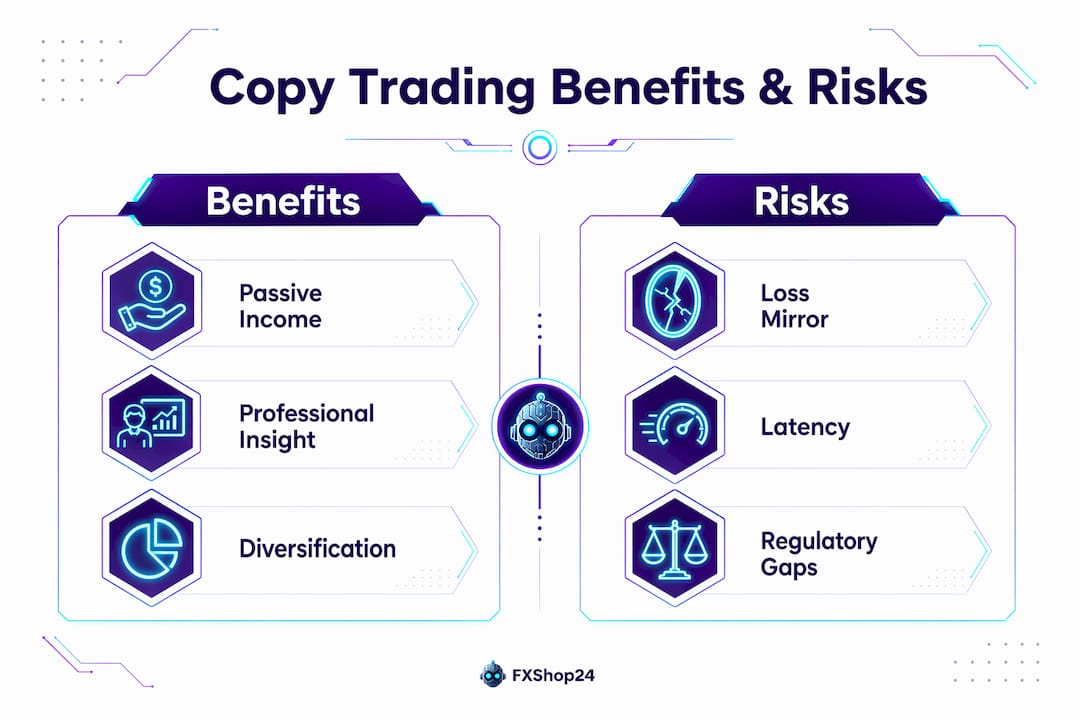
Copy trading benefits are real, but so are the downsides. You need both sides of the picture before committing capital.
Core advantages
- Access to professional expertise. You do not need technical analysis skills or years of chart experience to participate in markets. You delegate those decisions to traders with verified track records.
- Time efficiency. Copy trading runs automatically. You can hold a full-time job and still maintain an active trading portfolio without watching charts for hours.
- Built-in learning. Watching how a skilled trader responds to news events, volatility spikes, and drawdown periods teaches you more than most courses. Copy trading is better viewed as part of a broader trading journey than as a passive income machine.
- Diversification. Copying multiple lead traders across different asset classes and strategies spreads your risk across uncorrelated positions.
Real risks you cannot ignore
- Losses mirror mistakes. When a lead trader misuses leverage or holds a losing position too long, your account suffers the same damage. Mechanical execution can accelerate losses when the lead trader’s strategy relies on high risk.
- No control over timing. You cannot choose which specific trades to copy or skip. A single bad trade fires in your account before you can react.
- Strategy shifts happen without warning. A single change in lead trader strategy can impact copied accounts before stop-losses trigger, leaving followers exposed.
- Slippage and latency. Time delay between a leader’s trade and a follower’s execution impacts returns negatively, especially in fast-moving crypto markets.
Academic research adds a sobering data point here:
“Guided copy trading smooths returns but amplifies severe losses compared to independent trading, with 6–10% performance differences and higher tail risk versus manual trading.”
That finding means copy trading can make your average week look steadier while making your worst month significantly worse. That asymmetry is the core risk most beginners miss.
How does copy trading compare with traditional trading?
Copy trading occupies a unique space between self-directed trading and professional portfolio management. Understanding where it sits helps you decide how much of your capital to allocate to it.
| Factor | Copy Trading | Traditional Trading | Managed Portfolio |
|---|---|---|---|
| Decision-making | Delegated to lead trader | Fully independent | Delegated to licensed adviser |
| Regulatory protection | Limited, platform-dependent | Standard broker rules | Full MiFID II or equivalent |
| Transparency | Visible trade history | Full personal control | Varies by manager |
| Cost structure | Performance fee (10–20%) | Spreads and commissions | Management and performance fees |
| Investor control | Low, automated execution | High | Low to medium |
| Learning opportunity | High, observable in real time | High, direct experience | Low |
The regulatory gap is the most underappreciated difference. Copy trading platforms operate as what Oxford Law Blogs describes as a shadow intermediary, sitting between you and the market without the full regulatory guardrails that apply to licensed investment advisers. Under frameworks like MiFID II in Europe, traditional portfolio managers carry fiduciary duties. Most copy trading platforms do not. That gap means your recourse is limited if a lead trader blows up your account through reckless risk-taking.
Regulatory reforms may be needed to bring copy trading platforms under the same oversight as investment advisers. Until that happens, the burden of due diligence falls entirely on you.
What are effective copy trading strategies?
The difference between traders who profit from copy trading and those who lose capital comes down to how they structure and monitor their approach. Passive copying without a plan is not a strategy. It is a gamble.
Build a modular portfolio of lead traders
- Copy at least three to five lead traders with different styles. A trend-following forex trader, a gold scalper, and a crypto swing trader have low correlation. When one strategy underperforms, the others may offset losses.
- Allocate capital in fixed percentages per trader. Never put more than 30% of your copy trading budget with a single lead trader, regardless of their track record.
- Diversifying capital across multiple providers with automatic drawdown circuit breakers is the most reliable way to manage systemic risk in a copy trading portfolio.
Set hard risk limits before you start
- Define a maximum drawdown threshold for each copied trader. Setting individual position size caps and a 15% maximum drawdown threshold is a widely recommended starting point. When a trader hits that limit, the system stops copying automatically.
- Avoid lead traders who use leverage above 10:1 on a consistent basis. High leverage amplifies both gains and losses, and the losses hit followers just as hard.
- Use stop-copy triggers on your platform. These act as circuit breakers that disconnect your account from a lead trader when their drawdown exceeds your preset limit.
Prioritize risk profile over raw returns
Market analysts consistently urge traders to focus on risk profiles like volatility and drawdown history rather than headline return numbers. A trader showing 80% annual returns with a 60% maximum drawdown is far more dangerous than one showing 25% returns with a 12% maximum drawdown. The second trader gives you something you can actually manage.
Pro Tip: Sort lead traders by maximum drawdown first, not by total return. The traders who protect capital in bad months are the ones worth copying long-term.
Monitor actively, even when copying
Copy trading is delegated active risk, not passive risk. You still need to review your copied traders monthly. Check whether their strategy has shifted, whether their drawdown is trending upward, and whether market conditions have changed in ways that invalidate their edge. Treat it like a portfolio review, not a set-and-forget deposit.
Key takeaways
Copy trading delivers real advantages only when you treat it as an active, monitored strategy rather than a passive income source.
| Point | Details |
|---|---|
| Understand the mechanics | Lead traders earn 10–20% profit share, aligning incentives but not eliminating risk. |
| Recognize the regulatory gap | Copy trading platforms operate as shadow intermediaries with limited investor protections. |
| Set drawdown limits | Cap individual trader drawdown at 15% and use stop-copy triggers to protect capital. |
| Diversify across lead traders | Copy three to five uncorrelated traders to reduce exposure to any single strategy. |
| Monitor continuously | Review lead trader performance monthly; strategy shifts can impact your account without warning. |
Copy trading is a tool, not a shortcut
My honest view, after years of working with automated trading systems and watching traders use copy trading in every way imaginable, is this: copy trading is one of the most misused tools in retail trading. The marketing around it sells a fantasy of passive income. The reality is that it requires the same discipline as any other trading approach.
The traders I have seen succeed with copy trading treat it as a structured allocation decision. They research lead traders the way a fund manager researches investments. They set hard limits and stick to them. They review performance regularly and replace underperforming traders without sentiment.
The traders who fail treat it like a savings account with better returns. They pick the highest-return trader on the leaderboard, allocate too much capital, and then panic when a 20% drawdown hits. That drawdown was always in the data. They just did not look.
The regulatory environment is also shifting. The shadow intermediary framing from Oxford Law Blogs is not just academic. Regulators in the EU and UK are actively examining whether copy trading platforms need to be licensed as investment advisers. That shift, when it comes, will change how platforms operate and what protections you have. Staying informed about those changes is part of managing your exposure.
Copy trading works best as one component of a broader strategy. Pair it with your own trade copy software knowledge and solid risk management practices to get the most out of it without exposing yourself to avoidable losses.
— Fxshop24
Take your copy trading further with Fxshop24
Copy trading gives you access to professional strategies, but the traders who get the best results combine it with the right automated tools. Fxshop24 offers a full catalog of expert advisors, AI-powered trading robots, and MT4/MT5 systems designed to complement and extend what copy trading alone can do.
Whether you want to automate your own entries alongside copied trades, add a risk management layer, or explore automated futures trading systems that run independently of any lead trader, Fxshop24 has tools built for exactly that. Every product comes with lifetime updates, unlimited licenses, and full installation support. Browse the full range and find the system that fits your trading style at Fxshop24.
FAQ
What is copy trading in simple terms?
Copy trading is the automatic replication of a professional trader’s positions in your account, proportional to your allocated capital. Platforms like eToro and KuCoin handle the execution without any manual input from you.
Is copy trading good for beginners?
Copy trading for beginners works well as a learning tool, but it carries real risk. You should still set drawdown limits, diversify across multiple lead traders, and monitor performance monthly rather than treating it as passive income.
How much do lead traders earn from copy trading?
Lead traders typically earn a profit share of 10–20% of net gains from their followers, plus potential rebates on spreads. That incentive structure aligns their interests with yours but does not eliminate the risk of reckless trading.
What is the biggest risk in copy trading?
The biggest risk is that losses mirror the lead trader’s mistakes in real time. Execution latency and slippage can also cause followers to get worse entry prices than the lead trader, especially in volatile crypto markets.
How is copy trading different from a managed fund?
A managed fund operates under regulatory frameworks like MiFID II with full fiduciary duties. Copy trading platforms function as shadow intermediaries with limited investor protections, meaning your recourse is far more limited if a lead trader causes significant losses.