



8
Jun
Prop Firm Compliance Workflow: 2026 Operational Guide
TL;DR:
- A prop firm compliance workflow integrates six software layers to ensure regulatory adherence and operational efficiency. Proper sequencing, role separation, and automation of payout checks are essential for audit readiness and 2026 compliance standards. Building the compliance infrastructure first creates a resilient, trustworthy foundation for trading operations and regulatory confidence.
A prop firm compliance workflow is a structured set of integrated processes that ensures proprietary trading firms meet evolving regulatory requirements while maintaining operational efficiency and audit readiness. For compliance officers and consultants, this means designing systems where KYC, AML screening, payout controls, and real-time risk management operate as a single, traceable chain rather than isolated checkboxes. Tools like Track360, Sumsub, and Jumio have become standard infrastructure in this chain. With 2026 regulatory shifts tightening requirements around trader verification and payout transparency, getting the workflow architecture right from day one is no longer optional.
What must a prop firm compliance workflow include?
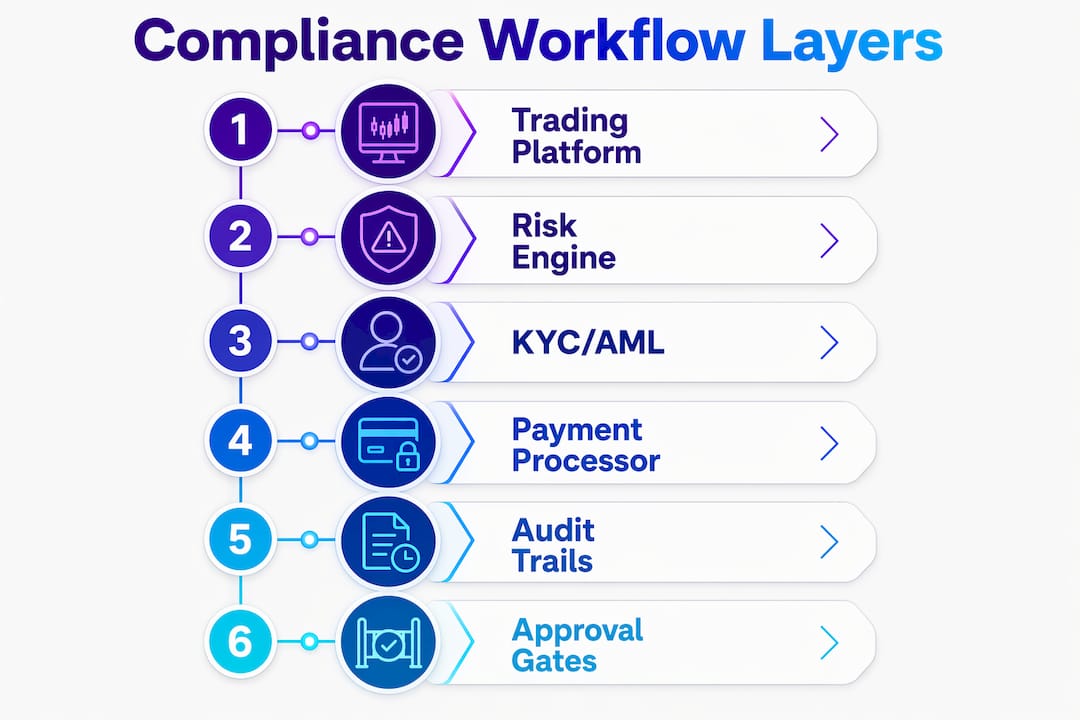
A well-designed prop firm compliance workflow runs on six distinct software layers, each with a defined compliance function. Miss one layer and you create a gap that regulators or bad actors will eventually find.
The six layers are:
- Trading platform (MT4, MT5, or a proprietary platform): Executes trades and feeds raw data to the risk engine.
- Risk engine: Monitors drawdown limits, consistency rules, and exposure thresholds in real time.
- KYC/AML provider (Sumsub, Jumio, or equivalent): Verifies trader identity at first deposit and screens against sanctions and PEP lists before payouts.
- Payment processor: Handles fund flows with compliance flags embedded at the transaction level.
- CRM: Manages trader lifecycle data, approval states, and communication records.
- Affiliate management platform: Tracks referral activity and enforces advertising compliance, including mandatory risk disclaimers and 18+ gating required under 2026 advertising standards.
Each layer must produce auditable outputs. Role-based access control determines who can view, modify, or approve records at each stage. Approval workflows require at least two named roles: a compliance reviewer who validates regulatory impact, and a workflow owner who manages business SLAs. These roles must never be held by the same person.
The table below maps each workflow layer to its primary compliance output:
| Workflow Layer | Primary Compliance Output |
|---|---|
| Trading platform | Trade logs with timestamps and execution records |
| Risk engine | Automated rule breach alerts and drawdown reports |
| KYC/AML provider | Identity verification status and sanctions screening results |
| Payment processor | Transaction records with compliance flags |
| CRM | Trader state history and approval audit trail |
| Affiliate management | Ad compliance logs and referral attribution records |

Audit trails must be immutable. Every state change, approval decision, and exception note must carry a timestamp and a named actor. Without this, your workflow is operationally functional but legally indefensible.
How to sequence the implementation of a prop firm compliance workflow
Sequencing matters as much as the components themselves. Firms that attempt to wire compliance into a live operation after launch face compounding technical debt and real regulatory exposure. The recommended approach is a 6-month preparation timeline that treats compliance infrastructure as a prerequisite, not a post-launch addition.
- Month -6: Entity setup. Register the legal entity, establish banking relationships, and confirm jurisdictional requirements. Identify which regulatory frameworks apply to your target trader base.
- Month -4: KYC integration. Connect your KYC/AML provider and configure identity verification triggers at first deposit. KYC at withdrawal is a regulatory red flag following enforcement actions against firms like MyForexFunds. First-deposit verification is now the baseline expectation.
- Month -3: CRM and payment wiring. Integrate your CRM with the payment processor and configure compliance flags at the transaction level. Map trader lifecycle states to approval workflows.
- Month -2: Beta testing. Run a closed beta with internal testers to validate end-to-end workflow integrity. Test exception queues, escalation paths, and payout gate logic under realistic conditions.
- Month -1: Affiliate platform and risk engine activation. Bring the affiliate management platform online and activate the risk engine with live rule sets. Confirm that all six software layers communicate correctly.
- Month 0: Public launch. Open to traders only after every compliance gate has been tested and signed off by both the compliance reviewer and the workflow owner.
Pro Tip: Run a deliberate failure test in Month -2. Intentionally trigger a KYC failure, a sanctions match, and a drawdown breach to confirm that exception queues populate correctly and escalation paths reach the right people.
This sequencing prevents the most common operational failure in prop firm launches: going live with a functional trading platform but an incomplete compliance layer. The trading side works; the regulatory side does not. That gap is where firms get shut down.
What are best practices for automating payout and compliance checks?
Payout automation is where compliance theory meets operational reality. A manual payout review process does not scale past a few hundred active traders, and inconsistency in manual reviews creates both regulatory risk and trader disputes. The solution is an event-driven, state-based workflow with explicit compliance gates at each transition.
The payout states follow this sequence: requested, eligibility check, compliance review, approval, paid, and reconciled. Each state has defined entry and exit criteria. A payout request cannot advance to the compliance review state until eligibility checks pass. A payout cannot reach the paid state without approval gate clearance.
Automated checks at the compliance gate cover:
- Identity status: KYC verification current and valid.
- Sanctions and PEP screening: Real-time check against current lists.
- Rule integrity: Trader has not breached drawdown limits, consistency rules, or challenge conditions.
- Behavioral risk flags: No evidence of multi-accounting, correlated trades, or abnormal execution patterns.
- Payout math validation: Profit split calculation verified against account records.
Automated checks categorize each payout as green (auto-approve), amber (human review required), or red (blocked with reason code). This risk-based routing keeps the majority of clean payouts moving without manual intervention while flagging genuine exceptions for review.
Dual approval is mandatory for high-value payments. Idempotent payment execution prevents duplicate payouts if a system retry occurs. Every exception must carry a reason code and a reviewer note before it can be resolved. These records form the internal decision log that protects the firm during audits or trader disputes.
Pro Tip: Build your exception queue as a first-class interface, not an afterthought. Compliance reviewers who work from a well-designed exception queue with full context, reason codes, and one-click escalation paths resolve cases in minutes rather than hours.
How can prop firms integrate risk management and operational governance?
Real-time risk management requires automated systems with continuous feedback loops. Risk engines monitor drawdowns, exposures, and anomalies on every tick. Human review enters only when a threshold breach triggers an alert. This architecture keeps the compliance workflow responsive without creating manual bottlenecks.
Behavioral monitoring is the layer most firms underinvest in. Automated flags for multi-accounting, correlated trades across accounts, and abnormal execution patterns are not optional features. They are the primary defense against challenge abuse, which directly affects payout integrity and regulatory standing.
“Compliance is now a defining operational pillar. Fragmented systems without audit trails risk firm survival.” — Global Regulatory Risks for Prop Firms
Governance structure determines whether your risk controls actually function under pressure. The ownership model should be explicit:
- Risk team: Controls limit parameters and threshold settings.
- Operations team: Manages exception resolution and SLA tracking.
- Compliance team: Sets policy, validates regulatory impact of workflow changes, and owns the audit trail.
Separating compliance reviewers from operational workflow owners is not bureaucratic overhead. It is the structural control that prevents a single point of failure from compromising both regulatory adherence and business operations simultaneously. Firms that collapse these roles into one person discover the problem during an audit, not before.
SLA tracking and escalation paths complete the governance picture. Every exception in the queue should carry a timestamp and an escalation deadline. Exceptions that age past the SLA threshold should auto-escalate to the compliance reviewer’s supervisor. This prevents the silent failure mode where exceptions sit unresolved because no one owns the clock. For guidance on back-office workflow automation, the governance principles that apply to financial firms translate directly to prop trading operations.
You can also strengthen your real-time monitoring posture by reviewing risk management for MT4 and MT5, which covers automated rule enforcement in live trading environments.
Key takeaways
A prop firm compliance workflow requires six integrated software layers, a sequenced 6-month build timeline, automated payout gates with risk-based routing, and strict role separation between compliance and operations to remain audit-ready under 2026 regulatory standards.
| Point | Details |
|---|---|
| Six-layer software stack | Trading platform, risk engine, KYC/AML, payment processor, CRM, and affiliate management must all produce auditable outputs. |
| KYC at first deposit | Integrating KYC at first deposit, not withdrawal, is the current regulatory baseline following enforcement actions in the industry. |
| State-based payout workflow | Payout requests must pass through defined states with explicit compliance gates before funds are released. |
| Role separation | Compliance reviewers and operational workflow owners must be distinct roles to maintain governance integrity. |
| Real-time risk monitoring | Automated risk engines monitor every tick; human review activates only on threshold breaches to avoid bottlenecks. |
Why compliance architecture is the actual product you are building
Most compliance officers I work with treat the workflow as support infrastructure for the trading product. That framing is wrong, and it leads to predictable failures. The compliance architecture is the product. Traders choose prop firms partly on payout reliability and transparency. Regulators evaluate firms on audit trail quality and control separation. Investors assess operational risk through governance structure. Every one of those stakeholders is evaluating your compliance workflow, not your challenge design.
The firms that built fragmented systems, with KYC in one tool, payout approvals in a spreadsheet, and risk monitoring in a separate dashboard with no shared data layer, are the ones facing enforcement actions or operational collapse in 2026. Integration is not a technical preference. It is a survival requirement.
The trend I find most significant right now is the move toward AI-driven behavioral analysis within risk engines. Pattern detection that previously required a human analyst reviewing account clusters can now run continuously and flag anomalies before a payout request is even submitted. Firms that adopt this capability early will have a material advantage in both fraud prevention and regulatory defensibility. The firms waiting for the technology to mature are already behind.
Build the compliance workflow first. Then build the trading product around it. That sequencing feels counterintuitive when you are trying to get to market, but it is the only order that produces a firm with genuine longevity.
— FxShop24
How FxShop24 supports prop firm workflow automation
Compliance-ready automation starts with the right trading infrastructure. FxShop24 offers expert advisors, AI-powered trading robots, and automated trading systems built for MT4 and MT5 environments, all tested for prop firm compatibility. These tools integrate directly with the risk and execution layers of a prop firm compliance workflow, reducing manual intervention at the trading level while keeping audit trails intact.
For compliance officers evaluating automation options, the automated futures trading systems guide at FxShop24 covers how modern automated systems align with prop firm operational requirements. You can also explore the prop firm trading checklist for a structured overview of compliance and operational readiness benchmarks. Every product on the FxShop24 marketplace includes lifetime updates and unlimited licenses, making it practical to maintain compliance alignment as regulatory standards evolve.
FAQ
What is a prop firm compliance workflow?
A prop firm compliance workflow is an integrated set of automated and governed processes covering KYC, AML screening, risk monitoring, payout approvals, and audit trail management. It connects six software layers to produce a traceable, regulatory-ready operation.
When should KYC be integrated in a prop firm workflow?
KYC must be integrated at first deposit, not at the withdrawal stage. Delaying KYC to withdrawal is a recognized regulatory red flag following enforcement actions against firms like MyForexFunds.
How does payout automation improve compliance?
Automated payout workflows use state-based logic to route each request through eligibility, compliance, and approval gates before funds are released. Green status payouts process automatically; amber and red statuses route to exception queues with reason codes for human review.
What roles are required in a prop firm compliance governance structure?
Three distinct roles are required: a risk team that controls limit parameters, an operations team that manages exceptions and SLAs, and a compliance team that sets policy and owns the audit trail. Combining these roles creates governance failures.
How do risk engines support proprietary trading compliance?
Risk engines monitor drawdowns, exposures, and behavioral anomalies on every tick, triggering human review only when thresholds are breached. This continuous monitoring is the foundation of real-time compliance in automated prop trading environments.