



29
May
What Is Prop Firm Compatibility for Automated Traders
TL;DR:
- Most traders believe finding a profitable expert advisor is the hardest part, but the real challenge is ensuring it complies with prop firm’s strict rules to avoid disqualification. Prop firm compatibility involves meeting risk management limits, operational constraints, and strategy policies, which many automated systems overlook, risking account rejection despite profitability. Regularly verifying your EA against current rules, configuring parameters appropriately, and testing in simulation environments are essential for sustained success in funded trading challenges.
Most traders who buy an expert advisor assume the hard part is finding one that makes money. The real challenge is finding one that makes money without getting you disqualified. What is prop firm compatibility? It’s the degree to which your automated trading system aligns with a prop firm’s specific risk rules, operational constraints, and strategy policies. Get this wrong, and a profitable EA can still cost you your challenge fee and your funded account.
Table of Contents
- Key takeaways
- What is prop firm compatibility, and why it matters
- Automated trading constraints that affect compatibility
- Consistency rules and profit concentration
- How to test your EA for prop firm compliance
- EA tools designed for prop firm compatibility
- My honest take on what traders keep getting wrong
- Find prop-firm compatible EAs at Fxshop24
- FAQ
Key takeaways
| Point | Details |
|---|---|
| Compatibility goes beyond profit | Your EA must meet drawdown limits, news filters, and trade frequency rules, not just show positive returns. |
| Firms hold traders accountable | Even with automation, risk management responsibility stays with you, not the bot. |
| Consistency rules trip up EAs | A single monster winning day can trigger a consistency violation requiring extended trading to recover. |
| Popular EAs carry hidden risk | Widely used third-party robots can hit concentration limits and lose eligibility over time. |
| Testing must mirror firm conditions | Backtesting alone is not enough. Simulating the exact prop firm environment catches operational violations. |
What is prop firm compatibility, and why it matters
Prop firm compatibility means your automated trading system satisfies every rule a proprietary trading firm sets as a condition for funding. This goes well beyond simply passing the profit target. Firms like FTMO, MyFundedFX, and others enforce a web of operational and risk-based rules that automated systems must clear at every level.
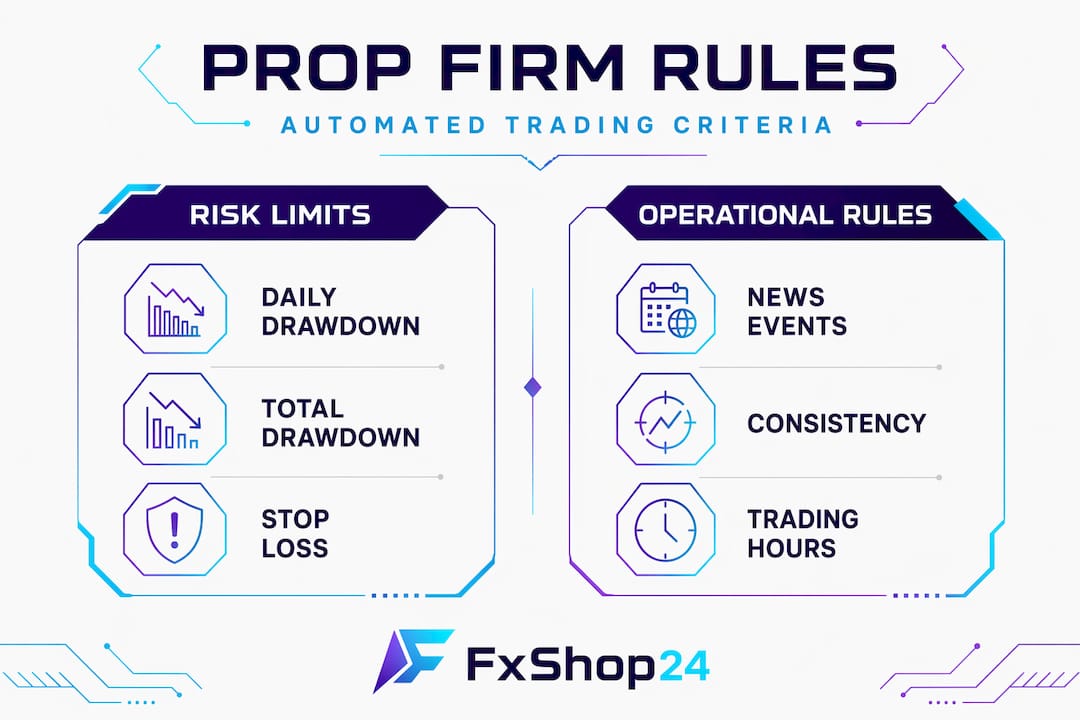
The rules that most directly affect automated traders include:
- Maximum daily loss limits: Your EA must calculate and monitor real-time equity so it never breaches the firm’s daily loss ceiling.
- Total drawdown limits: Cumulative losses from the starting balance must stay within a defined percentage, typically 5 to 10 percent.
- News event blackouts: Many firms prohibit open positions during high-impact economic releases.
- Best-day profit caps (consistency rules): No single trading day can contribute more than a set percentage, often around 30 percent, of your total accumulated profit.
- Trade frequency ceilings: Firms restrict how many server requests an EA can generate to prevent server abuse.
Understanding prop firm compatibility means understanding why these rules exist, not just what they are. Firms replicate live market conditions to evaluate whether a strategy is genuinely viable. Operational fairness in simulated environments means avoiding artificial trade patterns that would not survive in real markets. A martingale grid that looks clean in backtesting becomes a drawdown bomb in live-equivalent conditions, which is exactly why firms screen for it.
Pro Tip: Before you run any EA on a challenge account, pull up the firm’s full rule sheet and cross-reference each rule with your EA’s configurable parameters. If the EA has no setting for maximum daily loss, that is a red flag before you spend a dollar.
For a deeper look at how these factors stack up, the Fxshop24 guide on compatibility factors for traders covers the full picture clearly.
Automated trading constraints that affect compatibility
Understanding prop firm compatibility at a surface level is one thing. Knowing exactly which automated trading behaviors will get you disqualified is another. Here are the primary constraints your EA must handle.
Server request limits. FTMO’s EA-driven trading limit caps server requests at 2,000 per day per simulated trade. High-frequency EAs that open and close dozens of micro-trades per hour will hit this ceiling fast. Any EA running a scalping strategy with sub-minute logic needs careful throttling.
News filter integration. Many firms require traders to avoid positions during major news events like Non-Farm Payrolls or Federal Reserve announcements. A properly configured EA news filter blocks trading approximately two minutes before and after a high-impact event, which keeps your account compliant without requiring you to manually monitor every calendar entry.
Hard stop losses on every trade. EAs that rely on mental stops or trailing stops as the only protection fail prop firm audits. Compatible EAs use hard stop losses with equity-based drawdown protection so the system physically cannot exceed the firm’s limits.
Drawdown calculation logic. Firms measure drawdown from the account’s starting balance or from the highest equity point reached, depending on their rules. Your EA must track the correct baseline or it will breach a limit the trader thought they were safely within.
Strategy concentration and uniqueness. Popular third-party robots risk disqualification when many traders run them simultaneously on the same firm. Once an EA hits a firm’s maximum capital allocation threshold across all users, it may be flagged or banned regardless of individual performance.
Pro Tip: Set your EA’s maximum daily loss parameter at 80 percent of the firm’s actual limit. This buffer gives you room for slippage and spread widening without triggering a violation at the worst possible moment.
The Fxshop24 resource on passing MetaTrader challenges explains how to configure these constraints on MT4 and MT5 specifically.
Consistency rules and profit concentration
This is where many automated traders get blindsided. Consistency rules are designed to filter out lucky runs from genuinely repeatable strategies. Most traders focus on hitting the profit target and never read the fine print about how that profit needs to be distributed.
Here is how the math works in practice. If a firm’s consistency rule caps best-day profit at 30 percent of total accumulated gains, and your EA makes $3,000 in a single session while your overall profit sits at $5,000, that single day represents 60 percent of your total. The violation does not disqualify you outright in most cases. However, you must continue trading until the ratio normalizes, which means you carry challenge risk for longer with no additional profit target benefit.
| Scenario | Best-day profit | Total profit | Ratio | Status |
|---|---|---|---|---|
| Compliant strategy | $800 | $4,000 | 20% | Passes consistency rule |
| Borderline case | $1,200 | $4,000 | 30% | At the limit |
| Non-compliant EA | $2,500 | $4,000 | 62.5% | Forced to keep trading |
For automated systems, the practical fix involves two approaches:
- Internal profit caps per session. Configure the EA to close all positions and pause trading once the day’s realized profit reaches a defined ceiling, such as 25 percent of current total account gain. This prevents runaway winning sessions from creating a consistency problem.
- Position sizing adjustments. When cumulative profits are low early in a challenge, reduce position sizes so any given session cannot spike the ratio beyond acceptable levels. As the profit base grows, the EA’s natural sizing can expand.
Low-frequency, high-reward strategies face the toughest challenge here. A swing EA that wins once a week but wins big needs specific throttling logic to stay compliant. Consistency rules serve as payout filters, and they are explicitly designed to screen out the exact behavior these strategies produce.
How to test your EA for prop firm compliance

Testing for prop firm compatibility is not the same as testing for profitability. Most traders run a backtest, see a positive equity curve, and assume the system is ready. That approach misses the operational layer entirely.
Here is a practical testing framework before you submit an EA to a live challenge:
- Replicate the firm’s exact platform settings. Testing EA compatibility means matching the broker server, trade handling mode, and slippage settings. An EA that passes on a demo account with a different broker may fail on the firm’s specific infrastructure.
- Count server requests manually. Run the EA on a simulated account for one full trading day and log every open, close, and modification event. Sum the total and compare it against the firm’s published limit.
- Run news event simulations. Inject historical news timestamps into your forward test and confirm the EA’s news filter activates correctly. A filter that works 90 percent of the time is a liability, not an asset.
- Stress test drawdown tracking. Force the account to specific drawdown levels in simulation and confirm the EA closes positions and halts trading at the correct equity point, not after it.
- Check for banned position types. Some firms prohibit holding positions over weekends or through major central bank decisions. Verify your EA has explicit logic to close positions before these windows.
Pro Tip: Run your EA on the firm’s own demo environment for at least two full trading weeks before starting a paid challenge. The demo run reveals operational compliance issues that no backtest will catch.
Staying current on the full range of prop firm trading rules is also critical because firms update their policies regularly, and an EA that was compliant six months ago may not be today.
EA tools designed for prop firm compatibility
Not every EA available on the market is built with prop firm rules in mind. Those using martingale or grid strategies, where position sizes escalate with each loss, almost always violate drawdown limits before a challenge concludes. The EAs with the strongest prop firm track record share a specific set of features.
Successful prop-firm compatible EAs include hard stop losses on every trade, equity-based drawdown protection that closes all positions when a threshold is approached, and built-in news filters that reference an external calendar. They also support both MT4 and MT5 to match the platform a specific firm uses.
Popular tools like Forex Flex and Forex Robotron have earned reputations in the prop firm community specifically because they allow granular configuration of these parameters. Traders can set explicit daily loss limits, maximum position counts, and session-based trading windows to match almost any firm’s rule set.
That said, popularity introduces its own risk. Monitoring concentration risk is an ongoing responsibility when using widely distributed EAs. If the same robot is running on thousands of accounts at one firm, the firm may impose capital allocation restrictions that disqualify the strategy regardless of individual performance. Using an EA with customizable parameters and adjusting the configuration uniquely for your account reduces this exposure significantly.
The most effective approach is not selecting the most popular EA. It is selecting an EA you understand deeply enough to configure it precisely for the specific firm you are targeting.
My honest take on what traders keep getting wrong
I’ve watched traders burn through challenge fees repeatedly, and the pattern is almost always the same. They find an EA with a strong backtest, they read that automated trading is allowed, and they assume those two facts are enough. They’re not.
What I’ve learned from working with automated trading tools across dozens of prop firm environments is that the operational layer is where challenges are won or lost, not the signal layer. An EA can have genuinely excellent entry logic and still fail a challenge because nobody configured the daily loss limit correctly or because the news filter had a five-minute delay instead of two.
The other trap I see constantly is traders treating prop firm compatibility as a one-time checkbox. Firms update their rules. EA developers push updates that change behavior. The market regimes that an EA was tuned for shift. What passed six months ago might not pass today, and ongoing monitoring of strategy viability is not optional if you want funded accounts to stay funded.
My recommendation is to treat every new challenge like an unfamiliar environment, even if you’ve used the same EA before. Re-verify every parameter against the current rule sheet. Run the demo period without skipping it. And never assume that because a bot is marketed as prop-firm ready, it has been tested against the specific firm you’re targeting.
— FxShop24
Find prop-firm compatible EAs at Fxshop24
If you’ve spent time mapping out your EA’s configuration against prop firm requirements, the next logical step is finding systems built with those requirements already baked in. Fxshop24 specializes in automated trading tools for MT4 and MT5 that are configured with hard stop losses, news filters, and drawdown controls designed to meet prop firm standards. Whether you’re targeting a specific challenge or building a long-term funded trading operation, the automated trading systems guide at Fxshop24 covers the full range of options tested for prop firm environments. You can also explore the broader trading software overview to match the right tool type to your strategy and the firm you’re applying to.
FAQ
What is prop firm compatibility for an EA?
Prop firm compatibility means your expert advisor meets all of a firm’s risk and operational rules, including drawdown limits, news filters, and trade frequency caps, not just its profit target.
Can any automated trading system pass a prop firm challenge?
No. EAs using martingale or grid strategies typically violate drawdown rules, and many firms ban high-frequency trading or copy trading entirely. You must verify firm-specific EA policies before starting a challenge.
What are the main prop trading eligibility criteria for automated systems?
The core prop trading eligibility criteria include adherence to daily and total drawdown limits, compliance with news event restrictions, hard stop losses on every position, and avoiding strategy patterns that generate excessive server requests.
How do consistency rules affect automated trading strategies?
Consistency rules cap how much of your total profit can come from a single day, typically around 30 percent. An EA that generates a large single-day win may force extended trading to normalize the ratio, creating additional challenge risk.
How often should I recheck my EA’s prop firm compatibility?
Review compatibility every time the firm updates its rules or the EA receives an update. Treat each new challenge as a fresh validation exercise, because configuration drift and rule changes can create violations that did not exist in previous attempts.