



17
May
Defining prop firm compatibility for automated forex traders
TL;DR:
- Many prop firms permit automated trading but restrict strategies like latency arbitrage and high-frequency scalping, requiring EAs to behave like rule-based manual traders. Compatibility depends on precise risk and execution rules, such as drawdown types, loss limits, and holding restrictions, which must be integrated into the EA’s design. Continuous monitoring, matching firm platforms, and understanding policy differences between evaluation and funded accounts are essential for avoiding disqualification and maintaining compliance.
Most traders assume that if a prop firm says “automated trading is allowed,” they’re good to go. They connect their EA, let it run, and wait. Then comes the account breach, the failed challenge, or the disqualification email. Defining prop firm compatibility is not about whether automation is permitted — it’s about whether your specific system’s behavior, risk profile, execution logic, and monitoring setup line up precisely with each firm’s written and unwritten rules. This guide breaks down exactly what that means and how to get it right before you risk a dime of challenge fees.
Table of Contents
- Understanding prop firm automation rules and restrictions
- Key dimensions that define compatibility: risk and execution rules
- Platform and operational compatibility: matching tech stacks and execution paths
- Navigating evaluation versus funded account automation policies
- Codifying consistency rules into measurable metrics for automation
- Our perspective: compatibility is not a feature you check once
- Find EAs already built for prop firm compliance
- Frequently asked questions
Key Takeaways
| Point | Details |
|---|---|
| Compatibility is rule-based | Prop firm compatibility depends on your automation following specific trading and risk rules, not just using bots. |
| Strategy restrictions matter | Certain strategies like latency arbitrage and grid are commonly banned despite automation allowance. |
| Platform support is critical | Choosing a platform supported by the prop firm ensures smooth automated execution within rules. |
| Evaluation and funded rules differ | Automation allowed during evaluation might be restricted or forbidden on funded accounts. |
| Consistency rules must be precise | Automated systems need to implement clear, measurable metrics to meet consistency requirements. |
Understanding prop firm automation rules and restrictions
Every prop firm publishes a terms of service document, but reading it and understanding it are two different things. The rules around automated trading are rarely simple checkboxes. Most prop firms allow automation but ban high-frequency trading, latency arbitrage, tick scalping, and multi-account exploitation as specific prohibited categories. Passing the “allowed” test does not mean your EA passes the “compliant” test.
The distinction that separates allowed from prohibited automation is whether the bot behaves like a disciplined, rule-based trader or an exploitative system extracting edge from infrastructure rather than market analysis. Automation is only acceptable when the bot acts like a rule-based manual strategy, not an arbitrage system gaming price feed delays or brokerage infrastructure.
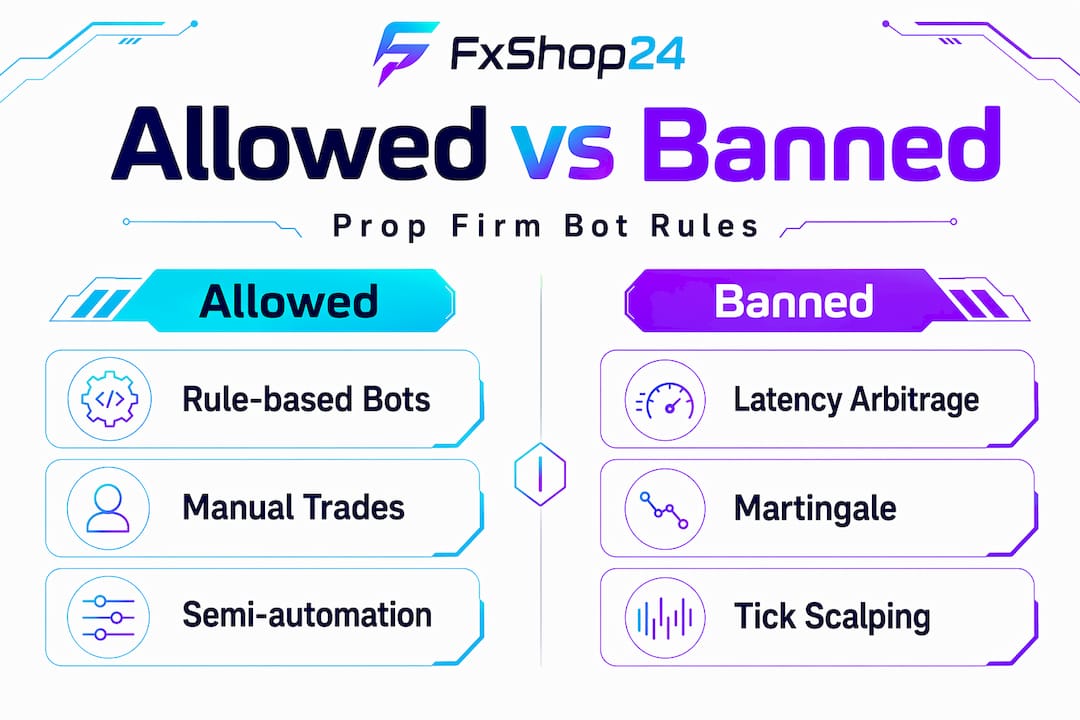
What does that mean in practice? Here is what typically falls on each side of the line:
Commonly prohibited strategies:
- Latency arbitrage (exploiting price feed delays between brokers)
- Tick scalping (holding trades for seconds and targeting micro price movements at high frequency)
- Grid and martingale systems that stack risk across correlated positions
- Multi-account copy trading used to pass the same challenge across multiple accounts simultaneously
- News spike exploitation bots that trade milliseconds before or after economic releases
Commonly allowed strategies:
- EAs using technical indicators with defined entry and exit conditions
- Trend-following or mean-reversion systems with fixed risk parameters
- Time-filtered strategies that avoid specific sessions or news windows
- EAs with position sizing tied to account balance, not arbitrary lot compounding
“The question is not whether your EA places trades automatically. It’s whether the logic behind those trades would be acceptable if a human placed them manually under the same rules. If the answer is no, the EA will not pass.”
You can find a detailed breakdown of how prop firm rules are decoded for automated traders to understand which specific rule categories apply to EA-based accounts. Matching your EA architecture to the right firm starts with this foundation.
Key dimensions that define compatibility: risk and execution rules
Prop trading compatibility criteria go well beyond strategy type. The actual architecture of your EA must respond to multiple distinct rule dimensions, each of which maps to a specific design requirement. Compatibility is shaped by drawdown type, daily loss limits, consistency rules, minimum trading days, and holding restrictions, with each dimension requiring specific logic built into the EA.
Here is how each dimension translates into EA design:
Drawdown type: Static drawdown calculates loss from the starting balance. Trailing drawdown follows the equity peak. Your EA’s stop-out logic must match the firm’s exact definition, or it will either over-trade near the limit or trigger violations before your risk engine fires.
Daily loss limit: This requires a real-time risk engine that monitors open floating losses plus closed losses within the current trading day. The EA must stop trading and close positions before the limit is hit, not after.
Consistency rules: Many firms require that no single trading day’s profit exceeds a percentage of total account profit. This cannot be eyeballed. It requires automated tracking of daily closed P&L relative to overall performance across the evaluation window.
Minimum trading days: EAs that scalp hard and finish challenges in two days will fail firms requiring a minimum number of active trading days. Build session counters into your logic.
Holding restrictions: Weekend, overnight, and pre-news holding bans require scheduled filters that flatten all positions before the restricted window opens, regardless of market conditions.
| Rule dimension | Design requirement | Common failure mode |
|---|---|---|
| Trailing drawdown | Dynamic equity peak tracker | EA uses balance-based stop instead |
| Daily loss limit | Real-time floating P&L monitor | Violation occurs before EA responds |
| Consistency cap | Per-day P&L vs. total P&L ratio check | Single big winning day triggers breach |
| Min trading days | Session activity counter | Challenge completed too fast |
| Overnight ban | Pre-close scheduled position flattener | News spike caught open position |
Pro Tip: Before programming any EA, download the firm’s full terms of service and map every rule to a specific EA function. This mapping document becomes your compliance checklist and your debugging guide when something goes wrong.
When comparing which EAs already handle these dimensions correctly, reviewing prop firm trading EAs compared side by side saves significant development time. For those building or buying EAs to run challenges, the guide on choosing a MetaTrader EA for prop firm challenges covers selection criteria in detail. Additional operational guidance is available for MT4 and MT5 users running live prop accounts.
Platform and operational compatibility: matching tech stacks and execution paths
Even a perfectly coded EA will fail if the underlying technology stack is mismatched with the firm’s infrastructure. Platform compatibility is often limited to specific platforms such as MT4, MT5, or NinjaTrader, and firms enforce platform-specific restrictions that can disable EA functionality entirely on certain account types.
Before writing a single line of EA code, verify the following:
- Supported platforms: Confirm exactly which platforms the firm supports and whether EAs are enabled on those accounts, not just mentioned in marketing copy.
- VPS requirements: Many firms recommend or require VPS hosting to ensure the EA runs 24 hours a day. A home internet outage that creates an orphaned open position can trigger a rule breach even if your EA logic is perfect.
- Data feed quality: Latency between your EA’s data feed and the firm’s execution server can create slippage that appears like prohibited behavior. Use the same or equivalent data source the firm uses.
- Order acknowledgement logging: Every signal generated, every order sent, and every fill received should be logged with timestamps. This is your defense if a compliance dispute arises.
- Connectivity failover: Build a reconnection routine into your EA. If the connection drops while a position is open, the EA must re-authorize and monitor the position immediately on reconnect, not wait for the next signal cycle.
Pro Tip: Run your EA on a demo account with the firm’s actual server settings for at least two weeks before starting a funded challenge. Watch for execution discrepancies between your backtested expectations and live fills. Firms do not accept “slippage made me do it” as an excuse for violations.
The platform question matters enough that understanding MT4 vs. MT5 differences directly affects your prop firm strategy. If you need help with the technical side, a step-by-step guide to installing trading systems on both platforms covers the setup process.

Navigating evaluation versus funded account automation policies
Here is where most traders get blindsided. They run an EA through the evaluation, pass it cleanly, get funded, connect the same EA to the funded account, and get terminated within days. The reason: most prop firms allow semi-automated trading during evaluation but prohibit fully automated trading on funded accounts, requiring active human management instead.
This distinction is critical and often buried in the funded account agreement rather than the challenge terms. The evaluation phase is treated as a controlled test environment. The funded account is treated as real capital management, which triggers stricter requirements.
What changes between evaluation and funded account policies:
- Full automation: Often acceptable during evaluation. Usually banned or heavily restricted once funding begins.
- Set-and-forget operation: Running an EA without any human monitoring is generally prohibited on funded accounts. Firms expect a trader, not just a machine.
- Active oversight requirement: Funded traders must demonstrate they are actively managing positions, reviewing risk, and capable of intervening when market conditions change.
- Strategy modification: Some firms require notification or approval before changing the EA or trading approach post-funding.
“Passing the evaluation with an EA and then running that same EA unmonitored on a funded account is one of the most common disqualification paths in prop trading. The rules that govern both stages are rarely identical.”
The evaluation versus funded account rules guide covers the specific policy differences across major firm structures. Reading it before you start a challenge, not after you pass, prevents the most expensive mistakes in prop trading.
Codifying consistency rules into measurable metrics for automation
Consistency rules are the least understood and most frequently violated prop firm requirement in automated trading. The concept sounds simple: don’t make all your money in one day. But the execution is genuinely complex. Most consistency rules fail when not defined with exact metrics, formulas, time windows, thresholds, and clear edge-case handling.
To build a compliant EA, you need to codify the rule precisely before writing the logic. Here is the step-by-step process:
Define the exact metric: Is it gross profit per day or net profit after commissions and swap? Is it closed trades only or does it include floating positions at day’s end? Ask the firm directly if the terms are ambiguous.
Set the evaluation window: Is the consistency check applied over the last 10 trading days, the entire evaluation period, or a rolling window? Your EA needs to know when the clock starts and resets.
Specify inclusions and exclusions: Commissions, swaps, and slippage can all affect daily P&L calculations. Know which items the firm includes in its formula and program the same calculation into your EA’s reporting logic.
Control time zone and day rollover: If the firm uses New York close at 5 p.m. EST to mark each trading day and your EA uses UTC midnight, your daily P&L buckets will not match. This mismatch alone can trigger a false consistency violation.
| Consistency element | What to confirm with the firm | EA implementation requirement |
|---|---|---|
| Profit metric | Gross vs. net (commissions, swap) | Match exact P&L calculation in EA |
| Evaluation window | Rolling days vs. total period | Program window start and reset logic |
| Daily cap threshold | Percentage of total or fixed amount | Real-time daily cap monitor |
| Day rollover time | Server time zone and cutoff hour | Synchronize EA clock to firm server |
Pro Tip: Add a consistency dashboard to your EA that displays real-time daily P&L, rolling window totals, and remaining headroom before the cap is reached. This single feature prevents more violations than any other compliance mechanism you can build.
Understanding the consistency rules built into compliant EAs gives you a baseline for how these metrics should be coded and monitored in practice.
Our perspective: compatibility is not a feature you check once
The way prop traders talk about compatibility suggests it is a box you tick before starting a challenge. Run the EA on a demo, see that it does not blow up, check the rules document, and go. That framing is exactly why so many well-built EAs still get traders disqualified.
Compatibility is not static. Prop firms update their terms. Funded account rules differ from evaluation rules. Market conditions change how risk parameters behave in ways that were not visible during backtesting. An EA that was compliant three months ago may violate a rule the firm quietly added to its funded account agreement.
The traders who consistently pass challenges and retain funded accounts treat compatibility as a continuous audit, not a pre-launch check. They review firm terms quarterly. They log every trade and every compliance metric. They have human oversight processes that run parallel to their automation, not as a backup plan but as a deliberate design decision.
There is also a strategic element here that most guides ignore. Choosing the right firm is itself a compatibility decision. Not every firm’s rules suit every trading style. A trend-following EA that holds positions for three days will never be compatible with a firm that bans overnight holding, regardless of how well it’s coded. Matching your strategy’s natural behavior to a firm whose rules accommodate it is half the compatibility battle, and it happens before you write a single line of code.
The traders who win at prop trading with automation are not necessarily the ones with the best EAs. They are the ones who understand the rules deeply enough to choose the right firm, design to those rules exactly, and stay compliant as conditions evolve.
Find EAs already built for prop firm compliance
If building all of this from scratch sounds like an engineering project rather than a trading project, that’s because it is. At FxShop24, we develop and curate EAs specifically designed around prop firm trading compatibility criteria, with drawdown logic, daily loss monitors, consistency tracking, and session filters already built in.
Our catalog covers both MT4 and MT5 platforms, with EAs tested against real prop firm rule sets for gold and forex markets. Every product includes lifetime updates and unlimited licenses, so when firms update their rules, your EA does not fall behind. Whether you’re starting your first challenge or managing multiple funded accounts, browse our prop firm-ready EAs to find a system that matches your firm’s requirements out of the box.
Frequently asked questions
What is prop firm compatibility for automated trading?
Prop firm compatibility means your automated system complies with the firm’s specific rules on allowed strategies and behavior across risk limits, execution logic, and monitoring requirements to avoid disqualification or account termination.
Are all automated trading strategies allowed by prop firms?
No. Firms commonly ban strategies like latency arbitrage, tick scalping, grid systems, martingale compounding, and multi-account copy trading, even when automation itself is technically permitted on the platform.
Can I use fully automated bots on my funded prop firm account?
Most firms prohibit fully unattended bots on funded accounts and require active human oversight. Semi-automated setups are more commonly accepted, particularly during the evaluation phase.
How important is the trading platform choice for prop firm automation?
Very important. Platform constraints directly affect compatibility, since firms support only specific platforms like MT4, MT5, or NinjaTrader and may restrict or disable EA functionality on certain account types regardless of strategy compliance.
How do I know if my EA’s consistency logic matches my firm’s calculation?
Ask the firm directly for the exact formula, time window, and what is included in the daily P&L calculation, then verify your EA’s internal calculation produces the same result using exact metric definitions rather than assumptions.