


31
Jan
Trading Robots: Boosting Forex Performance Explained
Manual trading often falls short when markets move at lightning speed, leaving even skilled traders vulnerable to missed opportunities and costly errors. For those aiming to outperform, understanding algorithmic precision is vital. With trading robots for MetaTrader 4 and 5, global traders gain tools that analyze data and execute trades faster than any human could, helping reduce emotional pitfalls and improve discipline. Here you will discover how these advanced systems work, what sets AI-powered robots apart, and how they can reshape your approach to forex success.
Table of Contents
- What Are Trading Robots and How They Work
- Main Types of Trading Robots for Forex and Gold
- Expert Advisors, AI Robots, and Key Features
- Risks, Myths, and Limitations of Automated Trading
- Prop Firm Strategies and Choosing the Right Robot
Key Takeaways
| Point | Details |
|---|---|
| Trading Robots Automate Processes | Trading robots use algorithms to automate forex trading, minimizing emotional decision-making and executing trades based on predefined rules. |
| Different Types for Unique Strategies | There are various types of trading robots, such as Grid Trading and Arbitrage, each suited for specific market conditions and trading strategies. |
| Expert Advisors for Consistency | Expert Advisors offer automated trade execution and risk management, enhancing the consistency of trading performance across multiple platforms. |
| Understand Risks and Limitations | Automated trading involves inherent risks, such as mechanical failures and overfitting, requiring continuous monitoring and risk management protocols. |
What Are Trading Robots and How They Work
Trading robots represent sophisticated algorithmic systems designed to automate forex trading processes, executing transactions based on predefined mathematical rules and strategies. These advanced software programs eliminate emotional decision-making by systematically analyzing market conditions and executing trades with precision and speed.
At their core, trading robots function through several key mechanisms:
- Analyzing real-time market data
- Identifying potential trading opportunities
- Executing trades automatically without human intervention
- Applying complex mathematical algorithms and statistical models
- Monitoring multiple currency pairs simultaneously
The fundamental advantage of these automated systems is their ability to trade much faster than manual traders, potentially reducing human error while maintaining disciplined trading strategies. Unlike human traders, robots operate with consistent logic, removing psychological biases that often compromise trading performance.
Algorithmic Precision enables these robots to process vast amounts of financial data in milliseconds, making split-second decisions based on sophisticated computational models. They can simultaneously track multiple market indicators, compare historical patterns, and execute trades with remarkable accuracy.
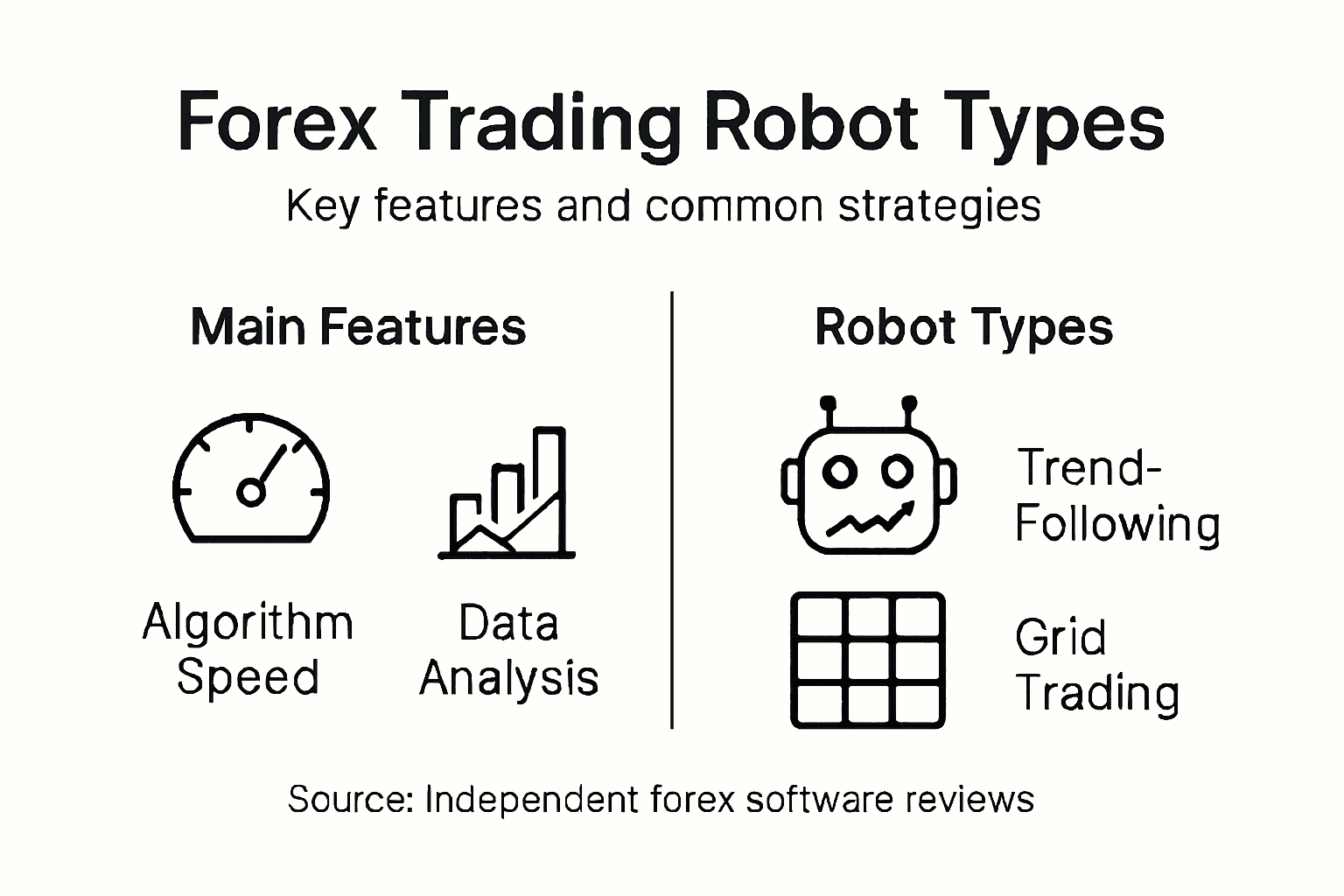
However, trading robots are not infallible. While they impose strict strategic discipline, they can also reduce trading flexibility. Traders must carefully configure their robots’ parameters and continuously monitor their performance to ensure optimal results.
Pro tip: Always backtest your trading robot using historical market data and start with small investment amounts to validate its performance before full-scale deployment.
Main Types of Trading Robots for Forex and Gold
Trading robots in forex and gold markets come in several specialized configurations, each designed to address unique trading strategies and market conditions. Understanding these different types helps traders select the most appropriate automated solution for their specific investment goals and risk tolerance.
The primary categories of trading robots include:
- Grid Trading Robots: Operate by placing multiple buy and sell orders at predetermined price intervals
- Trend-Following Robots: Designed to identify and capitalize on sustained market price movements
- Arbitrage Robots: Exploit price differences across different exchanges or trading platforms
- Scalping Robots: Execute numerous rapid trades to capture small price fluctuations
- Martingale Robots: Use progressive betting strategies to recover potential losses
Each robot type offers distinct advantages and risks. Exploring trading software types reveals the nuanced approaches these algorithmic systems employ to navigate complex financial markets.
Here’s a quick comparison of major trading robot types and their suitability by market condition:
| Robot Type | Best Market Condition | Key Strength |
|---|---|---|
| Grid Trading | Range-bound, flat markets | Reliable incremental gains |
| Trend-Following | Strong directional trends | Maximizes momentum trades |
| Arbitrage | High liquidity, divergence | Exploit price differences |
| Scalping | Volatile, liquid markets | Captures small fluctuations |
| Martingale | Unpredictable, risky | Aggressive loss recovery |
Grid Trading Robots work particularly well in range-bound markets, systematically placing orders at fixed intervals to profit from price oscillations. These robots thrive when currency pairs or gold prices demonstrate predictable lateral movements, creating opportunities for consistent, incremental gains.
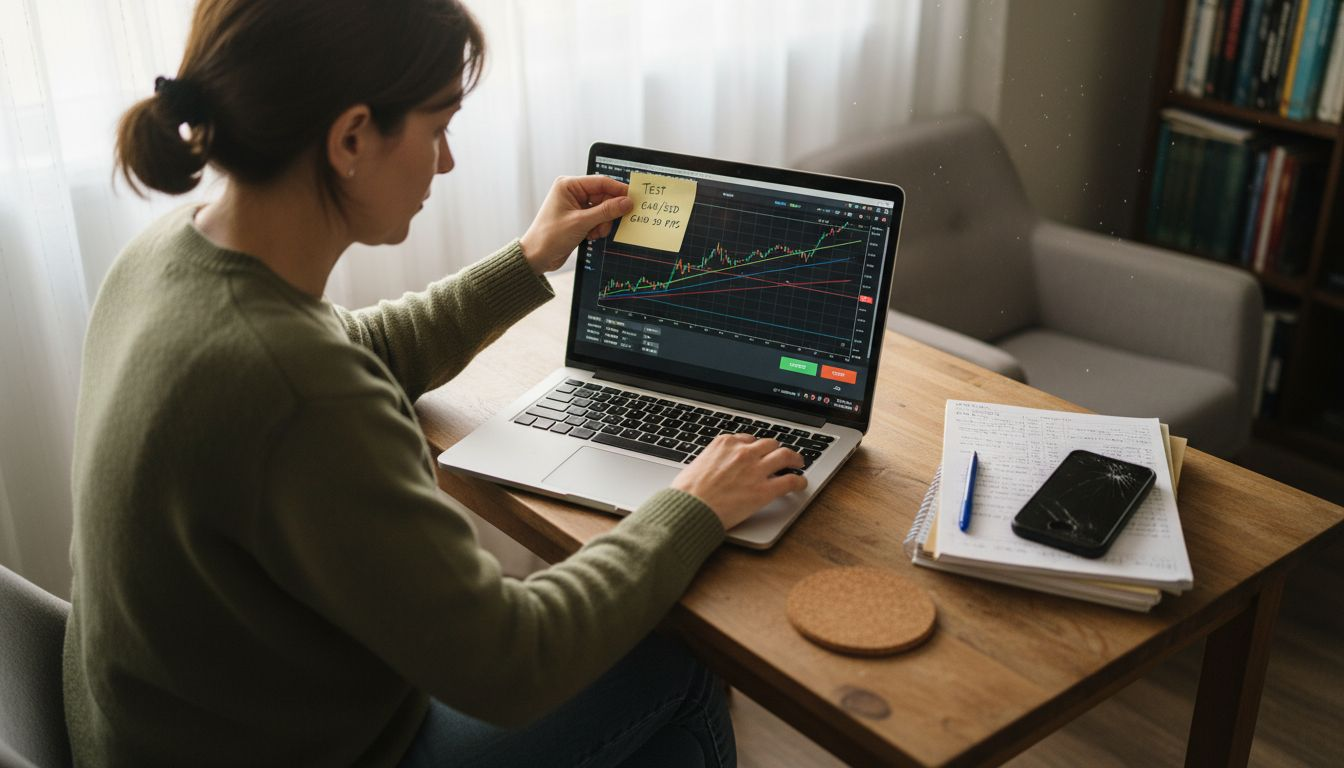
Trend-following robots, conversely, excel in markets experiencing clear directional momentum. By analyzing historical price data and current market indicators, these sophisticated algorithms can automatically enter and exit positions aligned with emerging market trends, potentially maximizing profit potential while minimizing emotional decision-making.
Arbitrage Robots represent a unique category, designed to identify and rapidly exploit price discrepancies across different trading platforms. These high-speed algorithms can execute trades within milliseconds, capturing minuscule price differences that would be imperceptible to human traders.
Pro tip: Always thoroughly backtest and understand the specific algorithmic logic of your chosen trading robot before deploying real capital, as each type carries unique risk profiles and performance characteristics.
Expert Advisors, AI Robots, and Key Features
Expert Advisors (EAs) represent sophisticated algorithmic trading systems that automate forex trading strategies with precision and efficiency. These advanced software programs are designed to execute trades automatically, removing emotional decision-making and providing consistent market engagement across multiple currency pairs and trading platforms.
The key features of modern Expert Advisors include:
- Automated trade execution based on predefined rules
- Advanced risk management controls
- Compatibility with MetaTrader 4 and 5 platforms
- Customizable trading parameters
- Real-time market data analysis
- Backtesting capabilities for strategy validation
AI-powered trading systems represent the next evolution in algorithmic trading, employing machine learning techniques to adapt and optimize trading strategies dynamically. These intelligent systems can analyze vast amounts of financial data, detect complex market patterns, and make predictive trading decisions that surpass traditional rule-based approaches.
Artificial Intelligence Robots take automation to the next level by incorporating adaptive learning algorithms. Unlike traditional EAs that follow fixed rules, AI robots continuously refine their strategies by processing market data, identifying emerging trends, and adjusting their trading approach in real-time.
Risk Management Features are crucial components of modern Expert Advisors. These sophisticated systems typically include advanced controls such as:
- Automatic stop-loss implementation
- Take-profit order generation
- Position size optimization
- Drawdown protection mechanisms
- Volatility-based trade filtering
The integration of machine learning technologies enables these robots to develop increasingly nuanced trading strategies, potentially outperforming static algorithmic approaches by learning from market dynamics and historical performance data.
This table summarizes the differences between traditional Expert Advisors and AI-powered trading robots:
| Feature | Traditional Expert Advisor | AI-Powered Trading Robot |
|---|---|---|
| Strategy Adjustment | Fixed rules only | Dynamic self-learning |
| Market Adaptability | Limited to presets | Refines with new data |
| Decision Logic | Deterministic algorithms | Predictive analytics |
| Complexity | Basic to advanced | Highly advanced |
Pro tip: Always start with a demo account to thoroughly test your Expert Advisor’s performance across different market conditions before committing real trading capital.
Risks, Myths, and Limitations of Automated Trading
Automated trading systems represent powerful technological tools, but they are not infallible magical solutions that guarantee consistent profits. Understanding the inherent risks and potential limitations is crucial for traders seeking to leverage these sophisticated algorithmic platforms effectively.
The primary risks associated with automated trading include:
- Potential for unexpected mechanical failures
- Software vulnerability to market volatility
- Risk of overfitting trading strategies
- Lack of adaptive human decision-making
- Technical infrastructure dependencies
- Potential regulatory compliance challenges
Machine learning trading algorithms face significant challenges in predictability and explainability. These systems can encounter complex issues that traditional manual trading approaches might more readily navigate, including unpredictable market behaviors and technological constraints.
Mechanical Failures represent a critical risk in automated trading systems. Software bugs, network connectivity issues, and server interruptions can potentially trigger unintended trades, causing substantial financial damage. Traders must implement robust monitoring mechanisms and have contingency plans to mitigate these technological vulnerabilities.
Overfitting Dangers emerge when trading algorithms are excessively optimized using historical data. These strategies might perform exceptionally well in backtesting but fail dramatically in live market conditions. Sophisticated traders recognize that past performance does not guarantee future results, especially in dynamic financial markets.
Most trading robots struggle with adapting to unprecedented market scenarios. While they excel at executing predefined strategies, they lack the nuanced judgment and contextual understanding that experienced human traders possess. This limitation becomes particularly evident during black swan events or extreme market volatility.
Automated trading systems are tools, not guaranteed profit generators. Successful implementation requires continuous monitoring, periodic strategy reassessment, and comprehensive risk management.
Pro tip: Implement strict risk management protocols, including maximum drawdown limits and automatic trading suspensions, to protect your capital from potential algorithmic trading failures.
Prop Firm Strategies and Choosing the Right Robot
Navigating proprietary trading firm (prop firm) challenges requires a strategic approach to selecting and deploying trading robots that can consistently demonstrate disciplined performance and risk management. Traders must carefully evaluate automated systems that can meet the stringent requirements of prop firm evaluations while maintaining sustainable trading metrics.
Key considerations when selecting a trading robot for prop firm challenges include:
- Consistent risk management capabilities
- Proven drawdown control mechanisms
- Ability to maintain stable profit ratios
- Adaptive strategy performance
- Compliance with specific prop firm trading rules
- Minimal consecutive loss protection
Trading bots for prop firm challenges must demonstrate exceptional discipline and precision. Unlike traditional retail trading scenarios, prop firm evaluations demand robots that can consistently execute strategies while adhering to strict risk parameters.
Risk Management Protocols are critical when deploying trading robots in prop firm environments. These automated systems must incorporate sophisticated risk control mechanisms that limit potential losses, maintain consistent trade sizes, and prevent aggressive trading behaviors that could trigger account disqualification.
Performance Evaluation Metrics play a crucial role in robot selection. Prop firms typically assess trading robots based on several key performance indicators:
- Maximum daily drawdown percentage
- Total profit factor
- Win rate consistency
- Trade frequency and duration
- Risk-to-reward ratio stability
Successful prop firm trading robots must balance aggressive profit generation with conservative risk management. They need algorithms sophisticated enough to identify high-probability trade setups while simultaneously implementing strict capital preservation strategies.
Prop firm trading robots are not about making massive gains, but demonstrating consistent, disciplined trading performance that meets specific evaluation criteria.
Pro tip: Always backtest your trading robot using prop firm-specific parameters and simulate their evaluation rules before attempting an actual challenge.
Elevate Your Forex Trading with Proven Automated Solutions
Struggling to consistently manage risk and capture profitable opportunities amid rapid market movements is a challenge every trader faces. This article highlights key pain points such as mechanical failures, overfitting, and the need for disciplined algorithmic strategies like Expert Advisors and AI-powered robots. At FxShop24, we understand these hurdles and offer a curated selection of tested, prop firm-compatible trading robots designed to automate your forex and gold trading with precision and reliability.
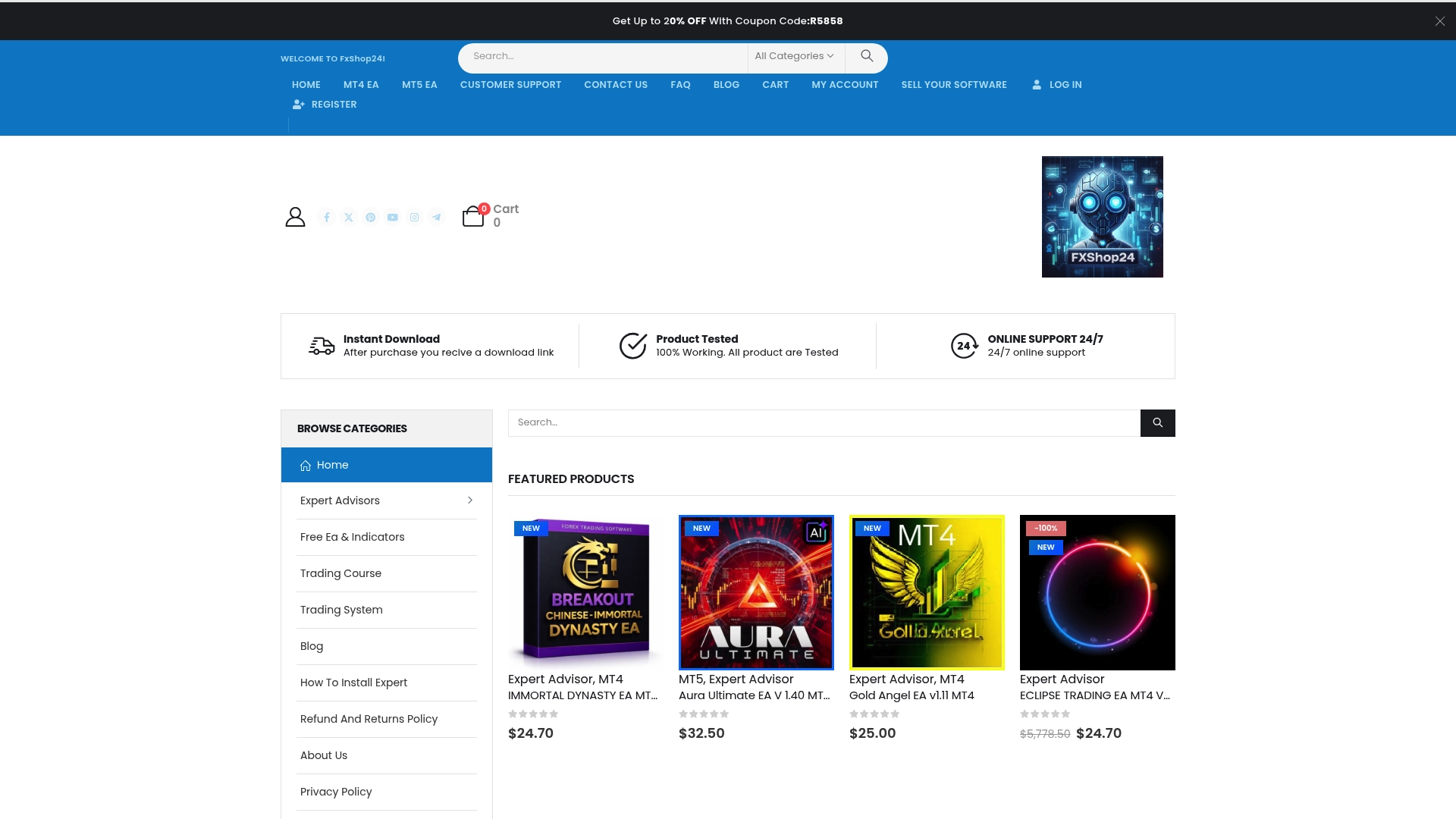
Discover how our range of Expert Advisors and AI-powered trading systems can help you achieve consistent performance by eliminating emotional bias and adapting strategies dynamically. Visit FxShop24 to explore expertly crafted EAs with lifetime updates and unlimited licenses. Take control of your trading journey today by choosing from our premium automated tools that come with detailed performance reviews and installation support. Start now to backtest and deploy trading robots built for real market conditions and prop firm challenges.
Frequently Asked Questions
What are trading robots?
Trading robots are automated systems that perform forex and gold trading by executing transactions based on predefined algorithms and strategies, without human intervention.
How do trading robots analyze the market?
Trading robots analyze real-time market data, identify trading opportunities, and apply mathematical algorithms to execute trades with precision and speed.
What are the main types of trading robots for forex and gold?
The main types of trading robots include grid trading robots, trend-following robots, arbitrage robots, scalping robots, and Martingale robots, each tailored to different market strategies and conditions.
How can I mitigate the risks associated with trading robots?
To mitigate risks, implement strict risk management protocols, backtest your trading strategies using historical data, and continuously monitor your trading robot’s performance.
Recommended
Author