


26
Jan
AI in Forex Trading: Transforming Profits and Risk
Trying to separate hype from reality in AI-driven Forex trading is a daily challenge for serious traders. As more MetaTrader expert advisors promise ‘automated profits’, the true value lies in systems that blend machine learning models and genetic algorithms to adapt to volatile markets. Understanding how AI really works can help you avoid costly mistakes, while learning how to pick strategies that combine adaptability, risk management, and transparency for Forex and gold trading success.
Table of Contents
- AI In Forex Trading Defined And Debunked
- Key Types Of AI And Automation Systems
- How AI Algorithms Analyze And Trade Forex
- Benefits And Limitations For Retail Traders
- Regulations, Safety Concerns, And Compliance In 2026
- Top Risks, Costs, And Common Missteps
Key Takeaways
| Point | Details |
|---|---|
| AI Enhances Trading | AI systems analyze vast historical data to identify patterns, adapting strategies without manual intervention. |
| Myths vs. Reality | AI does not guarantee profits or eliminate losses; it improves risk management and efficiency instead. |
| Different AI Types | Understanding the distinctions between neural networks, NLP, and hybrid systems is crucial for selecting the right expert advisor. |
| Compliance and Risk | Awareness of regulatory developments and system limitations is vital for informed trading decisions. |
AI in Forex Trading Defined and Debunked
When forex traders talk about AI in their trading, they’re usually referring to machine learning systems that learn from market data rather than traders manually coding every single trading rule. Here’s the critical distinction: traditional forex algorithms are rigid. You write the rules, backtest them, and if the market changes, you rewrite them. AI does something different. It examines years of historical price data, volume patterns, and market microstructure to discover what actually works. Machine learning models combined with genetic algorithms can optimize trading strategies far faster than manual rule adjustments ever could, and crucially, they adapt to new market conditions without requiring your constant intervention.
The practical reality differs from the hype you’ll see in marketing materials. Some traders hear “AI” and imagine a robot that prints money. What’s actually happening is more technical and less magical. AI systems in forex use reinforcement learning to make trading decisions by learning from market states and outcomes rather than relying on pre-labeled training data. Think of it like this: instead of someone telling the algorithm “when X happens, do Y,” the algorithm discovers through countless simulated trades which actions produce profitable results under different market conditions. It learns to recognize when the market is trending, when it’s ranging, when volatility is spiking, and what worked historically in similar situations. Your expert advisor runs millions of virtual trades in backtesting to refine its decision-making process before risking real capital.
Here’s where the myths crack: AI in forex doesn’t eliminate losses or guarantee profits. What legitimate AI-powered systems do accomplish is managing risk more intelligently and capturing patterns humans would miss through sheer computational power. The ensemble approach (combining multiple machine learning models) reduces the chance that your system gets blindsided by unusual market behavior. Backtesting on MT4 and MT5 expert advisors allows you to see exactly how an AI system would have performed across different market cycles, which is your safeguard against overfitting and false promises. The traders passing prop firm challenges with AI-powered EAs aren’t doing so because the AI magically prints profits. They’re succeeding because they’ve chosen systems built on solid machine learning principles, proper risk management, and realistic expectations about what automation can actually deliver in volatile currency markets.
Pro tip: When evaluating any AI-powered expert advisor, focus on the actual backtesting results across multiple currency pairs and market conditions, not on how fancy the marketing language sounds. Request performance reports showing drawdown periods and win rates rather than just average monthly returns, since that reveals how the system actually behaves when losses occur.
Key Types of AI and Automation Systems
Frankly, not all AI in forex trading works the same way, and understanding the differences matters when you’re choosing an expert advisor. The major systems fall into distinct categories based on how they process market information. Neural networks form the backbone of most AI trading systems because they excel at recognizing complex patterns in price data that human traders would never spot manually. These networks work by layering mathematical functions that adjust themselves during backtesting, learning which price movements and indicators historically preceded profitable trades. Natural language processing (NLP) represents a different beast entirely. While you’re focused on chart patterns and technical levels, NLP systems are simultaneously analyzing financial news, economic reports, and market commentary to gauge market sentiment and detect turning points before price action reflects them. AI algorithms in financial markets combine these approaches by pulling both quantitative signals from price data and qualitative insights from text-based information, which is why the best expert advisors typically use ensemble methods rather than relying on a single AI technique.
When you’re running an expert advisor on MetaTrader, you’re usually working with machine learning models that continuously adapt to changing market conditions. These differ from static rule-based systems because they genuinely improve over time rather than degrading as markets evolve. Deep learning models, a subset of machine learning, use multiple layers to identify increasingly abstract market features. A basic layer might detect simple price patterns, while deeper layers recognize how those patterns combine to form larger market structures. Sentiment analysis works alongside these systems to measure whether traders are optimistic or fearful at any given moment, which often drives short-term price movements more than fundamentals alone. The critical advantage is speed and precision. A human trader analyzing charts and news might catch three or four trading opportunities per day. An AI system running on MetaTrader 4 or MetaTrader 5 evaluates thousands of scenarios every minute, identifying opportunities across multiple currency pairs and timeframes simultaneously.
Here’s the practical breakdown of what you’re actually getting with different AI approaches. Pure price-action systems use neural networks to analyze candlestick patterns and technical indicators. News-based systems use NLP to monitor Bloomberg terminals and economic calendars. Hybrid systems, which tend to perform best in prop firm challenges, combine both approaches. The major AI algorithms applied in trading emphasize adaptive learning because markets shift constantly. A system built on 2023 data might struggle in 2025 if it can’t adjust to new volatility patterns or trading behaviors. This is why backtesting across multiple market cycles matters so much. You’re not just looking for high returns in the backtest. You’re watching for consistency across trending markets, ranging markets, high-volatility shocks, and recovery periods. The traders actually winning with AI-powered EAs have selected systems that maintain profitability across all these conditions, not just one specific market environment.
Pro tip: Test any new AI-powered expert advisor in demo trading for at least two complete market cycles (typically 3 to 6 months) to see how it adapts to changing volatility and trending conditions before committing real capital.
Here’s a comparison of major AI system types used in forex trading:
| AI System Type | Data Used | Main Strength | Ideal Market Condition |
|---|---|---|---|
| Neural Networks | Price & volume data | Pattern recognition | Trending and volatile markets |
| NLP Systems | News & text sources | Sentiment and event detection | Economic releases, major news |
| Hybrid/Ensemble | Price and news data | Adaptive and robust trading | Mixed conditions, unpredictable cycles |
| Rule-Based Algorithms | Pre-coded rules | Simplicity, speed | Stable/trending markets |
How AI Algorithms Analyze and Trade Forex
AI doesn’t just throw darts at a board and hope something sticks. Instead, these algorithms work through a systematic process of analyzing market data, identifying patterns, and executing trades based on learned behavior. The foundation starts with historical price data. An AI system ingests years of candlestick patterns, bid and ask spreads, volume data, and volatility metrics. It then searches for correlations between specific market conditions and profitable outcomes. When it discovers that a particular combination of indicators preceded profitable trades 73 percent of the time historically, it flags that as a potential trading signal. The system doesn’t memorize rules like a human trader would write them. Instead, it learns probabilistically which market states tend to produce winning trades and which ones carry higher risk of losses. Reinforcement learning algorithms evaluate market data sequentially to determine whether buying, selling, or holding produces the best long-term returns, continuously adjusting its approach based on trading feedback.

The real power emerges when the AI system operates in real-time trading. Your expert advisor watches the live bid and ask prices, calculates how current market conditions compare to historical patterns it learned, and makes microsecond decisions. If market conditions match a pattern that historically led to a 200 pip rally, the algorithm enters a position. If conditions resemble a pattern that preceded a 150 pip drawdown, it either avoids that trade or enters with tighter stops. This is where machine learning models for Forex trading reveal their advantage over static rule-based systems. A traditional EA might be programmed to “buy when the moving average crosses above the support level.” An AI system recognizes that this signal works on Tuesday mornings in GBP/USD but fails catastrophically on Friday afternoons when news volatility dominates. It learns these nuances and adapts its position sizing and entry logic accordingly.
Backtesting and validation form the crucial bridge between theory and actual trading results. When you backtest an AI-powered expert advisor on MetaTrader, you’re watching the algorithm make thousands of decisions across multiple market cycles, economic recessions, and volatility regimes. A quality AI system shows consistent profitability across trending periods, ranging periods, and crisis periods rather than dominating in just one market condition. The algorithm learns what bid-ask spread levels cause slippage, how volatility clusters before major economic releases, and which currency pair correlations shift during geopolitical events. Risk management gets baked into the decision-making process itself, not just added as an afterthought. The AI evaluates not just whether a trade will be profitable, but the probability-adjusted return considering the risk of being stopped out. This is why traders passing prop firm challenges with AI-powered EAs often report lower drawdowns alongside strong returns. The system hasn’t just learned to make money. It’s learned to make money while controlling losses.
Pro tip: When evaluating an AI expert advisor, focus on its performance during the worst 10 percent market conditions in the backtest, not just the average returns. A system that holds up during crisis periods with only moderate losses is far more reliable than one showing spectacular gains in calm markets but catastrophic drawdowns during volatility shocks.
Benefits and Limitations for Retail Traders
AI-powered expert advisors solve real problems that retail forex traders face daily. Speed ranks first among these advantages. Your brain processes information in milliseconds, but an AI system processes thousands of data points and executes trades in microseconds. While you’re still deciding whether to enter a trade based on a breakout, the algorithm has already entered, taken profits on half the position, and moved its stop loss to breakeven. Emotional discipline becomes automated. You no longer face the temptation to hold a losing trade hoping it rebounds or close a winning trade too early from fear. The algorithm executes its predetermined rules consistently across all market conditions, whether you’re sleeping, working, or eating dinner. You also gain access to 24/7 trading coverage. Retail traders juggling jobs and family cannot monitor all major currency pairs across all sessions. An AI system trades while you sleep, capitalizing on London, New York, and Tokyo session opportunities without fatigue-induced mistakes. AI systems provide faster analytical capabilities and unbiased decision-making that remove the psychological barriers preventing most retail traders from consistent profitability.
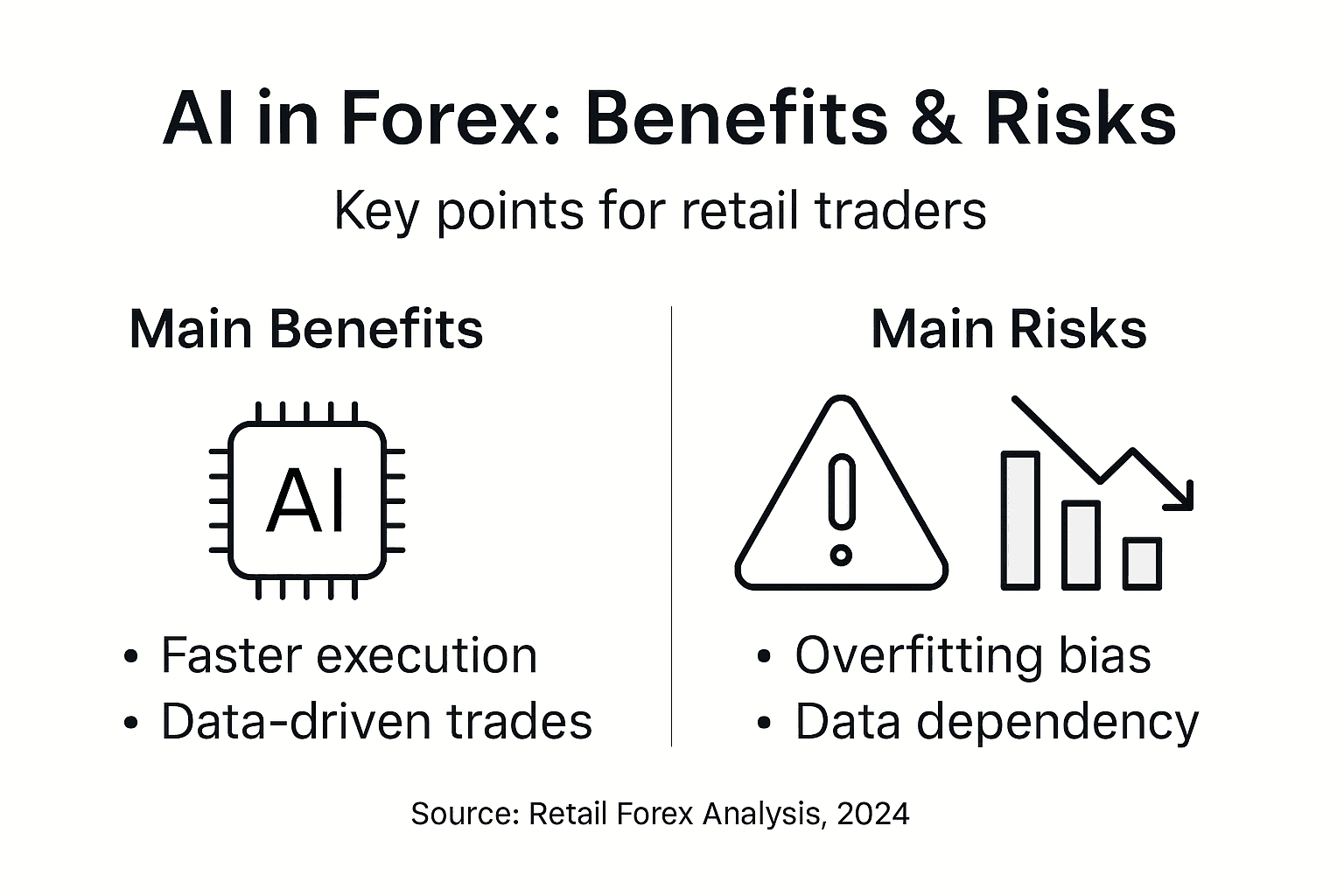
But here’s where reality crashes into marketing claims. The biggest limitation stems from historical data dependency. Your AI system learned patterns from the past 10 years of data, but markets occasionally do things they’ve never done before. A geopolitical shock, a central bank policy shift, or a pandemic-driven market disconnect can render historical patterns worthless. The algorithm keeps trading based on patterns that no longer predict future outcomes, potentially leading to devastating losses during unprecedented market moves. Overfitting represents another insidious problem. If you optimize your expert advisor parameters too aggressively against historical data, it becomes brilliant at trading the past but terrible at trading the future. The system memorizes noise instead of learning genuine patterns. Enhanced analytical capabilities mask risks from incomplete data and challenges in interpreting AI decisions, meaning you might be relying on a system you don’t fully understand making decisions you cannot easily explain or defend.
Retail traders also face the cold reality that AI cannot replicate human intuition during truly anomalous market conditions. When volatility explodes beyond anything the algorithm trained on, when liquidity dries up, or when markets gap through key levels overnight, AI struggles because these scenarios fall outside its learned experience. Additionally, not all AI systems are created equal. Cheap or poorly designed expert advisors might use oversimplified machine learning that actually underperforms simple moving average crossovers. The cost of sophisticated AI trading solutions can be substantial, and there’s no guarantee of profitability despite the expense. Most critically, AI works best when combined with human oversight, not replacing it entirely. You need to monitor performance, understand when the system might fail, and maintain the ability to shut it down if market conditions shift radically.
The Real Balance
Successful retail traders using AI don’t treat it as a magic button. They use AI to automate the mechanical aspects of trading while maintaining human judgment over strategy selection and risk management. They backtest extensively to catch overfitting. They monitor live trading carefully to ensure the algorithm behaves as expected. They accept that even the best AI system will experience losses and drawdowns. And they only allocate capital they can afford to lose to any single system, regardless of how impressive the backtest results appear.
Pro tip: Test your AI expert advisor on a completely different currency pair and timeframe than what it was originally optimized for. If it performs decently on untested data, it’s learning genuine patterns. If performance collapses, it was overfitted and you should search for a different system.
Regulations, Safety Concerns, and Compliance in 2026
Regulatory bodies worldwide are tightening their focus on AI-driven trading systems, and 2026 marks a critical inflection point for retail traders using expert advisors. The core concern centers on market integrity and systemic risk. When thousands of AI systems trade simultaneously based on similar learned patterns, they can amplify market moves in ways that benefit no one except the algorithms themselves. Financial regulators in the United States, European Union, and United Kingdom have all signaled stronger oversight of algorithmic trading, and AI-powered systems face heightened scrutiny. Compliance requirements now demand that traders using expert advisors understand their systems at a deeper level than simply “I bought an EA and it makes money.” You need to comprehend your algorithm’s logic, recognize its limitations, and maintain the ability to intervene if market behavior turns anomalous. Data privacy regulations like GDPR continue evolving to restrict how trading systems access and utilize personal and market data. These aren’t academic concerns. Brokers operating in regulated jurisdictions face fines for allowing clients to trade with non-compliant systems, and traders using unvetted expert advisors run the risk of account freezes or forced position closures if regulators determine the EA violates local trading rules.
A more subtle threat emerges from algorithmic collusion, where multiple AI systems inadvertently coordinate their trading behavior without explicit communication between traders. This creates the appearance of market manipulation even when no actual collusion occurred. Regulatory frameworks struggle to detect illegal AI behavior under current antitrust rules, making enforcement unpredictable. Retail traders caught in this trap have limited recourse. If regulators determine that your expert advisor participated in coordinated market movement, you could face legal liability regardless of whether you intentionally coordinated with other traders. This is why choosing expert advisors from reputable developers matters enormously. Established software providers build compliance monitoring into their systems and maintain documentation proving they avoid coordination patterns that regulators flag as suspicious. Additionally, regulations enforcing transparency and algorithmic accountability now require that AI trading systems maintain audit trails showing every decision, every market condition, and every trade execution. Your broker may request this documentation at any time to verify compliance.
What This Means for Your Trading
Frankly, the compliance landscape favors traders who use established, professionally developed expert advisors from companies that prioritize regulatory alignment. Cheap or obscure EAs from anonymous developers carry hidden regulatory risk. Regulated brokers increasingly refuse to accept expert advisors lacking proper documentation and compliance verification. You should verify that any expert advisor you use has been tested and approved by regulated brokers, comes with transparent documentation explaining its trading logic, and includes audit logging capabilities that allow you to prove the system operated as intended. Additionally, maintain personal records of backtests, strategy rationales, and performance metrics. If regulators ever question your trading activity, being able to demonstrate that your expert advisor follows reasonable risk management and operates within established technical trading frameworks protects you from accusations of market manipulation.
Pro tip: Before deploying any expert advisor on a regulated broker account, contact the broker’s compliance department directly and ask whether the EA is approved for use and what documentation they require to maintain your account standing. Getting written confirmation prevents costly account issues later.
Top Risks, Costs, and Common Missteps
Retail traders diving into AI-powered expert advisors often underestimate the true costs involved. The purchase price of the EA itself typically runs from $50 to $500, but that’s just the beginning. You’ll need reliable hosting if you want the system running 24/7 without your computer staying powered on. Cloud hosting through services supporting MetaTrader 4 and MetaTrader 5 costs $10 to $30 monthly. Then there’s data fees. Quality historical data for backtesting costs money. Premium market data subscriptions add another $50 to $200 per month depending on which pairs and feeds you need. Commission from your broker, spreads on every trade, and slippage during execution all compound into real losses. A trader might spend $300 to $500 monthly just to keep a sophisticated expert advisor operating, which means the system needs to generate consistent profits just to break even on operational expenses. Over-reliance on historical data and insufficient understanding of AI model limitations cause traders to deploy systems without truly comprehending their mechanics, leading to catastrophic losses when unprecedented market events occur.
The most devastating misstep involves overfitting, which deserves special attention because it destroys accounts silently. Your expert advisor performs beautifully in backtests because it’s been optimized to perfection against historical data it has already “seen.” But the future hasn’t happened yet, and the market doesn’t care about your backtest results. An overfitted system memorizes noise instead of learning genuine patterns. It might have 87 percent win rate in the backtest spanning 2020 to 2024, but when deployed live in 2025, it loses money consistently because it’s trading ghosts of patterns that no longer exist. Missteps like overfitting models and ignoring real-world trading constraints require rigorous out-of-sample testing and walk-forward analysis to prevent. You need to backtest your EA on data it has never seen before. Split your historical data into training periods and testing periods. Run the system on completely different currency pairs than what you optimized. If performance collapses on untested data, you’re overfitted and the system will fail live.
Critical Risks You Must Monitor
Technological failures represent another category traders ignore until they happen. Your EA might crash during a critical market move. Your broker’s servers might go down. Internet connectivity might fail. These aren’t theoretical concerns. Market moves don’t wait for your system to reconnect. You could be stopped out at terrible prices or, worse, your position could gap through your stop loss completely. Liquidity risk catches many traders off guard. Your backtest assumes perfect fills at market prices, but during volatile news releases or when spreads widen dramatically, you’ll fill at much worse prices. Your 100 pip profit target might become a 50 pip loss when you account for real-world slippage. Model bias creates another hidden danger. If your AI system was trained primarily on trending markets, it will underperform during range-bound periods and get whipsawed repeatedly. If it learned from data before major volatility regimes changed, it might keep trading as if 2022 volatility levels are normal when 2026 volatility is completely different.
Misunderstanding your system ranks high on the missteps list. Traders purchase expert advisors without reading documentation or understanding the trading logic. They see attractive backtest results without asking critical questions. What timeframes was this optimized for? What currency pairs? What was the volatility environment? Was this tested across multiple market cycles including bear markets? Without answers, you’re essentially gambling with money. Additionally, neglecting proper risk management creates losses that exceed the system’s capacity to recover. Many traders allocate their entire account to a single expert advisor. When it hits a normal drawdown period, they panic and shut it off right before it would have recovered. Successful traders using AI allocate only 5 to 15 percent of their account to any single system, allowing multiple approaches to balance each other and preventing catastrophic account wipeout from any single strategy.
Pro tip: Calculate your realistic monthly costs including hosting, data fees, and spreads, then backtest your EA on the assumption that it needs to generate at least that amount in profit just to break even. If it can’t consistently exceed that threshold, the system won’t be profitable in real trading.
Retail traders should understand the breakdown of AI expert advisor costs and risks:
| Cost/Risk Factor | Typical Range/Impact | Why It Matters |
|---|---|---|
| EA Purchase Price | $50-$500 one-time | Initial entry barrier |
| Hosting Fees | $10-$30 monthly | Required for round-the-clock trading |
| Market Data Fees | $50-$200 monthly | High quality backtesting needs |
| Broker Commissions | Varies by provider | Affects net profitability |
| Overfitting Risk | Potential account wipeout | Destroys live performance |
Unlock Smarter Forex Trading with AI-Powered Expert Advisors
Navigating the complex world of forex trading requires more than hope and guesswork. The article highlights the challenge many traders face: the need for adaptive AI systems that manage risk intelligently and adjust to ever-changing market conditions without constant manual intervention. If you are looking to overcome the pitfalls of overfitting, lack of emotional discipline, and limited speed in execution, leveraging AI-driven trading solutions is essential. Key concepts like machine learning, neural networks, and reinforcement learning are no longer just theory — they are the future tools that can transform your approach and help you stay competitive.
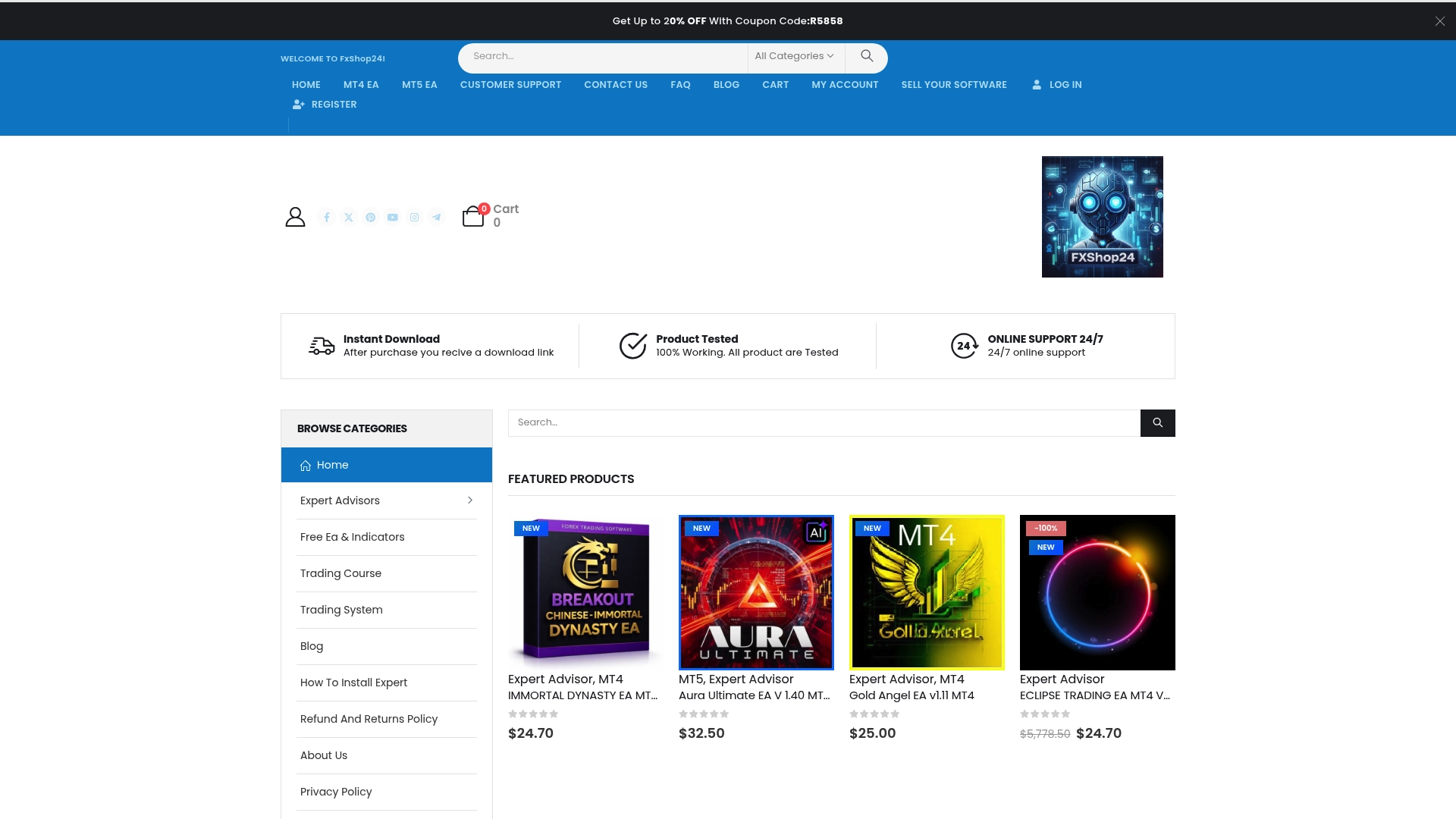
Take control of your trading journey today by exploring our selection of tested, prop firm-ready expert advisors designed specifically for MetaTrader 4 and MetaTrader 5. At FxShop24, you gain instant access to AI-powered trading robots and proven systems that perform across multiple market cycles, minimizing drawdowns and maximizing opportunities. Harness the power of automation with products backed by real performance reviews, lifetime updates, and unlimited licenses. Don’t settle for traditional rule-based bots. Visit FxShop24 now and upgrade your strategy with intelligent automation built for the modern forex and gold trader.
Frequently Asked Questions
What are the main advantages of using AI in Forex trading?
AI in Forex trading offers several advantages, including faster analysis of vast amounts of data, enhanced emotional discipline by automating trading decisions, and the ability to adapt to changing market conditions without manual intervention.
How do AI algorithms learn to trade?
AI algorithms learn to trade by analyzing historical market data to identify correlations between specific conditions and profitable outcomes, using techniques like reinforcement learning to improve their decision-making over time.
What risks should I be aware of when using AI-powered trading systems?
The main risks include overfitting, reliance on historical data, technological failures, and liquidity risks during volatile market periods. It’s essential to monitor performance and maintain proper risk management to mitigate these risks.
How important is backtesting for AI trading systems?
Backtesting is crucial as it allows traders to assess how an AI system would have performed in different market conditions. It helps identify potential overfitting and ensures the system can adapt to new market environments.
Recommended
- From Demo To Real: Transitioning Safely With Expert Advisors | FxShop24 Marketplace
- What Is Forex Automation: Transforming Modern Trading
- Dynamic Pips EA MT4 Review: Diversified, Smart, And Customizable Trading | FxShop24 Marketplace
- Comparing Grid, DCA, And Arbitrage Bots: Which One’s For You? | FxShop24 Marketplace
Author