


13
Jan
AI-Powered Trading: Transforming Forex and Gold Markets
Most american and international traders now rely on automated solutions that can evaluate markets in milliseconds. This shift matters because forex and gold volatility often outpaces human reactions, putting profit at risk for anyone not using cutting-edge technology. With over 60% of global trading activity powered by advanced algorithms, exploring how AI-driven systems analyze data and make fast, intelligent decisions could be the difference between ordinary and exceptional trading outcomes.
Table of Contents
- Defining AI-Powered Trading in Finance
- How AI-Powered Trading Systems Operate
- Types of AI Trading: EAs, Algorithms, Robots
- Benefits and Real-World Use Cases
- Risks, Compliance, and What Traders Must Know
Key Takeaways
| Point | Details |
|---|---|
| AI-Powered Trading Revolution | AI-powered trading utilizes advanced algorithms to autonomously analyze data and make trading decisions more efficiently than traditional methods. |
| Dynamic Adaptability | AI systems continuously learn from historical and real-time data, allowing for dynamic strategy adjustments tailored to market conditions. |
| Operational Risks | Traders must navigate risks such as algorithmic errors and model transparency issues, necessitating robust oversight and compliance mechanisms. |
| Transparent Metrics | When selecting AI trading systems, focus on those that demonstrate consistent performance across varied market scenarios with clear metrics. |
Defining AI-Powered Trading in Finance
Artificial intelligence has fundamentally transformed financial trading strategies, particularly in forex and gold markets. AI-powered trading represents a sophisticated approach where advanced algorithms leverage machine learning techniques to analyze market data, predict price movements, and execute trades autonomously. Unlike traditional trading methods, these systems can process massive volumes of complex financial information in milliseconds, identifying market patterns with unprecedented accuracy.
At its core, AI-powered trading employs multiple computational paradigms including deep learning, reinforcement learning, and natural language processing. These technologies enable trading systems to adapt dynamically, learning from historical market behaviors and real-time data streams. Proprietary trading firms increasingly rely on supervised machine learning models that can analyze hundreds of market features simultaneously, generating trading signals with remarkable precision.
The technological sophistication of AI trading extends beyond simple automated execution. These intelligent systems continuously optimize their decision-making processes, incorporating risk management protocols and adjusting strategies based on evolving market conditions. By integrating advanced machine learning trading algorithms, traders can potentially reduce emotional bias, improve response times, and develop more consistent trading performance across volatile financial markets.
Pro tip: Start by testing AI trading strategies with small capital allocations and gradually increase investment as you understand the system’s performance characteristics and risk parameters.
How AI-Powered Trading Systems Operate
AI-powered trading systems are sophisticated technological platforms that transform raw market data into intelligent trading decisions through advanced computational techniques. These systems begin by collecting and preprocessing complex market information, including price movements, trading volumes, fundamental indicators, and even real-time news sentiment. The initial data gathering phase is crucial, as it provides the foundational input for subsequent analytical processes.
The core operational mechanism involves multiple machine learning paradigms working in concert. Deep learning neural networks analyze historical price patterns, while reinforcement learning algorithms continuously optimize trading strategies based on performance feedback. Natural language processing components simultaneously scan news sources, economic reports, and social media to extract potential market-moving insights. This multi-layered approach allows AI-driven automated trading systems to make split-second decisions that would be impossible for human traders.
Critical to these systems is their ability to self-adapt and learn. Unlike traditional trading algorithms with fixed rules, AI-powered systems dynamically adjust their strategies based on changing market conditions. They can rapidly identify emerging patterns, assess risk in real-time, and execute trades with minimal human intervention. This adaptive capability is particularly powerful in volatile markets like forex and gold trading, where milliseconds can separate profitable trades from significant losses.
Pro tip: When evaluating AI trading systems, focus on their track record of adaptive learning and consistent performance across different market conditions, rather than being swayed by short-term results.
Types of AI Trading: EAs, Algorithms, Robots
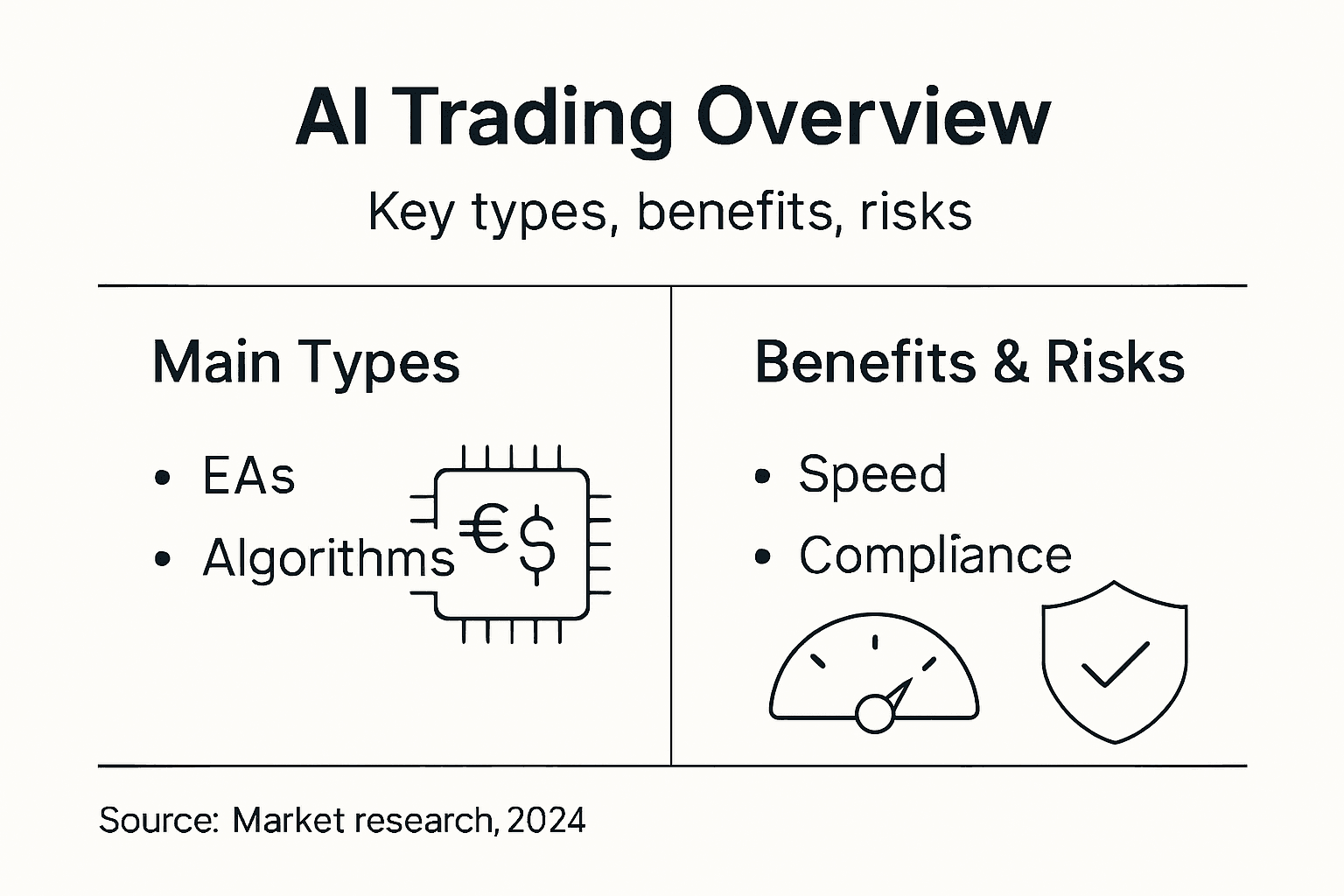
Expert Advisors (EAs) represent the fundamental building block of automated trading technologies, offering traders programmable scripts that execute trades based on predefined strategies. Algorithmic trading systems range from simple rule-based scripts to complex machine learning models that can adapt dynamically to changing market conditions. These tools are primarily designed for platforms like MetaTrader 4 and MetaTrader 5, allowing traders to automate their trading decisions with varying degrees of sophistication.
The spectrum of AI trading technologies includes three primary categories. Rule-based EAs operate using fixed logic and predetermined parameters, executing trades when specific market conditions are met. Machine learning algorithms represent a more advanced approach, utilizing neural networks and natural language processing to analyze historical data, market sentiment, and emerging trends. Trading robots constitute the most sophisticated category, capable of operating completely autonomously by making complex trading decisions using advanced reinforcement learning techniques.
Each type of AI trading system offers unique advantages and challenges. Rule-based EAs provide predictability and straightforward implementation, while machine learning algorithms offer adaptive strategies that can respond to complex market dynamics. Advanced trading robots can process massive amounts of data simultaneously, identifying subtle market patterns that human traders might miss. These systems continuously learn and optimize their strategies, potentially reducing emotional bias and improving overall trading performance across different market conditions.
Here’s a concise overview of key AI-powered trading types and their distinguishing features:
| Trading Type | Main Technology | Degree of Automation | Adaptability |
|---|---|---|---|
| Rule-based EA | Predefined logic scripts | Semi-automated execution | Fixed, low adaptability |
| Machine Learning | Neural networks, NLP | Automated data analysis | High, adapts to trends |
| Trading Robot | Reinforcement learning | Fully autonomous trading | Very high, self-learning |
Pro tip: When selecting an AI trading system, prioritize those with transparent performance metrics and the ability to demonstrate consistent results across multiple market scenarios.
Benefits and Real-World Use Cases
AI-powered trading technologies are revolutionizing financial markets by delivering unprecedented advantages in speed, accuracy, and strategic decision-making. Advanced market intelligence systems enable traders to process complex market data instantaneously, identifying profitable opportunities that would remain invisible to human analysts. These technologies dramatically enhance trading efficiency by reducing emotional bias, minimizing human error, and executing trades with millisecond precision across global forex and gold markets.
The real-world applications of AI trading span multiple sophisticated domains. Hedge funds now utilize deep reinforcement learning algorithms to dynamically adapt investment strategies, while institutional traders leverage sentiment analysis tools to interpret global news and economic signals. AI-powered trading strategies have demonstrated remarkable capabilities in portfolio optimization, risk management, and generating consistent returns across volatile market conditions. These systems can simultaneously analyze thousands of market variables, creating predictive models that outperform traditional human-driven approaches.
The benefits extend beyond mere execution speed. AI trading technologies introduce unprecedented levels of market transparency and efficiency. They enable more accurate price discovery, improve market liquidity, and provide sophisticated risk management protocols that can dynamically adjust to changing economic landscapes. By integrating alternative data sources like social media sentiment, geopolitical events, and macroeconomic indicators, these systems create a more holistic approach to trading that traditional methods cannot match.
Pro tip: When exploring AI trading solutions, prioritize platforms that offer transparent performance metrics and demonstrate consistent adaptability across different market environments.
Risks, Compliance, and What Traders Must Know
AI-powered trading technologies introduce complex regulatory and operational challenges that traders must carefully navigate. Algorithmic trading risks encompass multiple critical dimensions, including model transparency, potential market manipulation, and unintended algorithmic behaviors that can destabilize financial markets. Traders must understand that while these technologies offer immense potential, they also require sophisticated risk management strategies and deep technological comprehension.
Regulatory frameworks are struggling to keep pace with the rapid evolution of AI trading technologies. Advanced trading algorithms can autonomously engage in behaviors that raise significant antitrust and market fairness concerns. These self-learning systems might exploit market microstructures in ways that create unfair advantages, potentially distorting price efficiency and market competitiveness. Compliance now demands not just understanding trading rules, but comprehending the complex decision-making processes of AI systems.
Practical risk mitigation requires a multi-layered approach. Traders must implement robust monitoring mechanisms, maintain comprehensive audit trails, and develop deep understanding of their AI trading systems’ underlying algorithms. This includes regularly stress-testing models, validating performance across different market conditions, and establishing clear risk tolerance parameters. Understanding the potential for algorithmic bias, unexpected correlations, and systemic vulnerabilities is crucial for responsible AI trading deployment.
Below is a summary of AI-powered trading benefits versus key risks for traders to consider:
| Aspect | Major Benefits | Primary Risks |
|---|---|---|
| Speed | Millisecond trade execution | Potential algorithmic errors |
| Market Analysis | Identifies hidden opportunities | Model transparency issues |
| Decision-making | Reduces emotional biases | Algorithmic market manipulation |
| Risk Management | Dynamic strategy adjustment | Need for robust oversight |
Pro tip: Always maintain a human oversight mechanism that can interrupt AI trading systems during unexpected market conditions, ensuring you have a fail-safe against potential algorithmic errors.
Unlock the Power of AI-Powered Trading for Forex and Gold
Navigating the fast-paced world of forex and gold trading demands tools that not only keep up but outperform market volatility. The article highlights the key challenges traders face such as the need for adaptive AI systems that reduce emotional bias and rapidly analyze complex data. At FxShop24, we understand these pain points and offer a broad selection of automated trading solutions including expert advisors (EAs), AI-driven trading robots, and proprietary systems designed to enhance precision and consistency.
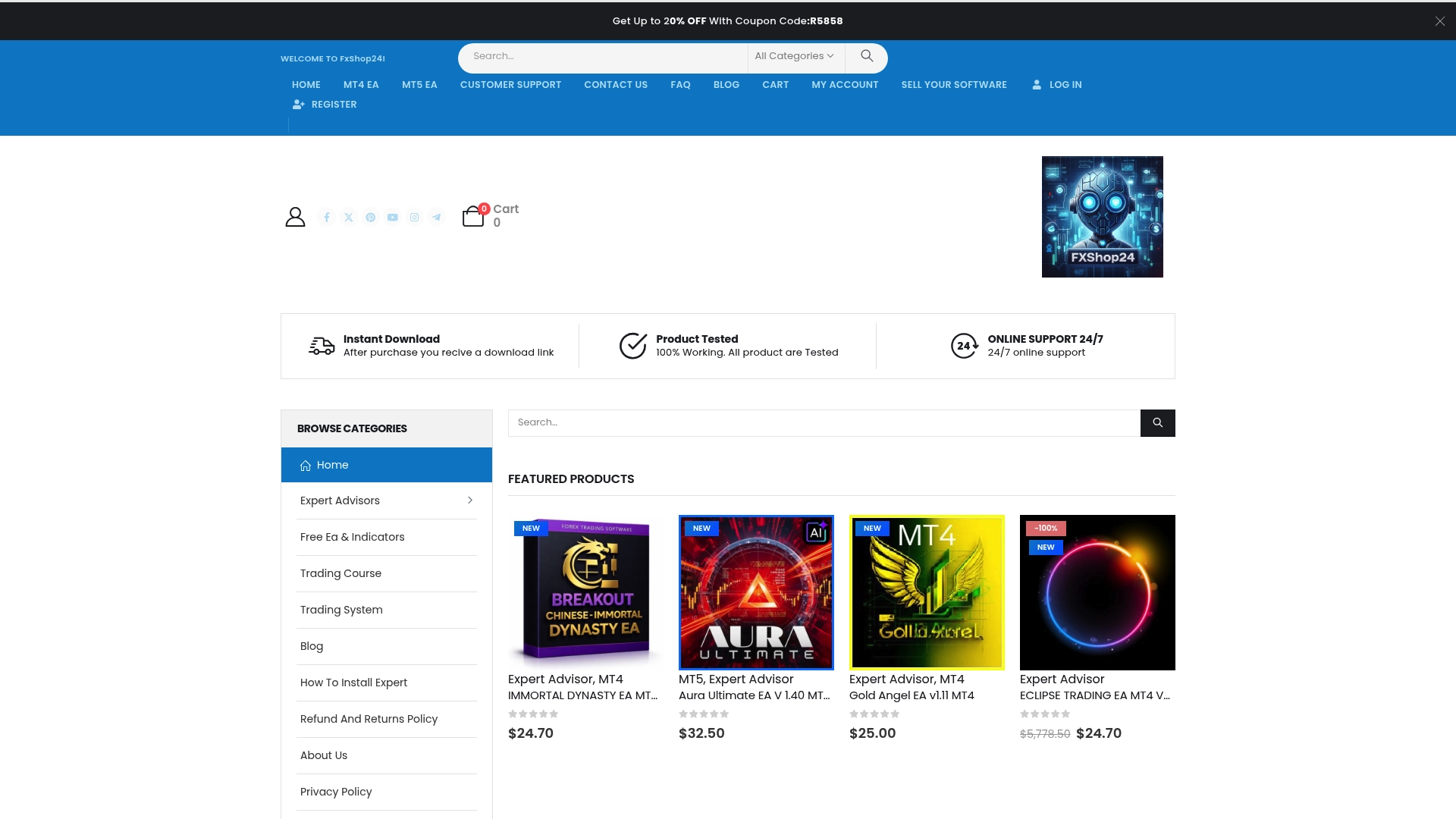
Take control of your trading journey today by choosing test-tested, prop firm-ready EAs that come with lifetime updates and unlimited licenses at FxShop24. Explore how our advanced trading software for MetaTrader 4 and MetaTrader 5 platforms can help you overcome traditional trading limitations. Don’t wait for market opportunities to pass by. Visit FxShop24 main site now and start automating smarter trades with proven AI technologies.
Frequently Asked Questions
What is AI-powered trading in finance?
AI-powered trading in finance refers to the use of advanced algorithms that leverage machine learning techniques to analyze market data, predict price movements, and execute trades autonomously in markets such as forex and gold.
How do AI trading systems operate?
AI trading systems collect and preprocess complex market information, utilizing machine learning paradigms like deep learning and natural language processing to make intelligent trading decisions and dynamically adjust strategies based on real-time data.
What are the different types of AI trading technologies?
The main types of AI trading technologies include Expert Advisors (EAs), which execute trades based on predefined strategies, machine learning algorithms that adapt to market conditions, and fully autonomous trading robots using reinforcement learning techniques for decision-making.
What are the benefits of using AI-powered trading systems?
AI-powered trading systems provide advantages such as increased speed and accuracy in trade execution, the ability to identify hidden market opportunities, reduced emotional bias in trading, and the implementation of sophisticated risk management strategies.