

24
Jul
Automated Futures Trading Systems: A Comprehensive Guide for Modern Traders
The financial markets have undergone a dramatic transformation over the past decade, with automated futures trading systems emerging as one of the most significant developments in trading technology. These sophisticated systems leverage computer algorithms to execute trades in futures markets without direct human intervention, offering unprecedented speed, precision, and the ability to operate around the clock.
Understanding Automated Futures Trading Systems
Automated futures trading systems are computer programs designed to analyze market conditions and execute trades based on predetermined criteria. These systems continuously monitor market movements and react instantly to signals, eliminating the emotional aspect from trading decisions that often leads to costly mistakes.
Futures contracts are standardized agreements to buy or sell an asset at a predetermined price on a specific future date. They offer several advantages including high liquidity, leverage capabilities, diversification opportunities, and hedging potential against price fluctuations. When combined with automation, these instruments become powerful tools for systematic trading strategies.
Core Components of Automated Trading Systems
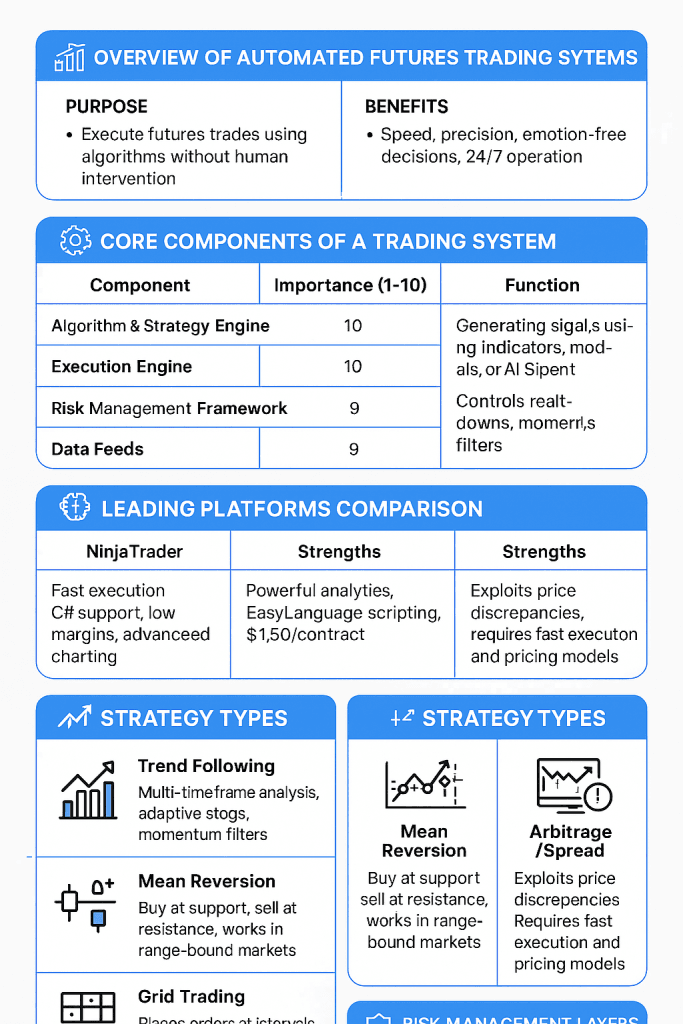
The architecture of automated futures trading systems consists of eight essential components, each playing a crucial role in system performance. The trading algorithm and execution engine represent the most critical elements, both rated at maximum importance (10/10), followed closely by risk management and data feeds at 9/10 importance.
Algorithm and Strategy Engine
The heart of any automated system is its trading algorithm, which processes market data and generates buy/sell signals based on technical indicators, statistical models, or machine learning algorithms. Modern systems can analyze vast amounts of data in real-time and identify patterns that would be impossible for human traders to detect manually.
Execution Engine
The execution engine translates trading signals into actual market orders, managing order routing, slippage control, and fill reporting. Professional-grade systems achieve execution speeds measured in milliseconds, crucial for capturing fleeting market opportunities.
Risk Management Framework
Risk management systems implement position sizing rules, maximum drawdown limits, and automated stop-loss orders. These controls are essential for preserving capital and ensuring long-term survival in volatile futures markets.
Leading Platforms and Technologies
NinjaTrader: The Futures Specialist
NinjaTrader stands out as the premier platform for dedicated futures traders, offering competitive commissions ranging from $0.09 to $1.29 per contract and low margin requirements starting at $50. The platform supports C# programming for custom strategy development and provides free simulation capabilities for strategy testing.
Key features include:
- Advanced charting with 100+ technical indicators
- High-performance backtesting engine
- Automated strategy deployment
- Real-time market scanner
- Risk management tools
TradeStation: Advanced Analytics
TradeStation excels for sophisticated traders with powerful backtesting capabilities and advanced automation features. At $1.50 per contract, it offers robust analytical tools and supports EasyLanguage for custom strategy development.
Interactive Brokers: Professional Grade
Interactive Brokers caters to professional and institutional traders, providing access to global futures markets with volume-based discounts. The platform supports multiple programming languages including Python, Java, and C++.
MetaTrader 5: Multi-Asset Automation
MetaTrader 5 has gained popularity for multi-asset trading with Expert Advisors enabling complete automation. The platform includes an integrated marketplace for purchasing trading robots and custom indicators.
Strategic Approaches in Automated Futures Trading
Trend Following Systems
Successful trend following systems typically employ:
Trend following represents one of the most popular automated approaches, using algorithms to identify and capitalize on directional price movements. These systems can capture 15-20% of market moves during strong trends, as observed during major commodity rallies and financial market trends.
- Multiple timeframe analysis
- Dynamic position sizing
- Adaptive stop-loss mechanisms
- Momentum confirmation filters
Mean Reversion Strategies
Mean reversion systems exploit the tendency of prices to return to their statistical average over time. These strategies work particularly well in range-bound markets and can generate consistent profits through systematic buying at support levels and selling at resistance.
Arbitrage and Spread Trading
Arbitrage strategies capitalize on temporary price discrepancies between related contracts, such as calendar spreads or inter-commodity relationships. These systems require high-speed execution and sophisticated pricing models to identify and exploit inefficiencies before they disappear.
Grid Trading Systems
Grid trading treats markets like fishing nets, placing buy and sell orders at regular intervals around current prices. While effective in sideways markets, these systems require careful risk management to avoid catastrophic losses during strong breakouts.
Risk Management in Automated Systems
Effective risk management is paramount in automated futures trading, with sophisticated systems implementing multiple layers of protection:
Pre-Trade Controls
- Position Size Validation: Ensuring trades don't exceed predetermined risk limits
- Capital Allocation Checks: Verifying sufficient margin and buying power
- Strategy Correlation Analysis: Preventing excessive concentration in correlated positions
- Market Condition Filters: Adapting strategy behavior based on volatility regimes
Real-Time Monitoring
- Drawdown Limits: Automatic system shutdown when losses exceed thresholds
- Performance Tracking: Continuous monitoring of key metrics like Sharpe ratio and profit factor
- Anomaly Detection: Identifying unusual trading patterns that may indicate system malfunction
Post-Trade Analysis
- Execution Quality Assessment: Analyzing slippage and fill rates
- Strategy Performance Attribution: Understanding which components drive returns
- Risk-Adjusted Return Calculation: Evaluating performance relative to risk taken
Backtesting and Strategy Validation
Robust backtesting forms the foundation of successful automated trading systems. Professional-grade validation requires:
Data Quality Standards
- Tick-Level Accuracy: Using high-quality historical data with proper tick-by-tick reconstruction
- Survivorship Bias Elimination: Including delisted contracts and discontinued series
- Corporate Action Adjustments: Properly handling contract rollovers and specification changes
Statistical Significance
Reliable backtests should include at least 200 trades to achieve statistical significance. NinjaTrader provides intraday data back to 2006 for comprehensive historical analysis.
Performance Metrics
Key metrics for strategy evaluation include:
- Profit Factor: Ratio of gross profits to gross losses (target >1.75)
- Maximum Drawdown: Largest peak-to-trough decline (target <20%)
- Sharpe Ratio: Risk-adjusted returns (target >1.0)
- Win Rate: Percentage of profitable trades (target >50%)
Walk-Forward Analysis
This advanced technique simulates real-time trading by dividing historical data into optimization and validation periods, providing a more realistic assessment of strategy robustness.
Technology Infrastructure and Latency Considerations
Low-Latency Execution
Latency plays a critical role in automated futures trading, especially for high-frequency strategies. Professional systems require:
- Sub-100 millisecond latency for equity futures
- Sub-50 millisecond latency for HFT strategies
- Co-location services at exchange data centers for ultra-low latency
System Architecture
Modern automated trading systems employ:
- Redundant Connectivity: Multiple network paths to exchanges
- Hardware Optimization: Specialized servers with FPGA acceleration
- Cloud Infrastructure: Scalable computing resources for complex calculations
- Real-Time Monitoring: 24/7 system health surveillance
Market Impact and Regulatory Environment
Market Evolution
Automation has fundamentally transformed futures markets. According to CFTC data, the percentage of automated orders increased consistently from 2013 to 2018, with average increases of 7% for financial products and 19% for physical commodities.
Automated orders tend to be smaller in size and have shorter market presence compared to manual orders. Interestingly, despite increased automation, end-of-day price volatility hasn't shown the same upward trend.
Regulatory Compliance
Algorithmic trading is widely accepted and regulated, with 99% of financial institutions using AI in some form as of 2023. Best practices include:
- Pre-trade risk controls
- Exchange messaging compliance
- Post-trade monitoring systems
- Regulatory reporting capabilities
Economic Considerations and Costs
Platform Costs
Costs vary significantly across platforms:
- NinjaTrader: Free option with higher commissions, $99 monthly subscription, or $1,499 lifetime license
- TradeStation: Volume-based commission structure with platform fees
- Interactive Brokers: Tiered pricing with volume discounts
- QuantConnect: Starting at $60 monthly for cloud-based development
Additional Expenses
Consider these supplementary costs:
- Real-time data feeds ($50-200 monthly)
- VPS hosting for low latency ($50-500 monthly)
- Custom development (varies widely)
- Backup connectivity and redundant systems
Future Trends and Innovations
Artificial Intelligence Integration
The future of automated futures trading lies in the increasing integration of AI and machine learning. Advanced AI models are already outperforming traditional statistical methods in:
- Pattern recognition and signal generation
- Dynamic risk adjustment
- Market regime identification
- Portfolio optimization
Quantum Computing Potential
Although still in early stages, quantum computing could revolutionize automated trading by:
- Solving complex optimization problems instantly
- Processing vast datasets simultaneously
- Enabling more sophisticated risk models
- Advancing cryptographic security
Blockchain and Decentralized Finance
The intersection of automated trading with blockchain technology may create new opportunities in:
- Decentralized derivatives markets
- Smart contract-based execution
- Transparent performance tracking
- Reduced counterparty risk
Best Practices for Implementation
Starting Your Automated Trading Journey
- Begin with Paper Trading: Test all strategies extensively in simulation before risking real capital
- Start Small: Begin with minimal position sizes while learning system behavior
- Diversify Strategies: Don't rely on a single approach or market
- Monitor Continuously: Automated doesn't mean unattended
- Plan for Failures: Have contingency procedures for system outages
Ongoing Optimization
- Regular Performance Reviews: Analyze results monthly and quarterly
- Strategy Refinement: Continuously improve based on market feedback
- Technology Updates: Keep systems current with latest developments
- Risk Management Evolution: Adapt controls as markets change
Conclusion
Automated futures trading systems represent a powerful evolution in trading technology, offering unprecedented opportunities for systematic profit generation. Success requires careful attention to system design, robust risk management, thorough backtesting, and continuous monitoring.
For experienced traders, these systems provide the ability to scale proven strategies while maintaining disciplined risk control. The key lies in understanding that automation amplifies both good and bad trading practices – making the foundational elements of sound trading even more critical.
The future belongs to traders who can effectively combine human insight with machine precision, leveraging technology to implement systematic approaches while maintaining the judgment and adaptability that define successful trading careers.
Whether you're a seasoned professional looking to scale your operations or a systematic trader seeking to automate proven strategies, the automated futures trading landscape offers compelling opportunities for those who approach it with proper preparation, realistic expectations, and unwavering discipline.