

15
Feb
7 Essential Types of Forex Robots Every Trader Should Know
Trying to choose the right forex trading robot can quickly become overwhelming. With so many strategies and claims out there, you might wonder which types of automated systems actually work and how they handle real market challenges. The truth is, each kind of forex robot has its own method, risk level, and way of seeking profits—some ride market trends, others hunt for small price changes, while certain robots rely on high-tech AI or advanced risk management models.
This list gives you a clear breakdown of the most important types of forex trading robots, revealing how their underlying strategies operate and what benefits or risks they carry. You will discover real-world methods—from trend-following algorithms enhanced by machine learning, to fast-moving scalping robots, to powerful grid and Martingale systems—that help traders target profits and manage losses.
Ready to uncover how each robot works and see which ones might fit your trading style? The insights ahead will help you recognize the keys to effective automation before you put your money on the line.
Table of Contents
- 1. Understanding Trend-Following Forex Robots
- 2. Exploring Scalping Robots for Fast Profits
- 3. Grid Trading Robots and Risk Management
- 4. Martingale Robots: High Risk, High Reward
- 5. AI-Powered Forex Robots for Smart Trading
- 6. News Trading Robots for Volatile Markets
- 7. Multi-Currency Robots for Diversified Portfolios
Quick Summary
| Takeaway | Explanation |
|---|---|
| 1. Trend-following robots capitalize on market momentum | These automated systems analyze price movements to identify and ride established trends for potential profit. |
| 2. Scalping robots execute high-frequency trades quickly | Designed for capturing tiny price movements, these robots make multiple trades within seconds to enhance profitability. |
| 3. Martingale robots increase position sizes after losses | This aggressive strategy seeks to recover losses through exponential growth of trade volumes, necessitating strict risk management. |
| 4. AI-powered robots utilize advanced algorithms for trading | Leveraging machine learning, these robots can adapt and refine strategies by processing vast amounts of market data in real-time. |
| 5. Multi-currency robots manage diversified trading portfolios | By trading multiple currency pairs simultaneously, these robots optimize exposure and exploit market correlations for risk management. |
1. Understanding Trend-Following Forex Robots
Trend-following forex robots represent a sophisticated class of automated trading algorithms designed to capitalize on sustained market momentum. These intelligent systems continuously analyze price movements and execute trades based on detecting and riding established market trends.
At their core, trend-following robots leverage mathematical models and statistical analysis to identify directional price movements across various currency pairs. By detecting market trend indicators, these algorithms aim to maximize profit potential while minimizing risk exposure.
Key characteristics of trend-following forex robots include:
- Automatic detection of emerging market trends
- Real-time price action analysis
- Systematic entry and exit point calculations
- Risk management through predefined trading parameters
Trend-following robots transform complex market data into actionable trading decisions.
Unlike manual trading strategies, these robots eliminate emotional decision-making by applying consistent mathematical rules. They continuously monitor multiple timeframes and currency pairs simultaneously, something human traders cannot efficiently accomplish.
Successful trend-following robots typically incorporate advanced features such as:
- Dynamic stop-loss mechanisms
- Adaptive position sizing
- Multi-indicator confirmation signals
- Performance tracking and self-optimization
Sophisticated algorithms drive these robots beyond traditional trading approaches. By integrating machine learning techniques, modern trend-following systems can adapt to changing market conditions with remarkable precision.
Pro tip: Always backtest and validate trend-following forex robots using historical market data before deploying real capital to assess their actual performance capabilities.
2. Exploring Scalping Robots for Fast Profits
Scalping robots represent a high-speed trading strategy designed to capture tiny price movements in financial markets. These automated systems execute multiple trades within minutes or even seconds to accumulate small but consistent profits.
Rapid trading algorithms enable traders to seize microscopic market opportunities that human traders might miss. By leveraging advanced computational power, scalping robots can process market data and execute trades at lightning speed.
Key characteristics of scalping robots include:
- Extremely short trade durations (seconds to minutes)
- High trade frequency
- Minimal profit target per trade
- Advanced technical indicator integration
- Rapid order execution capabilities
Scalping robots transform millisecond market fluctuations into potential profit streams.
The primary goal of these robots is to accumulate numerous small gains throughout trading sessions. Unlike traditional trading approaches that seek large price movements, scalping strategies prioritize volume and speed.
Successful scalping robots typically incorporate:
- Precise entry and exit algorithms
- Real-time market sentiment analysis
- Risk management protocols
- Adaptive trading parameters
Technical precision drives scalping performance. Modern scalping robots utilize complex mathematical models to predict and exploit momentary market inefficiencies with remarkable accuracy.
Pro tip: Always implement strict risk management settings and conduct extensive backtesting before deploying any scalping robot to live trading environments.
3. Grid Trading Robots and Risk Management
Grid trading robots represent a sophisticated automated trading strategy that systematically manages market volatility through strategically positioned buy and sell orders. These advanced algorithms create a mathematical grid of trade positions designed to capture profits across different market conditions.
Institutional trading algorithms leverage grid trading methods to optimize market performance by distributing risk across multiple price levels. By automatically executing trades at predefined intervals, these robots transform market unpredictability into potential profit opportunities.
Key characteristics of grid trading robots include:
- Automated order placement at multiple price levels
- Dynamic risk management protocols
- Ability to profit from both trending and ranging markets
- Sophisticated mathematical calculation of trade intervals
- Integrated stop loss and take profit mechanisms
Grid trading robots transform market complexity into systematic trading opportunities.
The fundamental principle behind grid trading involves creating a network of buy and sell orders at incremental price points. Precise mathematical algorithms determine the optimal spacing and execution of these orders to maximize potential returns while minimizing potential losses.
Effective grid trading robots typically incorporate:
- Advanced risk calculation models
- Adaptive trading interval strategies
- Automatic position size adjustments
- Real-time market volatility assessment
Technical precision minimizes trading risks. Modern grid trading systems utilize machine learning and high-frequency trading techniques to enhance decision-making accuracy and reduce potential drawdowns.
Pro tip: Always implement strict risk management parameters and conduct extensive backtesting before deploying any grid trading robot to live market environments.
4. Martingale Robots: High Risk, High Reward
Martingale robots represent an aggressive automated trading strategy that dramatically increases position sizes after consecutive losses. These controversial algorithms embody a high-stakes approach to trading where potential rewards are matched only by substantial financial risks.
Automated trading strategies leverage mathematical principles to systematically adjust trade sizes with the goal of recovering previous losses through exponential position scaling.
Key characteristics of Martingale robots include:
- Geometric progression of trade position sizes
- Automatic doubling of trade volumes after losses
- Calculated risk recovery mechanisms
- Psychological trading approach automation
- Rapid equity management strategies
Martingale robots transform losing streaks into potential comeback opportunities.
The fundamental mechanism involves exponentially increasing trade sizes after each unsuccessful trade. Mathematical precision drives risk management in these complex algorithmic systems, attempting to recoup losses through aggressive position sizing.
Successful Martingale robot deployment requires:
- Robust initial capital reserves
- Strict risk limitation protocols
- Comprehensive market volatility analysis
- Advanced drawdown prevention strategies
Calculated risks define Martingale approaches. While potentially lucrative, these robots demand exceptional risk management and psychological discipline to prevent catastrophic account destruction.
Pro tip: Always implement strict maximum drawdown limits and never risk more than 1-2% of your total trading capital when utilizing Martingale trading strategies.
5. AI-Powered Forex Robots for Smart Trading
AI-powered forex robots represent the cutting edge of automated trading technology, leveraging advanced machine learning algorithms to make intelligent trading decisions. These sophisticated systems transform complex market data into strategic investment opportunities.
Advanced AI trading techniques enable traders to harness computational intelligence for unprecedented market analysis and decision-making. By processing vast amounts of data in milliseconds, these robots can identify trading patterns humans might easily miss.
Key characteristics of AI-powered forex robots include:
- Dynamic market sentiment analysis
- Real-time economic data processing
- Adaptive learning capabilities
- Continuous performance optimization
- Sophisticated risk management protocols
AI trading robots transform raw market data into strategic investment opportunities.
The fundamental advantage of these robots lies in their ability to learn and adapt. Machine learning algorithms continuously refine trading strategies by analyzing historical and real-time market information, creating increasingly precise predictive models.
Successful AI forex robots typically incorporate:
- Deep learning neural networks
- Sentiment analysis algorithms
- Advanced statistical modeling
- Automated risk adjustment mechanisms
Intelligent algorithms drive trading performance. Modern AI systems combine multiple computational techniques to create robust, adaptive trading strategies that can navigate complex and volatile market environments.
Pro tip: Always verify the underlying AI model’s performance metrics and ensure the robot has been thoroughly backtested across multiple market conditions before deployment.
6. News Trading Robots for Volatile Markets
News trading robots represent a sophisticated automated trading approach designed to capitalize on market movements triggered by breaking economic announcements and global events. These intelligent systems transform real-time information into rapid trading decisions with unprecedented speed and precision.
Advanced news trading algorithms leverage machine learning to process complex market sentiment and execute trades during high-volatility periods. By analyzing news sources faster than human traders, these robots can identify and act on trading opportunities within milliseconds.
Key characteristics of news trading robots include:
- Instantaneous news sentiment analysis
- Automated trade execution
- Multi-source information processing
- Rapid risk assessment
- Dynamic market reaction prediction
News trading robots transform information into immediate trading opportunities.
The fundamental advantage of these robots lies in their ability to simultaneously process multiple news sources and economic indicators. Sophisticated neural networks drive decision-making by interpreting complex market signals and predicting potential price movements.
Successful news trading robots typically incorporate:
- Real-time news aggregation
- Sentiment analysis algorithms
- Volatility prediction models
- Automated risk management protocols
Machine learning enhances trading precision. By continuously learning from market reactions, these robots develop increasingly nuanced strategies for navigating volatile trading environments.
Pro tip: Always configure news trading robots with strict risk management parameters and validate their performance across multiple market conditions before deploying live capital.
7. Multi-Currency Robots for Diversified Portfolios
Multi-currency forex robots represent a sophisticated approach to trading that simultaneously manages positions across multiple currency pairs. These advanced trading systems enable traders to spread risk and capitalize on complex market dynamics beyond traditional single-pair trading strategies.
Advanced portfolio allocation techniques optimize trading performance by balancing currency exposures and managing potential risks. By analyzing correlations between different currency pairs, these robots can make more intelligent trading decisions.
Key characteristics of multi-currency robots include:
- Simultaneous trading across multiple currency pairs
- Advanced correlation analysis
- Dynamic risk management
- Automated position sizing
- Complex mathematical optimization models
Multi-currency robots transform global market complexity into strategic trading opportunities.
The primary advantage of these robots lies in their ability to diversify trading exposure. Sophisticated correlation algorithms enable traders to hedge risks and identify non-obvious trading opportunities across different currency markets.
Successful multi-currency robots typically incorporate:
- Cross-currency correlation analysis
- Real-time market sentiment tracking
- Adaptive position management
- Advanced risk distribution strategies
Mathematical precision drives diversification. By leveraging complex statistical models, these robots can identify and exploit subtle market relationships that individual human traders might overlook.
Pro tip: Configure multi-currency robots with strict risk management parameters and regularly validate their performance across different market conditions to ensure consistent portfolio optimization.
Below is a comprehensive table summarizing the types of forex trading robots and their key characteristics discussed in the article.
| Robot Type | Characteristics | Key Benefits | Important Notes |
|---|---|---|---|
| Trend-Following | Detect and follow market trends; real-time analysis; automated decisions | Optimized trend exploitation, reduced trading risks | Suitable for sustained market momentum scenarios |
| Scalping | Short-duration trades; high frequency; small profit targeting | High-frequency trading generates small, consistent gains | Requires advanced computational power |
| Grid Trading | Place trades at pre-set intervals; incorporate risk management | Benefits from diverse market conditions | Demands precision in risk and interval calculations |
| Martingale | Adjust position sizes based on prior performance | High earning potential by recovering losses | Involves high financial risk; use strict risk controls |
| AI-Powered | Use machine learning for adaptive trading strategies | Provides intelligent decisions; learns and adapts over time | Requires thorough backtesting of AI models |
| News Trading | Bases trades on real-time news and economic data | Captures opportunities during high market volatility | Configure for strict risk management |
| Multi-Currency | Trades across multiple currency pairs; manages portfolio exposure | Diversified strategy reduces dependency on single markets | Optimal for global market conditions |
Discover the Right Forex Robot to Transform Your Trading Success
Every trader faces the challenge of navigating volatile markets, managing risk, and capturing profitable opportunities. Whether you’re intrigued by trend-following efficiency, the speed of scalping robots, or the smart adaptability of AI-powered systems, mastering these essentials is crucial to overcoming common trading pitfalls. The article highlights key pain points like risk management, emotional decision-making, and the need for automated precision — all areas where the right expert advisor can make a vital difference.
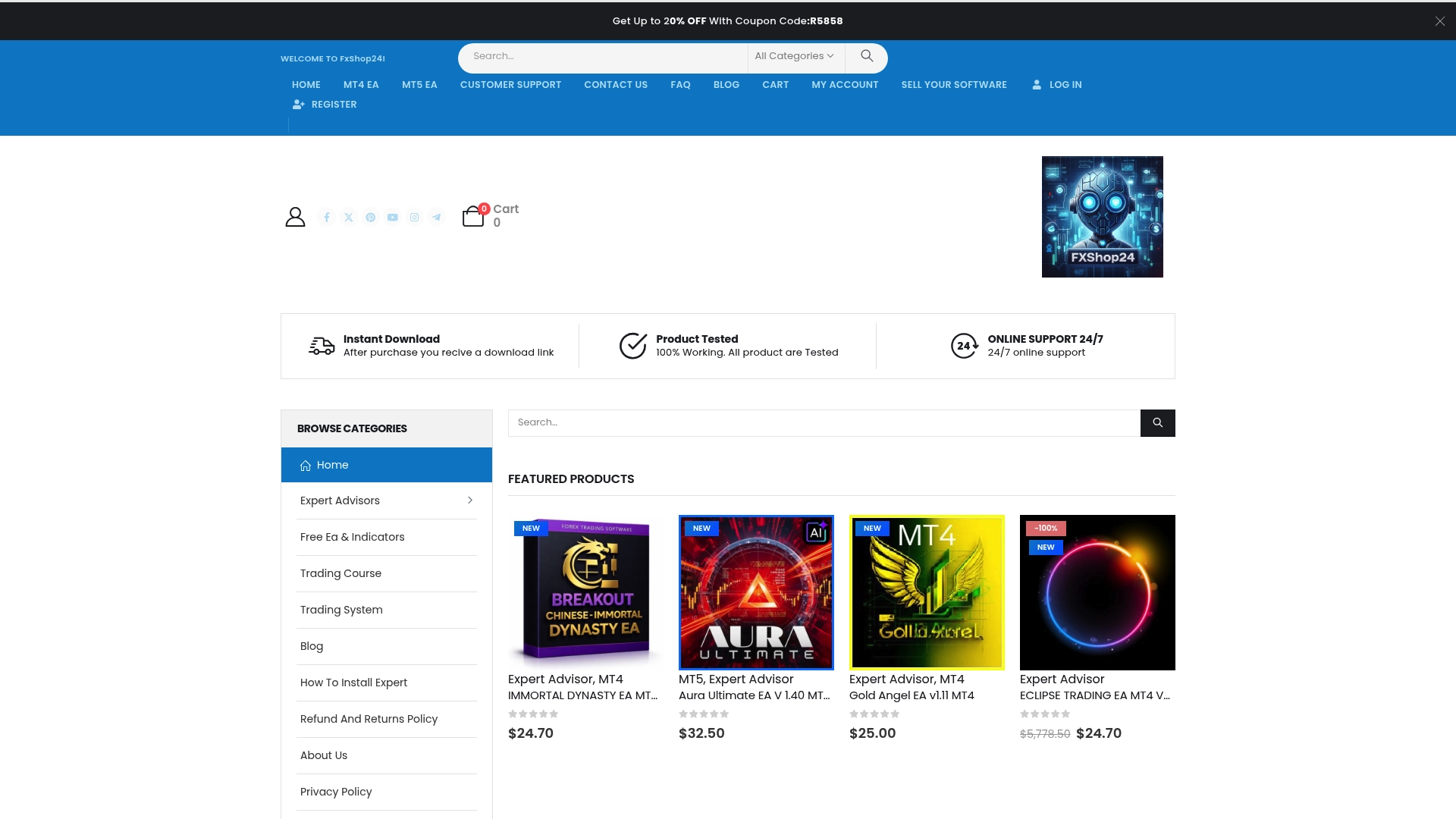
Take control of your trading journey today with proven, prop firm-ready automated solutions from FxShop24. Gain immediate access to expertly crafted forex robots designed for MT4 and MT5 platforms that help you:
- Automate complex strategies such as grid trading and news trading
- Minimize risk with built-in money management
- Benefit from lifetime updates and unlimited license use
Don’t wait for volatility to work against you. Visit FxShop24 now and choose from a wide range of expert advisors and premium trading systems to elevate your trading performance starting today.
Frequently Asked Questions
What are trend-following forex robots?
Trend-following forex robots are automated systems designed to identify and capitalize on ongoing market trends. To employ one, make sure to backtest its performance using historical data to assess its reliability.
How do scalping robots work in forex trading?
Scalping robots execute numerous trades in very short periods to capture small price movements. Consider using a scalping robot during times of high volatility to maximize the frequency of trades and profit opportunities.
What is grid trading in forex robots?
Grid trading robots create a series of buy and sell orders at set price intervals to profit from market fluctuations. Set your trading parameters carefully and adjust your grid spacing according to market volatility to enhance effectiveness.
What are the risks associated with Martingale robots?
Martingale robots increase trade sizes after a losing position, which can result in significant financial risks if not managed properly. Establish strict maximum drawdown limits to protect your trading capital when using this strategy.
How do AI-powered forex robots improve trading strategies?
AI-powered forex robots use machine learning to analyze massive amounts of data and adapt their trading strategies in real-time. Regularly evaluate their performance metrics to ensure they remain effective over time.
What should I consider when using news trading robots?
News trading robots capitalize on market volatility triggered by economic announcements. Configure their risk management settings to minimize losses during unexpected market swings, and validate their performance with thorough backtesting.
Recommended
- Stop Losing Money: 10 Forex Trading Bot Mistakes That Kill Accounts (And How To Fix Them) | FxShop24 Marketplace
- Comparing Grid, DCA, And Arbitrage Bots: Which One’s For You? | FxShop24 Marketplace
- Are Forex Trading Bots Dead? Do People Still Pass Prop Firm Challenges With EAs? | FxShop24 Marketplace
- How To Choose The Best Forex Robot For Your Trading Style | FxShop24 Marketplace