
30
Jun
Gold Trend Bot Strategy: A Complete 2026 Guide
TL;DR:
- A gold trend bot strategy is automated software that identifies market trends using technical indicators to execute trades on XAUUSD. It works effectively during risk-off events by following macroeconomic-driven breakouts, with success depending on proper indicator selection, session timing, and risk management. Using simple indicator combinations and strict filters improves performance, while active oversight and broker choice are essential for long-term profitability.
A gold trend bot strategy is defined as automated software that executes trades on gold (XAUUSD) by detecting and following directional market trends through technical indicator filters. Unlike manual trading, these systems run 24 hours a day and remove emotional decision-making from every entry and exit. The standard industry term for this approach is a trend-following expert advisor (EA), and understanding what separates a profitable one from a losing one comes down to three things: indicator selection, session timing, and volatility-tuned risk management. Traders who treat gold like a standard forex pair consistently underperform. Gold’s sharp reactions to macroeconomic news and its frequent false breakouts demand a purpose-built approach that most generic bots simply cannot handle.
What is gold trend bot strategy and how does it work?
A gold trend bot strategy is automated software that executes trades on XAUUSD based on market trend signals and carefully filtered criteria. The bot scans price data continuously, waits for a confirmed trend signal, and places a trade only when multiple conditions align. That multi-condition requirement is what separates a professional setup from a basic script.

The core logic works in layers. First, the bot identifies the dominant trend direction using exponential moving averages (EMAs). Second, it confirms momentum with a secondary indicator like RSI. Third, it checks whether current market conditions, including session timing and volatility level, meet the minimum threshold for a valid entry. Only when all layers agree does the bot place a trade.
Gold trends strongly during risk-off events and central bank decisions, with breakout momentum frequently driving sustained directional moves that bots can automate effectively. This macro behavior is exactly why trend-following logic suits gold better than mean-reversion approaches. The market moves hard in one direction, and a well-built bot rides that move without hesitation.
Broker selection is a non-negotiable part of the setup. Successful configurations require broker spreads under 20 cents (2 pips) plus commissions to remain profitable. Even a slightly wider spread erodes the thin margins that trend bots depend on across hundreds of trades.
How does a gold trend bot identify and follow trends?
Gold trend bots rely on a small set of proven indicators rather than a large collection of overlapping signals. The most common combination uses EMA crossovers, RSI thresholds, and Bollinger Bands to confirm trend direction and entry timing.
The key indicators used in most gold trading bot strategies include:
- EMA crossovers (12/26 for short-term signals, 50/200 for long-term trend direction) confirm when momentum shifts in a clear direction.
- RSI thresholds (typically 50–70 for longs, 30–50 for shorts) filter out entries that go against the dominant trend.
- Bollinger Bands identify periods of price compression before breakouts, giving the bot an early warning of a potential trend move.
- Session filters restrict trading to the London and New York overlap, when gold liquidity and volatility peak.
- Higher-timeframe confirmation requires the H1 chart to agree with the M15 entry signal before any trade is placed.
Filtering trades to the London-New York overlap improves win rate by 12% on average. That single filter alone is worth adding to any gold trading automated strategy.
Pro Tip: Set your EMA periods based on the timeframe you trade. A 50/200 EMA crossover on the H1 chart gives a reliable trend bias. Then drop to M15 for your actual entry trigger. This two-step confirmation cuts false signals significantly.
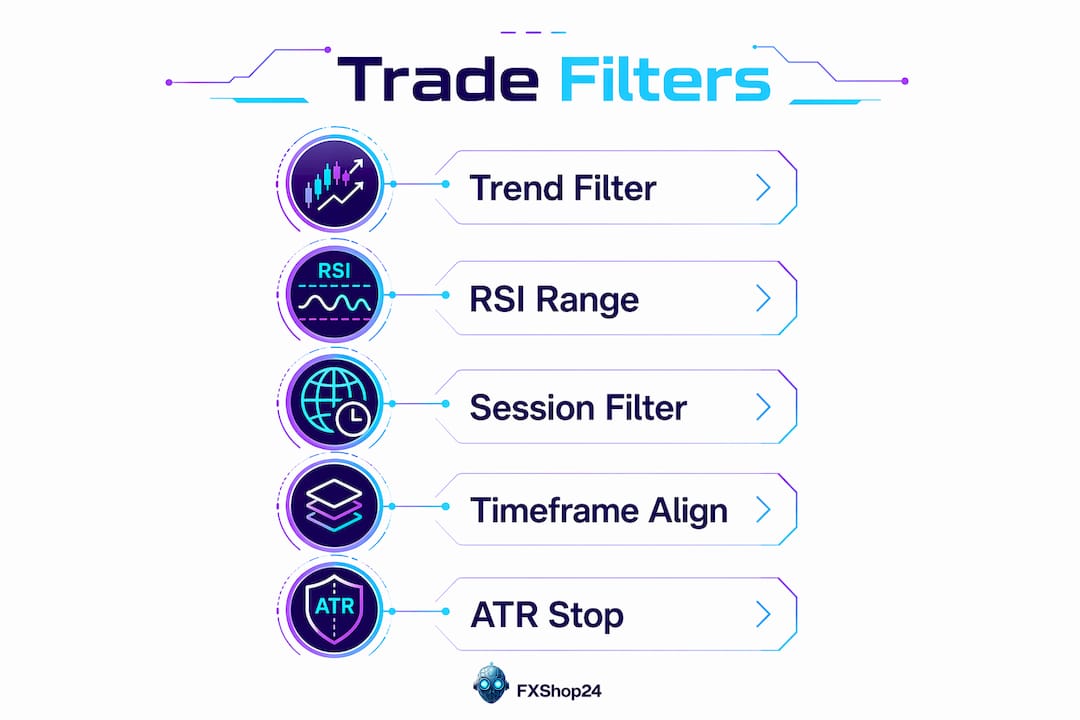
Higher-timeframe trend confirmation is the most underused filter in retail gold bots. Most traders set up their bot on a single timeframe and wonder why it keeps getting chopped up in ranging markets. Requiring the H1 trend to align with the M15 entry is the single fastest way to improve signal quality.
What risk management techniques do gold trend bots use?
Gold requires volatility-tuned risk management that is distinct from forex pairs due to its frequent false breakouts and sharp reactions to macroeconomic news. A bot that works on EUR/USD will often fail on XAUUSD because the position sizing and stop logic are calibrated for a calmer market. Gold moves differently, and the risk model must reflect that.
The four core risk management techniques used in professional gold trend bots are:
ATR-based dynamic position sizing. Dynamic position sizing based on ATR adjusts trade exposure according to current volatility, scaling down during high-volatility periods and increasing during calm trends. This protects the account from outsized losses when gold spikes unexpectedly.
ATR-based trailing stops. Partial take-profits cap winners prematurely and degrade the risk-reward ratio. Trailing stops tied to ATR let the bot stay in a trade as long as the trend holds, capturing the full move rather than exiting early.
Maximum drawdown limits. Professional bots include a hard drawdown ceiling, typically set as a percentage of account equity. When that ceiling is hit, the bot pauses trading automatically. This rule prevents a bad run from becoming a catastrophic loss.
News event filters. Gold reacts violently to Federal Reserve decisions, CPI releases, and geopolitical events. A well-built bot includes a news filter that suspends trading in the 30 minutes before and after major scheduled releases.
Pro Tip: Set your ATR multiplier for trailing stops at 1.5x to 2x the current ATR value on the H1 chart. This gives the trade enough room to breathe without giving back too much profit when gold pulls back.
The combination of ATR-based sizing and trailing stops is what allows high-performing gold bots to target strong annual returns. The ATR adapts the bot to current conditions rather than forcing a fixed risk model onto a market that changes character constantly.
Common pitfalls and misconceptions in gold trend bot strategies
The most damaging misconception in gold trend bot strategy design is that more indicators equal better performance. Using just 3 core indicators, specifically price, EMA, and ATR, in a simple trend-following logic outperforms complex systems that layer many correlated filters. Complex systems overfit to historical data and collapse during live trading.
The most common mistakes traders make with gold trend bots include:
- Treating gold like a standard forex pair. Gold’s market behavior is unique. Its volatility profile, reaction to news, and tendency to produce false breakouts require a volatility-tuned risk model that standard forex bots do not include.
- Using partial take-profits. Taking partial profits sounds conservative, but it consistently caps winners and ruins the risk-reward ratio over a large sample of trades. Trailing stops do the job better.
- Ignoring session timing. Running a gold bot around the clock without session filters exposes it to low-liquidity periods where spreads widen and false signals multiply.
- Skipping volatility filters. Entering trades during extreme volatility events, such as surprise rate decisions, produces losses that wipe out weeks of gains.
- Over-optimizing on backtests. A bot that produces a perfect backtest curve has almost always been curve-fitted to past data. Real performance requires out-of-sample testing on data the bot has never seen.
The role of indicators in trading is to confirm what price is already telling you, not to predict the future. Traders who forget that principle keep adding indicators until the system is too complex to function reliably.
How to practically use and optimize a gold trend bot strategy
Putting a gold trading bot strategy into practice requires decisions in four areas: broker selection, parameter tuning, session timing, and ongoing management.
| Parameter | Recommended Setting | Why It Matters |
|---|---|---|
| Broker spread | Under 20 cents (2 pips) | Wider spreads erode thin trend-bot margins |
| EMA periods | 12/26 (short), 50/200 (long) | Captures both short and long-term trend shifts |
| RSI range | 50–70 (long), 30–50 (short) | Filters counter-trend entries |
| ATR multiplier | 1.5x–2x for trailing stops | Adapts exits to current volatility |
| Trading session | London-New York overlap | Highest liquidity and cleanest signals |
ECN or raw spread brokers averaging 5–15 cents plus commission are the right choice for gold bot profitability. Randomly high spreads erode performance quickly, and no amount of parameter tuning compensates for a bad broker.
Parameter tuning should follow a structured process. Start with default EMA and ATR settings, run a backtest on at least 12 months of data, then adjust one variable at a time. Never change two parameters simultaneously. That discipline makes it clear which adjustment actually improved performance.
Pro Tip: Before going live, run your bot on a demo account for at least 4 weeks during the same market conditions you expect to trade. A bot that performs well in a trending market may fail badly in a ranging one. Confirm it handles both.
Active management beats the set-and-forget approach for gold bots. Gold’s character changes with macro regimes. A bot tuned for a trending market needs its session filters and ATR settings reviewed when the market shifts to range-bound behavior. Check your bot’s performance weekly, not monthly. You can learn more about automating gold on MT4 and MT5 to set up these parameters correctly from the start.
What are multi-layered filters and how do they improve performance?
Multi-layered filters are a set of independent conditions that must all be true before a gold trend bot places a trade. The concept is straightforward: each filter removes a category of low-probability trades. Stack enough filters together and the bot only trades when conditions are genuinely favorable.
Multi-layered filters requiring higher-timeframe confirmation can eliminate roughly 30–40% of losing trades without sacrificing profitable ones. That is a significant improvement in trade quality from a relatively simple addition to the bot’s logic.
The standard layered filter stack for a gold trend bot looks like this:
| Filter type | Example condition | What it removes |
|---|---|---|
| Trend filter | H1 EMA 50/200 aligned | Counter-trend entries |
| Momentum filter | RSI between 50–70 | Weak or exhausted moves |
| Volatility filter | ATR within normal range | Extreme spike entries |
| Session filter | London-New York overlap only | Low-liquidity false signals |
| Price structure filter | Price above/below key EMA on M15 | Choppy, directionless entries |
High-performing gold bots combine EMA crossovers, RSI ranges, and session filters to filter entries and target strong annual returns. Each filter works independently, which means they do not create the correlated noise problem that plagues bots with too many overlapping indicators.
The multi-timeframe approach, specifically requiring H1 trend alignment before acting on M15 entries, is the most effective single filter a trader can add. It forces the bot to trade with the larger trend rather than against it, which is where the real edge in gold trend trading techniques lives. For a deeper look at how reliable trade signals are constructed using these filters, the principles apply directly to gold bot configuration.
Key Takeaways
A gold trend bot strategy works because it combines EMA-based trend detection, ATR-driven risk management, and session timing filters to trade XAUUSD with a defined, repeatable edge.
| Point | Details |
|---|---|
| Broker spread is non-negotiable | Use ECN brokers with spreads under 20 cents to protect thin trend-bot margins. |
| ATR drives both sizing and exits | Dynamic ATR position sizing and ATR trailing stops adapt the bot to gold’s volatility. |
| Fewer indicators outperform more | Price, EMA, and ATR in simple logic beat complex multi-indicator systems in live trading. |
| Session filters add measurable edge | Restricting trades to the London-New York overlap improves win rate by 12% on average. |
| Multi-layered filters cut losing trades | Higher-timeframe confirmation eliminates 30–40% of losing entries without reducing winners. |
What I’ve learned from watching gold bots succeed and fail
Most traders who struggle with gold trend bots make the same mistake: they build complexity into the system when the market punishes them, instead of questioning whether their filters are actually independent. I’ve seen setups with eight indicators that all measure the same thing in slightly different ways. The backtest looks great. Live trading destroys the account within three months.
The bots that hold up over time share one quality: they are simple enough to explain in two sentences. EMA confirms the trend. ATR sizes the position and trails the stop. Everything else is noise reduction, not signal generation.
The other lesson that took time to learn is that gold is not a forex pair with a different symbol. Its relationship to the dollar, central bank demand, and geopolitical risk creates price behavior that no EUR/USD-tuned bot can handle. Traders who accept that gold needs its own logic, its own risk model, and its own session rules consistently outperform those who copy-paste a forex EA onto XAUUSD.
Automation does not mean abandonment. The best gold trend bot traders I’ve observed check their systems weekly, adjust ATR multipliers when volatility regimes shift, and pause the bot ahead of major central bank events. That active oversight is what separates a sustainable automated strategy from one that eventually blows up.
— Fxshop24
Gold trend bot tools available at Fxshop24
Fxshop24 offers a curated selection of expert advisors and automated trading systems built specifically for gold and forex markets on MT4 and MT5.
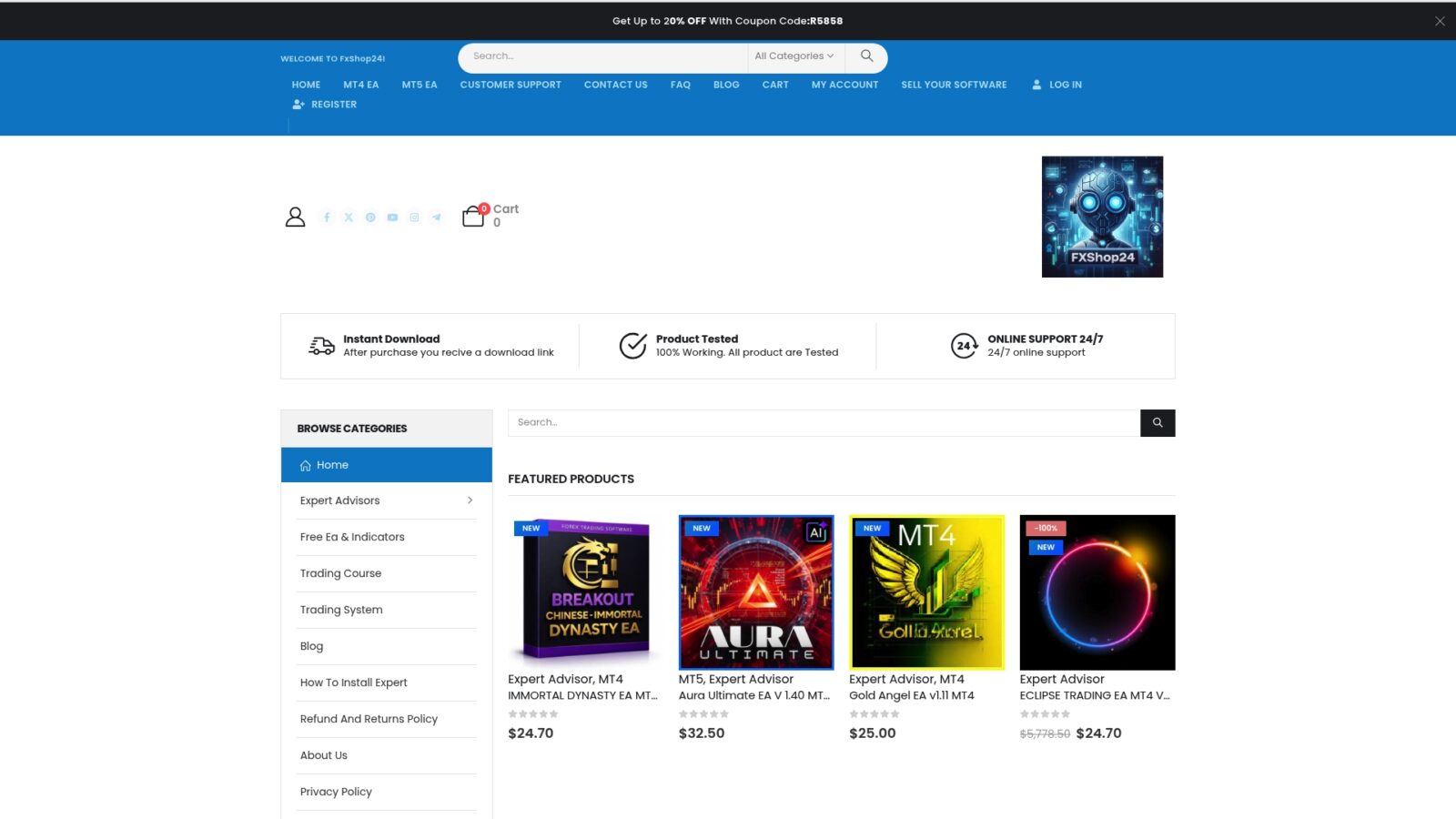
Traders looking to put a gold trend bot strategy into practice can browse the automated trading systems catalog at Fxshop24, which includes trend-following EAs, AI-powered gold bots, and prop firm-ready systems with lifetime updates. Each product comes with installation guidance and detailed performance documentation. For traders who want to understand the broader ecosystem before buying, Fxshop24’s gold trading system tips resource covers indicator selection, parameter tuning, and strategy optimization in practical detail. Professional-grade tools are available for immediate download, with support for both retail traders and prop firm participants.
FAQ
What is a gold trend bot strategy?
A gold trend bot strategy is automated software that trades XAUUSD by detecting directional market trends through technical indicators like EMA crossovers, RSI, and ATR-based filters. It executes trades only when multiple conditions confirm a valid trend entry.
What indicators do gold trend bots use?
Most gold trend bots use EMA crossovers (12/26 or 50/200), RSI thresholds, and ATR for position sizing and trailing stops. Session filters restricting trades to the London-New York overlap are also standard in professional setups.
Why does gold need a different bot strategy than forex?
Gold exhibits unique volatility driven by macroeconomic events, central bank decisions, and geopolitical risk. Standard forex bots fail on XAUUSD because they lack the volatility-tuned risk models and session filters that gold’s market behavior requires.
How do multi-layered filters improve gold bot performance?
Multi-layered filters require several independent conditions to align before a trade is placed. This approach eliminates roughly 30–40% of losing trades without reducing the number of profitable entries.
What broker spread do I need for a gold trend bot?
ECN or raw spread brokers averaging 5–15 cents plus commission are the minimum requirement for gold bot profitability. Spreads above 20 cents erode margins quickly and make most trend-following setups unprofitable over time.