



6
Jun
Industry Gold Trading Terms: the Trader’s Glossary
TL;DR:
- Gold trading terms specify how the mechanisms, products, and contractual language govern transactions across markets, influencing costs and risks. Understanding allocations, documentation, Incoterms, and instruments is essential for effective risk management and operational clarity in gold trading. Mastery of this terminology enhances trading precision, reduces operational errors, and provides a competitive edge in the gold market.
Industry gold trading terms are the specialized vocabulary describing the mechanisms, products, and contractual language that govern how gold is bought, sold, and settled across global markets. Whether you trade spot XAU/USD on MetaTrader 5, hold a futures position on COMEX, or source physical bullion through the London OTC market, every transaction is shaped by precise terminology. Misread a contract clause or misunderstand an Incoterm, and you absorb costs or risks you never agreed to carry. This glossary cuts through the complexity so you can trade with clarity and confidence.
What are the core industry gold trading terms you need to know?
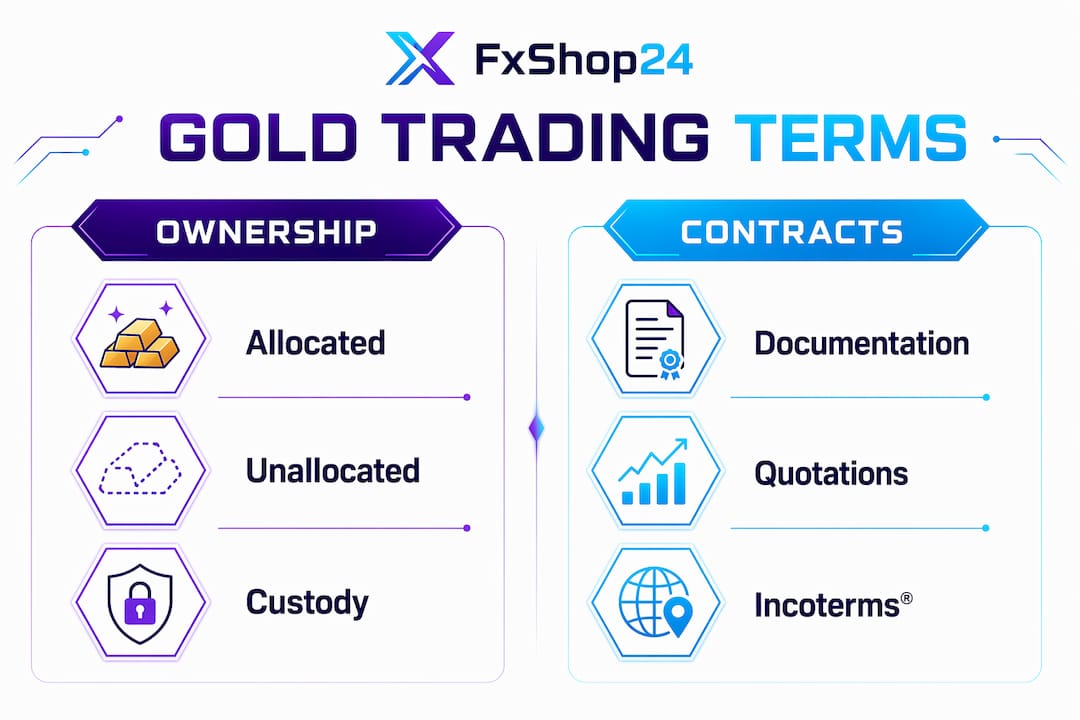
Gold market terminology divides into four practical categories: ownership and custody terms, contract and documentation terms, logistics and risk-transfer terms, and instrument-specific terms. The LBMA (London Bullion Market Association) sets the benchmark for most professional gold trading language, and understanding its framework is the fastest way to build fluency across all four categories. Traders who skip this foundation routinely misread counterparty exposure, settlement obligations, and delivery conditions.
What are allocated and unallocated gold, and why do they matter?
Allocated gold is physical ownership of specific, bar-identified metal held in a vault on your behalf. Each bar carries a unique serial number, refiner stamp, and weight, and both your supply contract and custody contract must reference those same bars. Allocated gold ownership depends on tightly paired custody and supply contracts identifying metal at bar level. If either document is loose or mismatched, your legal claim reverts to something far weaker.

Unallocated gold is a credit claim, not physical ownership. You hold a fine-ounce balance against a bullion bank’s pooled metal, which means your exposure tracks the institution’s solvency as much as the gold price. Unallocated accounts are the default in London OTC gold trading because they allow transactions in round dollar amounts unconstrained by individual bar weights. That operational convenience comes with a real cost: counterparty risk.
The practical difference matters enormously for risk management:
- Allocated account: You own specific bars. In a bank insolvency, your metal is segregated from the bank’s estate.
- Unallocated account: You are an unsecured creditor. Your claim ranks alongside other general creditors if the institution fails.
- Switching between the two: Moving from unallocated to allocated triggers custody fees and requires contract documentation identifying specific bars.
- London OTC clearing: Clearing banks including HSBC, UBS, and JP Morgan use the AURUM electronic clearing system to net settle vast daily unallocated transactions in physical gold.
Pro Tip: If you are holding gold as a long-term reserve rather than a trading position, request an allocated account and verify that both your supply and custody contracts reference the same bar serial numbers. One mismatched document can eliminate the legal separation you paid for.
How are gold trading contracts and quotations structured?
Every professional gold transaction follows a sequenced documentation chain. Gold trade documentation includes a transactable quote with a price formula and validity window, a formal offer, and a purchase agreement outlining all obligations. Each document builds on the last, creating a controlled evidence chain that protects both parties in an audit or dispute.
The sequence works as follows:
- Transactable quote: States the price formula, quantity, and a validity window during which the buyer can accept. Treat this window as an operational risk control, not a formality. Prices move fast, and an expired quote accepted in error creates immediate pricing disputes.
- Offer and acceptance: Formalizes the commitment. Once both parties sign, the commercial terms are locked.
- Purchase agreement: Details delivery obligations, payment schedule, and title transfer conditions.
- Invoice and MT103 payment confirmation: The MT103 is the SWIFT payment message confirming funds transfer. It serves as the primary payment evidence in any post-trade audit.
- Allocation records and delivery dossier: These documents prove title at bar level and establish the chain of custody from refinery to vault to buyer.
Clear documentation sequencing is not bureaucratic overhead. Sequenced documents provide a controlled evidence chain that is crucial for audit compliance and operational risk control. A missing allocation record or an unsigned purchase agreement can stall settlement for weeks and expose you to legal liability.
What are the main Incoterms® used in gold trading?
Incoterms® 2020 define exactly where risk and cost transfer from seller to buyer in a physical gold shipment. Incoterms® 2020 define risk-transfer points and transport insurance responsibilities that are critical for gold shipment contracts. Choosing the wrong term for your transport mode is one of the most common and expensive mistakes in physical gold trade.
| Incoterm | Risk transfers at | Seller pays freight? | Seller pays insurance? | Best suited for |
|---|---|---|---|---|
| FOB (Free on Board) | Loading onboard vessel | No | No | Sea/inland waterway |
| CIF (Cost, Insurance, Freight) | Loading onboard vessel | Yes | Yes (minimum, ICC C) | Sea/inland waterway |
| FCA (Free Carrier) | Handover to buyer’s carrier | No | No | Multimodal/container |
| CIP (Carriage and Insurance Paid) | Handover to carrier | Yes | Yes (higher, ICC A) | Multimodal/container |
FOB and CIF both transfer risk at the point of loading onboard a vessel, but CIF requires the seller to arrange and pay for freight plus minimum insurance under Institute Cargo Clauses C. CIF sounds more protective, but ICC C covers only major perils. For high-value gold shipments, buyers often prefer FOB and arrange their own broader coverage under ICC A.
FCA is the preferred term for containerized gold shipments. A key update in Incoterms® 2020 option A6(b)/B6(b) now allows the buyer’s carrier to issue an onboard bill of lading to the seller, closing a long-standing gap in letter-of-credit documentation for containerized trade.
Pro Tip: Never use FOB for containerized gold. Risk transfers at the port railing, but your container may sit in a terminal for days before loading. Use FCA instead, which transfers risk when the carrier takes possession, giving you cleaner insurance coverage and documentation.
What are the main instruments and terminology used in gold markets?
Gold trading instruments each carry their own vocabulary. Gold trading instruments include spot/OTC, futures, ETFs, and CFDs, each with distinct delivery, leverage, and fee structures. Knowing which instrument you are trading determines which terms apply to your position.
Spot gold (XAU/USD) is the price for immediate delivery, typically settled within two business days in the OTC market. The spread is the difference between the bid and ask price, and it is your immediate cost of entry. In the London OTC market, spot gold is quoted in US dollars per troy ounce.
Futures contracts trade on exchanges like COMEX and carry expiration dates. Key terms include:
- Rollover: Closing a near-month contract and opening the next to maintain exposure without taking delivery.
- Contango: When futures prices are higher than spot, reflecting storage and financing costs.
- Backwardation: When futures prices are below spot, often signaling tight physical supply.
- Tick size: The minimum price movement for a contract, which on COMEX gold futures is $0.10 per troy ounce.
Gold ETFs like SPDR Gold Shares (GLD) hold physical gold and trade on stock exchanges. The premium or discount to net asset value (NAV) tells you whether the ETF is trading above or below the value of its underlying gold holdings. A persistent premium signals strong demand; a discount can indicate redemption pressure.
CFDs (Contracts for Difference) offer leveraged exposure to gold prices without physical delivery. CFDs allow long and short positions without physical holding, making them the instrument of choice for short-term traders on MT4 and MT5 platforms. Key CFD terms include margin (the deposit required to open a position), leverage ratio, and overnight swap (the financing cost for holding a leveraged position past the daily close).
| Instrument | Delivery | Leverage | Key term |
|---|---|---|---|
| Spot OTC | T+2 | Varies by broker | Spread |
| Futures (COMEX) | Contract expiry | Exchange-set margin | Rollover / contango |
| ETF (GLD) | None (equity) | None (unleveraged) | NAV premium/discount |
| CFD (MT4/MT5) | None | Up to 500:1 | Margin / swap |
How do traders apply these terms to manage risk and optimize trades?
Mastering gold market terminology only pays off when you apply it systematically inside your trading workflow. Here is how professionals integrate these concepts:
Match your account type to your risk profile. If you are holding physical gold as a reserve asset, use an allocated account and verify bar-level documentation. If you are trading for liquidity and price exposure, an unallocated account or CFD is operationally simpler, but price your counterparty risk accordingly.
Treat validity windows as hard deadlines. Traders should treat quotation validity windows as critical operational risk controls affecting timing and pricing certainty. Set calendar alerts and never accept a quote after expiry without requesting a fresh one.
Select Incoterms before finalizing contracts. Incoterm choices significantly affect cost-risk allocation. Confirm your transport mode first, then choose the term that aligns risk transfer with your insurance coverage. Mismatched terms create gaps where neither party’s insurer will pay.
Know your instrument’s rollover mechanics. Futures traders who miss a rollover date can face physical delivery obligations on COMEX. Set alerts for first notice day, which is the first day a futures seller can notify the exchange of intent to deliver.
Audit your documentation chain before settlement. Confirm that your allocation records, MT103 confirmation, and delivery dossier are complete and cross-referenced. A controlled evidence chain is your primary defense in any post-trade dispute.
Use clearing structure knowledge to assess settlement risk. Non-member participants access London Good Delivery clearing indirectly through clearing members holding unallocated accounts. Understanding this structure tells you exactly where your settlement risk sits in the chain.
Pro Tip: Build a personal gold trading glossary document that maps each term to the specific contract clause or platform setting where it appears. When you see “contango” in a broker report, you should be able to link it directly to your rollover cost calculation in seconds.
For deeper guidance on automating your gold trading workflow, integrating these terms into a systematic process reduces execution errors significantly.
Key takeaways
Mastering industry gold trading terms requires understanding allocated versus unallocated ownership, documentation sequencing, Incoterms® 2020 risk-transfer points, and instrument-specific vocabulary before placing a single trade.
| Point | Details |
|---|---|
| Allocated vs. unallocated gold | Allocated means bar-level ownership; unallocated is a credit claim with counterparty risk. |
| Documentation sequencing | Quote, offer, agreement, MT103, and allocation records form a legally defensible evidence chain. |
| Incoterms® selection | Match the Incoterm to your transport mode; FOB does not suit containerized gold shipments. |
| Instrument vocabulary | Spot, futures, ETFs, and CFDs each carry distinct terms for delivery, leverage, and settlement. |
| Validity windows | Treat quote validity windows as hard operational deadlines, not administrative formalities. |
Why terminology mastery is the edge most traders overlook
At Fxshop24, we work with traders across the full spectrum, from retail CFD traders running expert advisors on MT5 to institutional buyers sourcing allocated bullion. The pattern we see repeatedly is this: traders spend months refining their entry signals and almost no time on the contractual and operational language that governs what actually happens when a trade settles.
The risk is not abstract. An unallocated account holder who assumes they own physical gold is carrying credit exposure they have not priced. A trader who uses CIF on a containerized shipment has an insurance gap they may not discover until a claim is denied. A futures trader who does not understand first notice day can receive a delivery obligation on a contract they intended to roll.
The good news is that terminology mastery compounds quickly. Once you understand the allocated versus unallocated distinction, every conversation with a bullion bank becomes more precise. Once you know your Incoterms, every physical trade contract takes minutes to review instead of hours. We recommend pairing this glossary work with hands-on platform practice on MT4 or MT5, where you can see terms like spread, swap, and margin expressed in real numbers on live positions. Theory and practice reinforce each other faster than either does alone.
— FxShop24
Take your gold trading further with Fxshop24
Understanding gold trading definitions is the foundation. Executing on them with speed and precision is where automated tools earn their place.
Fxshop24 offers expert advisors and automated futures trading systems built specifically for gold and forex markets on MT4 and MT5. These tools handle rollover management, position sizing, and risk controls so your strategy executes consistently, even when you are away from the screen. Every EA comes with lifetime updates, unlimited licenses, and prop firm compatibility. If you are ready to move from understanding gold market terminology to trading it systematically, browse the Fxshop24 marketplace and find the tool that fits your style. You can also explore trading software options to match your platform setup.
FAQ
What is the difference between allocated and unallocated gold?
Allocated gold means you own specific, bar-identified physical metal held in custody on your behalf. Unallocated gold is a credit claim on a bullion bank’s pooled metal, making you an unsecured creditor rather than a direct owner.
What does XAU/USD mean in gold trading?
XAU/USD is the standard currency pair notation for spot gold priced in US dollars per troy ounce. XAU is the ISO 4217 currency code for gold, and it is the primary symbol used on MT4, MT5, and most OTC trading platforms.
What is contango in gold futures trading?
Contango is a market condition where gold futures prices are higher than the current spot price, reflecting the cost of storage and financing over time. Traders holding long futures positions in contango pay a premium at each rollover.
What are Incoterms® and why do they matter for physical gold?
Incoterms® 2020 are standardized trade terms that define exactly where risk and cost transfer from seller to buyer in a physical shipment. Choosing the wrong Incoterm for your transport mode can create insurance gaps and unresolved liability in a gold delivery dispute.
What is an MT103 in a gold transaction?
An MT103 is a SWIFT payment message that confirms an international wire transfer has been executed. In gold trade documentation, it serves as the primary evidence of payment and is a required component of the post-trade settlement record.