



30
May
Why Use Proprietary Trading Systems for Forex and Gold
TL;DR:
- Proprietary trading systems are purpose-built automated platforms that enhance trading performance by removing emotional bias and enforcing strict risk rules. They provide speed, consistency, and scalability, especially benefiting forex and gold markets with high liquidity and volatility. These systems are accessible to retail traders through ready-made solutions, enabling professional-level automation without institutional budgets.
Most traders assume proprietary trading systems are reserved for hedge funds and institutional desks with million-dollar tech budgets. That assumption is wrong, and it’s costing retail and semi-professional traders real money. Understanding why use proprietary trading systems starts with recognizing what they actually are: purpose-built automated platforms that combine signal generation, execution, and risk enforcement into a single, coherent framework. In forex and gold markets specifically, where spreads, slippage, and volatility can destroy an otherwise sound strategy, these systems offer performance advantages that generic platforms simply cannot match.
Table of Contents
- Key takeaways
- Why use proprietary trading systems to improve performance
- Automation, risk management, and scaling
- Why forex and gold traders specifically benefit
- Proprietary systems versus other trading methods
- My take on proprietary systems for serious traders
- Take your trading further with Fxshop24
- FAQ
Key takeaways
| Point | Details |
|---|---|
| Performance edge over emotion | Systematic execution removes emotional bias, delivering consistent results across volatile forex and gold sessions. |
| Automation scales risk control | AI-native risk enforcement handles thousands of positions in real time, far beyond manual oversight capacity. |
| Cost-to-move ratio matters | Spread and slippage management in proprietary systems can turn marginal strategies into profitable ones. |
| Proprietary beats off-the-shelf | Custom-built systems offer superior backtesting depth, execution precision, and compliance readiness. |
| Accessible to serious retail traders | White-label and ready-made proprietary EAs make professional-grade automation available without institutional budgets. |
Why use proprietary trading systems to improve performance
The core benefits of proprietary trading come down to one thing: removing the variables that kill consistency. Human traders make dozens of micro-decisions each session. They second-guess entries, move stop-losses under pressure, and abandon strategies during drawdowns. A properly designed proprietary system does none of that.
Execution speed is a concrete advantage that compounds over time. In forex markets, a delay of even 50 milliseconds between signal and execution can mean the difference between filling at the intended price and absorbing several pips of slippage. Proprietary systems built on low-latency infrastructure eliminate that gap. Platforms like DolphinDB demonstrate this directly: their risk architecture reduces monitoring latency from minutes to milliseconds, which is the kind of responsiveness that separates profitable automated trading from costly manual guesswork.
The advantages of trading systems in volatile conditions are especially visible in gold (XAU/USD). Gold can swing 30 to 50 dollars in a single session during macro events. A systematic approach with pre-set rules handles that volatility mechanically. The system does not hesitate. It does not freeze. It executes according to logic that was validated before the trade was ever placed.
Key performance improvements proprietary systems deliver:
- Consistency: The same entry and exit rules apply at 3 a.m. as they do at the New York open, without fatigue or emotional drift.
- Backtesting depth: Strategies can be validated across years of historical data in hours, identifying which setups hold up across different market conditions.
- Execution precision: Orders execute at pre-defined conditions, with slippage controls built into the logic rather than left to chance.
- Multi-asset coordination: A single system can manage positions across EUR/USD, GBP/JPY, and XAU/USD simultaneously without cognitive overload.
Pro Tip: When evaluating any proprietary trading system, run it through at least three distinct market regimes in backtesting: a trending period, a ranging period, and a high-volatility event window. A strategy that only profits in trends will fail you half the time.
Research from the ATLAS performance framework makes a compelling point: strategy profitability depends more on the cost-to-move ratio than on raw signal quality. In other words, a mediocre signal on a low-cost instrument can outperform a brilliant signal on a high-cost one. Proprietary systems are built to account for this. They do not just fire signals. They factor in spread conditions, execution costs, and timing to assess whether a trade is actually worth taking.
Automation, risk management, and scaling
Manual risk management has a ceiling. Once a trader is managing more than a handful of open positions, the ability to monitor, adjust, and respond in real time collapses. Automation does not have that ceiling.
This is where AI-native risk platforms have changed the game for proprietary trading firms and serious retail traders alike. QuantSentry’s AI risk engine delivers consistent low-latency enforcement across thousands of accounts simultaneously, detecting abusive behaviors like copy trading and multi-accounting before payouts are processed. That level of automated oversight is simply not achievable through human monitoring.
“Risk systems should empower risk managers with configurable policy-driven tools rather than dictate risk decisions, preserving governance flexibility.” — KRM22 CEO, via John Lothian News
That quote captures something most traders miss when they think about automation. The goal is not to remove humans from risk decisions entirely. The goal is to enforce rules mechanically so that humans can focus on strategy and oversight rather than manually checking every position.
Proprietary systems with built-in automation offer several concrete risk advantages:
- Real-time drawdown monitoring: The system flags or closes positions the moment a defined loss threshold is breached.
- Position sizing enforcement: Every trade is automatically sized according to account risk parameters, preventing oversizing during high-confidence moments.
- Audit trail generation: Every decision the system makes is logged and traceable, which is critical for compliance and post-trade analysis.
The Meridian risk platform demonstrates why auditability matters: its architecture delivers immutable, reproducible outputs with full traceability, reducing disputes and speeding up issue resolution. For traders using proprietary systems at prop firms, that kind of audit-grade certainty protects against payout disputes and account terminations.
As you scale from one account to five or ten, manual oversight becomes impossible. Automation is what makes scaling viable without proportional increases in headcount or screen time.

Pro Tip: Before deploying any automated risk system, map out your maximum acceptable drawdown, daily loss limit, and position concentration caps. A system that cannot enforce specific numbers is just an expensive alert system.
Platforms like those reviewed at AI in forex risk management show how MT4 and MT5 environments can integrate these risk controls directly into expert advisors, making professional-grade enforcement accessible to individual traders.
Why forex and gold traders specifically benefit
Not all markets are created equal for algorithmic trading. Forex and gold have characteristics that make proprietary systems especially effective.
| Market factor | Impact on proprietary systems |
|---|---|
| 24-hour trading | Automation captures moves during off-hours when manual traders are asleep |
| High liquidity | Tighter spreads enable more frequent, lower-cost strategy execution |
| Volatility patterns | Systematic rules exploit recurring volatility windows like London open and NFP releases |
| Cost sensitivity | Small spread reductions significantly improve net profitability over hundreds of trades |
The cost-to-move ratio framework is particularly relevant here. In forex and precious metals, the difference between a 0.5 pip and a 1.5 pip average spread is not trivial over a high-frequency strategy. Proprietary systems are designed to route orders intelligently, evaluate live spread conditions before executing, and avoid trading during cost-unfavorable windows.
Algorithmic trading also handles regime adaptability better than most traders expect. A system built for trending markets does need explicit filters to avoid choppy conditions, but that logic can be coded and backtested. A human trader relies on intuition to make the same call, and intuition is inconsistent. Understanding proprietary trading advantages in this context means recognizing that the edge is not just in the signal. It is in the execution conditions around that signal.
Gold trading specifically benefits from automation because XAU/USD reacts sharply to macro catalysts: inflation data, Fed statements, geopolitical events. Proprietary systems can be programmed with news filters that halt trading during high-impact windows, protecting accounts from the kind of spike-and-reverse moves that wipe out manual traders who are watching the wrong screen.
Proprietary systems versus other trading methods
The comparison between systematic and discretionary trading is worth making directly, because traders often assume that experience and intuition should replace automation.
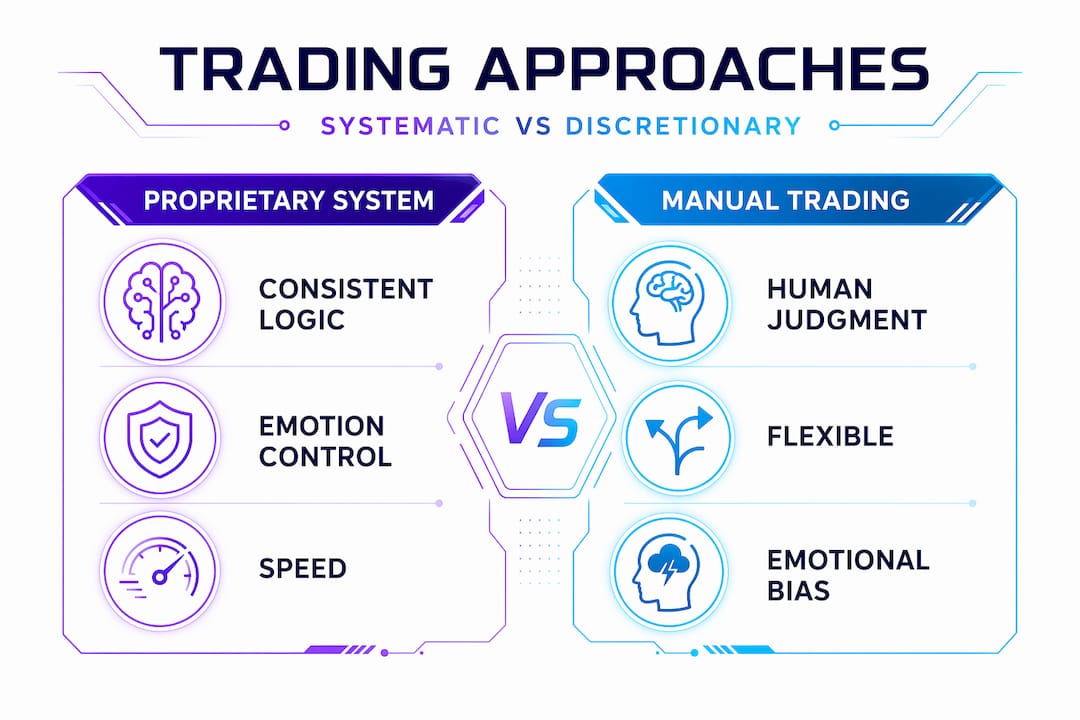
Systematic trading removes emotion and supports repeatable, backtested logic. Discretionary trading offers adaptability but sacrifices consistency. Combining both approaches with AI-assisted tools is where the real performance edge exists for modern traders.
Here is how proprietary systems stack up against conventional alternatives:
| Criteria | Proprietary system | Manual/discretionary trading |
|---|---|---|
| Emotional control | Full mechanical enforcement | Vulnerable to fear and greed |
| Execution speed | Millisecond-level | Limited by human reaction time |
| Scalability | Scales to multiple accounts | Degrades with account complexity |
| Backtesting | Rigorous historical validation | Relies on memory and selective recall |
| Risk enforcement | Automated, consistent | Dependent on trader discipline |
The one honest limitation of proprietary systems is overfitting. A strategy built on five years of historical data can still fail if market structure changes. The most effective traders address this by combining systematic and discretionary elements. They let the system handle execution and risk, while retaining human judgment for strategy selection and regime assessment.
White-label proprietary platforms can also save months of development time compared to building from scratch, which is why ready-made expert advisors on MT4 and MT5 have become the practical entry point for traders who want proprietary-level performance without a development team.
My take on proprietary systems for serious traders
I have watched a lot of traders make the same mistake. They build or buy a system with solid backtest results, then override it the moment it hits a three-trade losing streak. That is not a system problem. That is a trust problem, and it comes from not understanding what you are actually running.
In my experience, the traders who benefit most from proprietary systems are not the ones with the most sophisticated code. They are the ones who commit fully to the logic, monitor it honestly, and resist the urge to intervene during normal drawdown periods. The system’s edge is statistical. It plays out over hundreds of trades, not three.
What I have found particularly underestimated is the cost side of the equation. Traders obsess over win rate and ignore spread costs, commission drag, and slippage. A properly built proprietary system accounts for all of those at the strategy design stage. The risk-system auditability that modern platforms now offer makes it genuinely possible to trace where performance is leaking.
My honest advice: do not start with the most complex system available. Start with one pair, one timeframe, one clear edge. Let it run. Learn what it does under different conditions. Then scale. The temptation to run a dozen strategies simultaneously before you understand any of them is how traders blow accounts they should have grown.
— Fxshop24
Take your trading further with Fxshop24
If reading this has made you want to move from theory to action, Fxshop24 has the tools to get you there without the months of development time. The platform offers MT4 and MT5 expert advisors built for forex and gold trading, with prop-firm-ready risk parameters, lifetime updates, and unlimited licenses included.
Whether you are transitioning from manual trading or looking to replace an underperforming EA, the automated trading systems guide at Fxshop24 covers exactly what to look for in a proprietary system. You will also find detailed breakdowns of the trading software types used across forex and gold markets, so you can make an informed choice rather than a hopeful one. Instant download, real support, and tested performance data are included with every product.
FAQ
What is a proprietary trading system?
A proprietary trading system is a purpose-built automated platform that combines trade execution, signal generation, and risk enforcement into a single framework, used by traders or firms to trade their own capital with consistent, rule-based logic.
Why use proprietary trading systems instead of manual trading?
Proprietary systems remove emotional decision-making, enforce risk rules mechanically, and execute trades at speeds no human can match. For forex and gold traders, this translates directly into more consistent performance across volatile sessions.
How do proprietary trading systems manage risk automatically?
Modern systems use AI-native risk engines that monitor positions in real time, enforce drawdown limits, detect rule violations, and generate full audit trails. Platforms like QuantSentry demonstrate how automated abuse detection can protect margins without manual oversight.
Are proprietary trading systems suitable for retail forex traders?
Yes. Ready-made expert advisors on MT4 and MT5 bring proprietary-level automation to individual traders. White-label platforms have also reduced setup complexity significantly, making professional-grade tools accessible without institutional resources.
What makes forex and gold markets well-suited to algorithmic trading?
Both markets offer 24-hour liquidity, recurring volatility patterns, and cost structures where small spread improvements have a large cumulative impact on profitability. Proprietary systems can exploit these characteristics far more consistently than manual trading allows.