



23
May
Configuring Prop Firm Trading for Forex and Gold
TL;DR:
- Most traders fail prop firm challenges due to misconfiguration rather than poor strategy, emphasizing the importance of aligning platform settings with firm rules. Proper setup involves automating risk monitoring via EA, configuring account reset times, and selecting position sizes suited to volatility, especially for gold trading. Ensuring compliance through automated tools and matching trading style with firm rules significantly increases the likelihood of success in funded accounts.
Most traders who fail prop firm challenges don’t lose because of bad strategy. They lose because of misconfiguration. Configuring prop firm trading correctly means aligning your platform settings, risk parameters, and position sizing with the firm’s specific rules before you place a single live trade. Get one setting wrong and a single volatile candle on XAUUSD or EURUSD can breach your daily loss limit before you’ve had your morning coffee. This guide walks you through every step, from software setup to real-time compliance monitoring, with specific guidance for Forex and gold traders running MT5 accounts.
Table of Contents
- Key takeaways
- Configuring prop firm trading: what you need first
- Setting up MT5 for prop firm compliance
- Managing risk and position sizing for Forex and gold
- Troubleshooting compliance and maintaining consistency
- My honest take on prop firm configuration
- Tools from Fxshop24 to set up your prop trading right
- FAQ
Key takeaways
| Point | Details |
|---|---|
| Read firm rules first | Match your platform configuration to the firm’s daily loss limits and drawdown rules before trading. |
| Use equity-based monitoring | Track floating losses in real time by choosing equity over balance as your MT5 monitoring metric. |
| Size gold positions tightly | Limit XAUUSD to 0.2–0.5 lots per $50K to avoid volatility-triggered daily loss breaches. |
| Automate your risk limits | Use an Expert Advisor to auto-close positions and block new trades as thresholds are approached. |
| Match firm to your style | Choosing a firm whose rules fit your trading behavior dramatically improves your pass rate. |
Configuring prop firm trading: what you need first
Before you touch MT5 settings or load an Expert Advisor, you need to build your configuration on the right foundation. That starts with three things: the right software, the firm’s official rulebook, and a clear understanding of what the numbers actually mean.
On the software side, MT5 is the platform of choice for most prop firm traders. You will also want a dedicated risk management EA or plugin that can monitor equity in real time and automate rule enforcement. Without that layer, you are relying on manual discipline to catch limit breaches while also managing active trades. That is a recipe for failure.
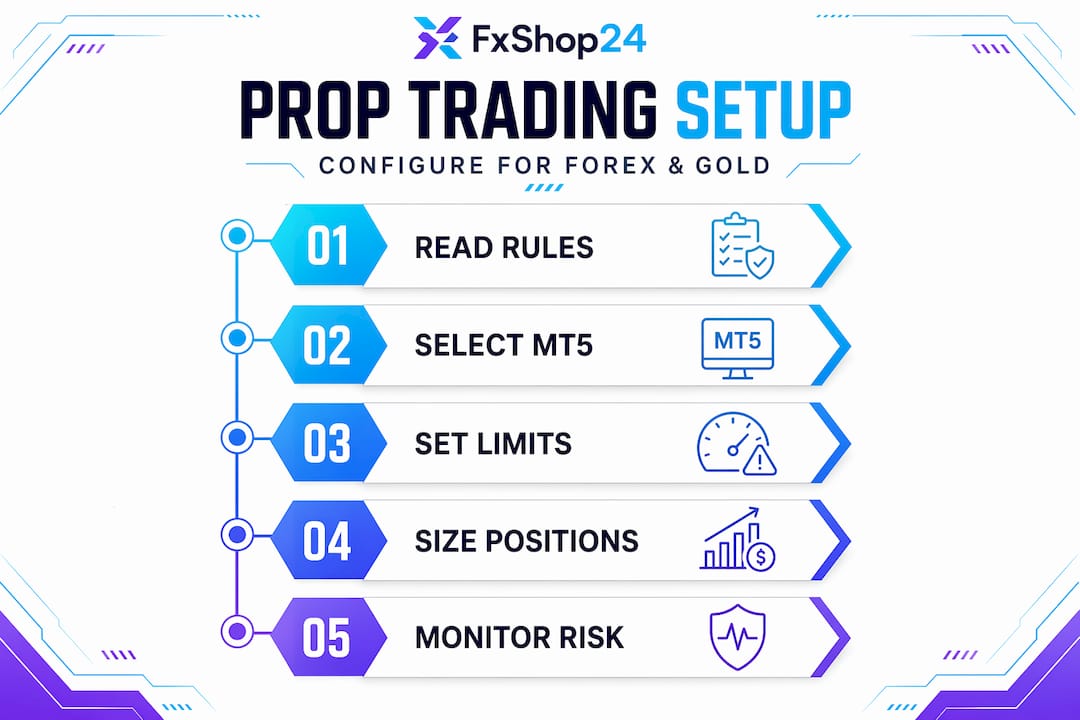
The firm’s rulebook is non-negotiable reading. Standard prop firm challenges require an 8 to 10% profit target in Phase 1 and 5% in Phase 2, with daily loss limits capped between 3% and 5%. Those percentages will directly determine every threshold you set inside your trading platform.
Here is a quick reference for what to gather before you start prop trading configuration:
- Account size and phase targets from your specific firm’s challenge page
- Daily loss limit type: Is it static (fixed dollar amount based on starting balance) or dynamic (recalculated against the prior day’s close)?
- Drawdown type: Maximum drawdown and whether it is trailing or static
- Reset time: The exact time the daily loss counter resets, often 5 PM EST or midnight GMT
- Restricted instruments or trading hours: Some firms prohibit news trading or limit overnight positions on gold
- Minimum trading days required per phase
Pro Tip: Most prop firms have no hard time limit on challenge phases but do require a minimum of 3 to 5 trading days per phase. Rushing to hit the profit target in two days often leads to oversizing and daily limit breaches.
Here is a reference table comparing common prop firm parameters and the tools typically used to configure for them:
| Parameter | Typical range | Configuration tool |
|---|---|---|
| Daily loss limit | 3% to 5% of account | Risk EA or MT5 alert |
| Max drawdown | 8% to 12% of account | Risk EA with equity floor |
| Trailing drawdown | Moves with highest equity | Trailing drawdown monitor |
| Profit target (Phase 1) | 8% to 10% | Performance tracker |
| Minimum trading days | 3 to 5 per phase | Trade journal |
Setting up MT5 for prop firm compliance
This is the core of your prop trading platform setup. MT5 is flexible enough to automate almost every compliance rule, but only if you configure it correctly from the start.
Follow these steps in order:
Set your daily loss reset time. Configure MT5 drawdown monitoring to reset at the firm’s official time, typically 5 PM EST. If your EA resets at midnight but the firm counts from 5 PM, your compliance window is off by seven hours and you could double-count losses.
Switch from balance-based to equity-based monitoring. Balance only shows closed P&L. Equity includes floating losses on open positions. If you have three open gold trades going against you, balance looks fine but equity is already breaching your limit. Always use equity.
Set your daily loss threshold with a buffer. If the daily loss limit is 5%, set your automated alert and close threshold at 4.5%. That 0.5% buffer absorbs slippage, spread, and commission costs on auto-close execution.
Configure maximum drawdown floors. Your maximum drawdown is separate from the daily limit. Set a second EA threshold that monitors cumulative equity drawdown from account peak and blocks all trading if it approaches the maximum allowed floor.
Add trailing drawdown logic. Trailing drawdown rules track your highest equity point and move the liquidation floor upward as profits grow. A risk EA that does not account for this will give you false safety readings as your account balance rises.
Load your compliance EA on every chart you trade. MT5 Expert Advisors can synchronize daily loss limits across all open charts, block new trade execution once thresholds are approached, and auto-close positions at 95% of the daily limit. This removes the possibility of a second trade opening while the first is already in drawdown.
Test everything on a demo account first. Run the exact scenario you are worried about. Open a gold trade, let it move 200 pips against you, and confirm the EA closes and blocks correctly before going live.
Pro Tip: Implementing a proper risk firewall in MT5 involves three distinct layers: the daily loss reset, the maximum drawdown floor, and the trailing drawdown ceiling. Treat them as separate configurations, not one combined threshold. Conflating them is one of the most common errors in prop trading configuration.
A common mistake traders make is using a general trading EA that lacks prop-firm-specific logic. Review the best prop firm EA criteria before committing to any automated tool for challenge compliance.
Managing risk and position sizing for Forex and gold
Risk management is where most traders fail at setting up prop trading, especially when they trade both Forex pairs and gold on the same funded account.
Gold (XAUUSD) is a different animal. The dollar-per-pip value on a standard gold lot is many times higher than on a typical Forex pair, and intraday moves of 30 to 50 dollars per ounce are common during New York and London overlap. Gold trading on a $50K prop account should be limited to 0.2 to 0.5 lots per trade to avoid triggering the daily loss limit on a single adverse move.
Here is how to think about the sizing interaction:
- A 5% daily loss limit on a $50K account means $2,500 is your maximum daily loss
- One standard lot of gold (100 oz) moves roughly $100 per dollar move in gold price
- A 25-dollar adverse move on 0.5 lots costs $1,250, which is 50% of your daily allowance from one trade
- Trading 1.0 lots in the same scenario costs $2,500, instantly hitting your limit with zero room for any other trades that day
For Forex pairs, the calculus is more forgiving but the principle is the same. Sizing for 1% risk per trade on a $50K account means risking $500 per position, which gives you five concurrent trades before the daily limit is threatened. Learn more about applying this framework with the 1% risk rule used by experienced prop traders.
| Instrument | Volatility risk | Recommended lot size ($50K) | Key caution |
|---|---|---|---|
| XAUUSD (Gold) | Very high | 0.2 to 0.5 lots | Avoid news windows |
| EURUSD | Moderate | 0.5 to 1.0 lots | Watch spread at open |
| GBPUSD | High | 0.3 to 0.8 lots | Volatile on UK data |
News events are where properly sized accounts still get blown. Economic releases like CPI, NFP, and FOMC decisions create spikes that can move gold 20 dollars in seconds. If you hold a position into one of these events, no amount of correct sizing will protect you from a gap through your stop. Close positions 30 minutes before scheduled high-impact news.
Consistency rules at many firms also penalize traders who make a large portion of their total profit in a single trade. Switching to a bi-weekly or monthly payout cycle can help gold traders avoid triggering these restrictions, since longer cycles allow profits to spread across more trading sessions.
Pro Tip: If you find yourself adjusting position size upward to recover losses faster, stop. That pattern is how emotional mistakes cause failures more than any technical misconfiguration. Predefined position sizing and automated damage limits remove the temptation.
Troubleshooting compliance and maintaining consistency
Even with a well-configured setup, live trading surfaces issues that demo testing never catches. Here is what to watch for.

Equity versus balance discrepancies are the most common source of confusion. Suppose you open a gold trade that immediately moves against you by $800. Your balance still shows the starting value, but your equity is already down $800. If your EA is monitoring balance only, it will not trigger. Always verify your monitoring is set to equity mode after every platform restart, since some EAs reset to default settings on MT5 updates.
Trailing drawdown breaches catch traders by surprise because the floor moves. A trailing drawdown works like this: if you start at $50K and grow to $55K, the drawdown floor rises with you. Now your floor might be at $48K rather than the original $45K. If you then give back $7K in losses, you breach the floor even though your current balance is still above the starting point. Monitor your trailing drawdown ceiling separately from your maximum drawdown, and update it in your EA settings after any significant profit run.
Watch for these specific warning signs during live trading:
- EA not triggering at the correct equity level after an MT5 update or restart
- Daily reset time shifting due to daylight saving time changes at the firm’s server location
- Spread widening during thin liquidity periods creating unexpected losses beyond your stop
- Overlapping open positions consuming more daily limit than your per-trade calculations anticipated
“The traders who pass funded challenges consistently are not the ones with the best entry signals. They are the ones who never breach a rule, because their system makes breaching nearly impossible.”
Automating MT5 compliance is not a shortcut. It is the floor-level requirement for anyone serious about funded trading. Manual oversight will always have gaps, and in volatile markets those gaps cost accounts.
For additional guidance on interpreting specific firm rules as an automated trader, prop firm rules decoded provides a structured breakdown that is especially useful when switching between firm types.
My honest take on prop firm configuration
Most traders treat platform configuration as a checkbox. They set the daily loss limit once, forget it, and focus on entries. That mindset is why so many funded accounts get pulled in the first week.
I’ve seen traders with genuinely profitable strategies lose funded accounts not because of bad trades, but because their risk EA was monitoring balance instead of equity. One big floating gold loss and the account is gone before the EA even notices. The configuration was technically in place. It just was not configured correctly.
My experience working with prop firm-ready EAs has taught me one thing above all else: automation is not about convenience. It is about eliminating the moments where emotion overrides discipline. Using predefined damage bands to reduce or halt trading automatically is not optional for most traders. It is the only reliable protection against the sequence of decisions that happens after a bad trade.
The other thing most guides will not tell you: choosing a firm whose rule set matches your style matters more than any configuration tweak. If you are a gold scalper who takes large short-term positions, a firm with a trailing drawdown model is going to work against you structurally. Static drawdown firms give scalpers more room to breathe. Get that match right before you spend time on setup.
Prop firm models are also changing. More firms are tightening consistency rules and adding volatility-based restrictions on gold during news events. The traders who will thrive are the ones who build adaptive configurations and update them as firm rules evolve.
— FxShop24
Tools from Fxshop24 to set up your prop trading right
If you have read this far, you know that prop trading configuration is not one-step setup. It requires the right EA, the right settings, and the right strategy for the instrument you are trading.
Fxshop24 offers a vetted selection of automated trading systems and Expert Advisors built specifically for MT4 and MT5 prop firm environments. Whether you are trading gold, major Forex pairs, or a combination of both, the automated trading systems catalog includes prop-firm-compatible EAs with lifetime updates and unlimited account licenses. You can also explore MT4 and MT5 trading tools tested for compliance with major prop firm rule sets. For traders who want to go deeper on platform knowledge, financial literacy coaching through Storehouse Firm provides structured courses on trading platform setup and compliance basics that complement hands-on configuration work.
FAQ
What is the first step in configuring prop firm trading?
Read your firm’s specific rulebook before touching any platform settings. The daily loss limit type, drawdown structure, and reset time must be confirmed before you configure thresholds in MT5.
How do I configure MT5 for prop firm daily loss limits?
Set your EA to monitor equity rather than balance, align the daily reset time with the firm’s official server time, and configure an auto-close threshold at 0.5% below the stated daily loss limit to account for execution slippage.
Why is gold harder to trade on prop firm accounts than Forex?
Gold has much higher dollar-per-lot volatility. A single standard lot on XAUUSD can trigger a daily loss limit breach in one adverse move, which is why position sizing for gold should be kept to 0.2 to 0.5 lots on a $50K account.
What causes most prop firm account failures?
Research shows that emotional errors and manual risk management gaps cause more failures than bad strategies. Automating compliance rules removes the human error layer that leads to limit breaches.
Does choosing the right firm type matter for configuration?
Yes. A firm with a trailing drawdown model requires different configuration logic than a static drawdown model, and matching firm rules to your trading style is one of the highest-impact decisions you can make before setting up prop trading.