

20
May
Prop Firm Trading Checklist for Serious Traders
TL;DR:
- Most traders fail prop firm evaluations due to poor preparation and misunderstanding firm rules. A structured checklist focusing on firm vetting, risk management, and disciplined trading significantly increases success odds. Maintaining vigilance over rules, platform reliability, and continuous evaluation are essential for funded account management.
Only 5–10% of traders successfully pass prop firm evaluations, and a staggering 27% of failures come down to rule violations or misreading the firm’s terms. That’s not a skill problem. That’s a preparation problem. A solid prop firm trading checklist changes the math entirely. Whether you’re stepping into your first evaluation or managing a funded account for the third time, having a structured set of criteria to work through before, during, and after your challenge is what separates traders who get paid from traders who keep paying evaluation fees.
Table of Contents
- Key takeaways
- 1. Firm selection: what to check before you pay
- 2. Risk management rules to read word by word
- 3. Evaluation strategy: how to trade during the challenge
- 4. Post-approval checklist: managing a funded account
- 5. Prop firm comparison using a checklist table
- What I’ve actually learned watching traders fail and succeed with prop firms
- Tools and resources to give you an edge at Fxshop24
- FAQ
Key takeaways
| Point | Details |
|---|---|
| Vet the firm before paying | Check regulatory clarity, payout history, and contract terms before spending a dollar on an evaluation. |
| Know every drawdown rule cold | Understand whether the firm uses static or trailing drawdown, since the difference directly affects how much room you have to trade. |
| Trade tighter than the firm requires | Set personal loss limits below the firm’s maximum to create a buffer that protects your account. |
| Journals are your feedback loop | Detailed trade journaling after each session catches patterns that explain why accounts get violated. |
| Treat funded accounts as businesses | Consistency and payout planning matter more than chasing large single-day wins once you’re funded. |
1. Firm selection: what to check before you pay
Starting with the right firm is the most undervalued step on any forex prop firm checklist. Many traders skip this entirely, pay the evaluation fee, and only later discover the firm has unclear payout terms or vague rule definitions.
Here is what to verify before you sign up:
- Regulatory and legal transparency. The firm should disclose its legal structure, jurisdiction, and terms of service clearly. Legal clarity and firm stability directly affect whether you will ever see a payout.
- Clear drawdown and rule definitions. Ambiguity in rule language is a red flag. You need exact numbers for daily loss limits, maximum drawdown, and what constitutes a violation.
- Evaluation cost vs. realistic pass probability. A $600 evaluation with murky rules and a 4% pass rate is a worse deal than a $150 evaluation with transparent mechanics.
- Supported platforms and instruments. Confirm the firm supports MT4 or MT5 if that is your platform, and that it allows trading in your preferred markets, whether forex, gold, or indices.
- Payout structure and profit split. Look for firms offering at least 80% profit splits with clearly scheduled payouts. Anything vague here is worth walking away from.
Pro Tip: Search for the firm’s name alongside terms like “payout denied” or “rule change” in trading forums before committing. Real trader experiences surface faster than any official review.
For additional guidance on vetting firms, the tips for a legit firm resource from Fxshop24 covers the legal and contractual angle in detail.
2. Risk management rules to read word by word
This is where most traders lose. Not because they can’t trade, but because they didn’t read the fine print. Your day trading checklist for prop firms needs to include a thorough review of every risk-related clause in the agreement.
Static vs. trailing drawdown
These two models behave very differently in practice. Static drawdown calculates your loss floor from your initial balance and keeps it fixed. Trailing drawdown raises that floor every time your equity hits a new high, which means a good run of trades actually tightens your maximum allowable loss going forward.
| Feature | Static drawdown | Trailing drawdown |
|---|---|---|
| Floor calculation | Fixed at starting balance | Moves up with equity highs |
| Risk to profitable traders | Low | Higher — winning trades reduce buffer |
| Preferred by traders in 2026 | Yes | Less common preference |
| Trading flexibility | More breathing room | Less room after strong days |
Trader preference has clearly shifted toward static models because they allow trades to retrace naturally without immediately threatening the account.
Other rules you must confirm
- Daily loss limit. Most firms set this between 3% and 5% of the starting balance. Know the exact number and never approach it.
- Best-day profit cap. Some firms enforce a rule where single-day profit cannot exceed 35–40% of your total account profit target. This forces consistency and punishes traders who depend on one big day.
- News and overnight trading restrictions. Many firms prohibit holding positions through major economic events or over the weekend. Missing this can void a perfectly executed run.
- Violation consequences. Understand whether a violation means an instant reset or a warning system. Some firms allow one buffer; most do not.
Pro Tip: Print or save a PDF of the firm’s full rule set on the day you sign up. Firms can and do update rules after you join, and contracts with retroactive changes are a documented risk in this industry.
3. Evaluation strategy: how to trade during the challenge
Knowing the rules is half the battle. Executing within them is the other half. The best practices for prop trading during an evaluation start with a mindset shift. This is not a sprint. Treat it as a business operation with controlled inputs and measurable outputs.
Here are the steps that improve your pass rate:
- Define your setup in writing before you trade. Only take trades that match your pre-defined criteria. Discretionary impulse trades are where evaluations get violated.
- Use a profit target that gives you room to breathe. A typical Phase 1 challenge requires 8–10% profit and Phase 2 requires 5%. Pace your progress so you hit these over the full allowed time period.
- Trade during your highest-performing hours. Review your backtest data or historical trades and identify the sessions where your strategy performs best. Stick to those windows.
- Set personal limits below firm limits. If the firm allows a 5% daily loss, cap yourself at 2.5%. That buffer has saved more evaluations than any strategy tweak.
- Journal every trade with tags. Multi-account trade journaling with detailed tagging of setups, sessions, and outcomes is what separates traders who adapt from those who repeat the same mistakes across attempts.
Successful prop traders consistently point to discipline and consistency as the leading predictors of passing, not aggressive profit chasing. The data backs this up.
Pro Tip: If you’re using an expert advisor for your evaluation, verify it’s been tested against the specific firm’s rules before running it live. Fxshop24 has a full breakdown on passing challenges with EAs that addresses this directly.
4. Post-approval checklist: managing a funded account
Passing the evaluation feels like the finish line. It is not. It is the starting line for a different set of challenges. Risk management in prop trading shifts slightly once you are funded, because now payout consistency and account preservation matter as much as profit generation.
Work through these items after you get approved:
- Monitor your drawdown level daily. Trailing drawdown models are especially unforgiving after profitable periods. Check your current floor every morning before you place a trade.
- Establish a payout rhythm. Most firms require a minimum number of trading days before you can withdraw. Know that number and plan your withdrawals around it from day one.
- Track performance data systematically. Record win rate, average risk-to-reward, and session performance weekly. This data tells you when your strategy is drifting before a violation happens.
- Re-read the firm’s rules monthly. Payout reliability and platform stability are tied to the firm’s internal processes, which can change. Staying current with firm communications is non-negotiable.
- Plan for drawdown buffers during scaling. If the firm offers a scaling plan, understand that higher account sizes typically come with the same percentage limits but larger absolute dollar risks.
The biggest mistake funded traders make is relaxing their discipline after approval. The account is not yours to own. It is yours to manage responsibly within defined parameters.
5. Prop firm comparison using a checklist table

Before committing to any firm, use this table to benchmark what you are getting. The criteria below represent the core of any forex prop firm checklist.
| Criteria | What to look for | Red flags |
|---|---|---|
| Evaluation fee | Proportional to account size, refundable on pass | High fees with no refund policy |
| Profit split | 80% or higher | Anything below 75% |
| Drawdown model | Static preferred | Trailing drawdown with no floor protection |
| Daily loss limit | Clearly stated, 3–5% range | Vague or missing from terms |
| Payout schedule | Weekly or biweekly, clearly documented | “At firm’s discretion” language |
| Platform support | MT4 or MT5 confirmed | Proprietary-only platforms with no track record |
| News trading rules | Explicitly stated, even if restricted | No mention either way |
| Rule change policy | No retroactive changes, written into contract | Unilateral change rights reserved by firm |
Use this table as a live document. Fill in each column for the two or three firms you are seriously considering, and the choice usually becomes obvious.
What I’ve actually learned watching traders fail and succeed with prop firms
I’ve tracked hundreds of evaluation attempts through Fxshop24, and the pattern is always the same. The traders who fail repeatedly are not bad traders. They are unprepared traders. They skip the contract, assume the rules match what a YouTube reviewer said six months ago, and then get blindsided by a best-day cap or a trailing drawdown model they never knew existed.
The traders who pass consistently do one thing differently. They treat the checklist as a living document, not a one-time exercise. They check drawdown levels before every session. They know their daily loss limit to the cent. They read every firm update email instead of archiving it.
Here is the part most articles skip: platform reliability matters more than strategy once you are funded. I’ve seen clean trades get disrupted by execution delays on unreliable firm platforms. Strong platform access is not a bonus. It is a baseline requirement. And contracts that allow retroactive rule changes are the single biggest legal risk in this space that almost nobody reads about until it affects their payout.
My honest take: choose boring over exciting. A firm with clear rules, static drawdown, and scheduled payouts beats a firm promising 90% splits and a flashy interface every time. Consistency in your approach and consistency in your firm’s behavior are both on your checklist.
— FxShop24
Tools and resources to give you an edge at Fxshop24
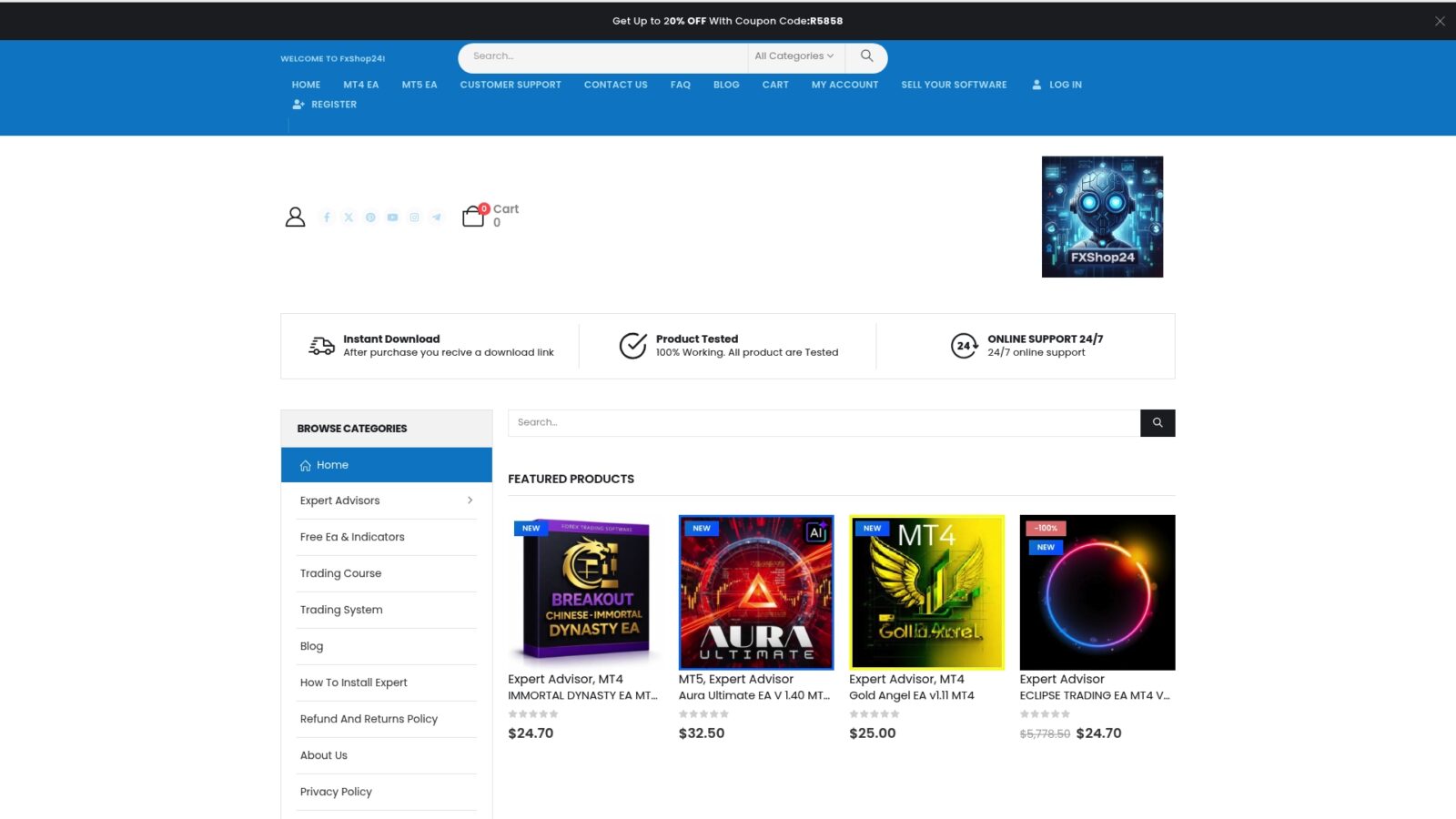
If you are serious about passing evaluations and managing funded accounts efficiently, the right tools remove a significant amount of execution risk. At Fxshop24, we specialize in prop firm-compatible automated trading systems built for MT4 and MT5 environments. Our automated trading systems guide walks you through the exact types of EAs and trading robots that align with prop firm rule structures, from drawdown-safe execution logic to news filter settings.
For hands-on risk control during live trading sessions, the TraderAgent MT4 tool gives you session-level trade management with built-in risk parameters you can set once and enforce automatically. It is the kind of tool that keeps a bad trading day from becoming an account violation. All products come with lifetime updates and unlimited licenses, so your setup grows with you as your trading scales.
FAQ
What is a prop firm trading checklist?
A prop firm trading checklist is a structured set of criteria covering firm selection, risk rules, evaluation strategy, and funded account management that traders use to maximize their success probability at proprietary trading firms.
What percentage of traders pass prop firm challenges?
Only 5–10% of traders pass prop firm evaluations, with rule violations and misunderstood terms accounting for 27% of all failures.
What is the difference between static and trailing drawdown?
Static drawdown fixes the loss floor at your starting balance, while trailing drawdown raises that floor as your equity grows, which reduces your available trading buffer after a profitable run.
How much profit do I need to pass a prop firm evaluation?
Most Phase 1 evaluations require an 8–10% profit target, and Phase 2 typically requires 5%, with daily loss limits between 3% and 5% throughout.
What should I check in a prop firm contract before signing?
Look for exact drawdown definitions, daily loss limits, payout schedules, news trading restrictions, and whether the firm reserves the right to change rules retroactively. Evaluating legal terms carefully protects you from discretionary payout denials and vague violation definitions.