



19
Feb
Master the Forex Strategy Building Process for MT4 and MT5
Every trader has faced the uncertainty of building a new system from scratch, wondering where missteps could cost both time and capital. Defining clear goals and analyzing market dynamics are vital steps across all trading styles, whether you prefer day trading or hold positions longer. With tools like MetaTrader 4 and MetaTrader 5, systematic strategy development and backtesting become accessible and practical for retail traders. This guide will highlight essential steps that transform your approach into a disciplined, data-driven process.
Table of Contents
- Step 1: Assess Trading Goals And Market Conditions
- Step 2: Define Key Strategy Rules And Entry Criteria
- Step 3: Configure MT4 Or MT5 Tools And Software
- Step 4: Backtest Strategy For Robustness And Accuracy
- Step 5: Optimize Parameters For Maximum Performance
- Step 6: Validate Strategy With Live Or Demo Accounts
Quick Summary
| Key Point | Explanation |
|---|---|
| 1. Define Trading Goals Clearly | Assess your objectives including risk tolerance, trading frequency, and expected returns to shape your strategy effectively. |
| 2. Establish Systematic Entry Criteria | Develop precise, objective rules for entering trades to eliminate emotional decision-making and ensure consistency. |
| 3. Backtest to Validate Strategies | Use historical data to simulate performance, identifying strengths and weaknesses before risking real capital. |
| 4. Optimize Parameters for Performance | Refine key variables systematically to enhance profitability while maintaining consistent results across market conditions. |
| 5. Validate with Demo Accounts First | Test your strategy in real-time without financial risk to observe behavior under various market conditions before going live. |
Step 1: Assess Trading Goals and Market Conditions
Successfully building a forex trading strategy begins with clarity about your objectives and a comprehensive understanding of market dynamics. Your trading goals will fundamentally shape every subsequent decision in strategy development, making this initial assessment critical for long-term success.
Start by defining your specific trading objectives across multiple dimensions. Consider factors like expected annual return percentage, maximum acceptable drawdown, and preferred trading frequency. Will you pursue day trading, swing trading, or longer-term positional strategies? Traders need to align their goals with their personal risk tolerance and available time commitment. Fundamental market analysis helps traders understand the broader economic context that will influence currency movements.
- Evaluate personal risk appetite
- Determine investment time horizon
- Assess available trading capital
- Understand personal skill level and experience
Carefully analyze current market conditions using both fundamental and technical indicators. This involves examining economic indicators like interest rates, GDP growth, and political stability alongside technical tools such as moving averages, relative strength index (RSI), and Bollinger Bands. Each indicator provides unique insights into potential market trends and volatility.

Here’s a quick comparison of popular technical indicators used in forex analysis:
| Indicator | Primary Use | Common Signal | Most Effective In |
|---|---|---|---|
| Moving Averages | Trend identification | Crossover/pullback | Trending markets |
| RSI (Relative Strength Index) | Momentum measurement | Overbought/oversold | Volatile periods |
| Bollinger Bands | Volatility analysis | Band breakout | Rangebound markets |
This table summarizes how each indicator functions and when it is most beneficial for trading decisions.
Understanding market conditions is not about predicting the future, but about preparing for multiple potential scenarios.
Pro tip: Create a detailed trading plan document that clearly outlines your goals, risk management strategy, and market analysis approach before committing any real capital.
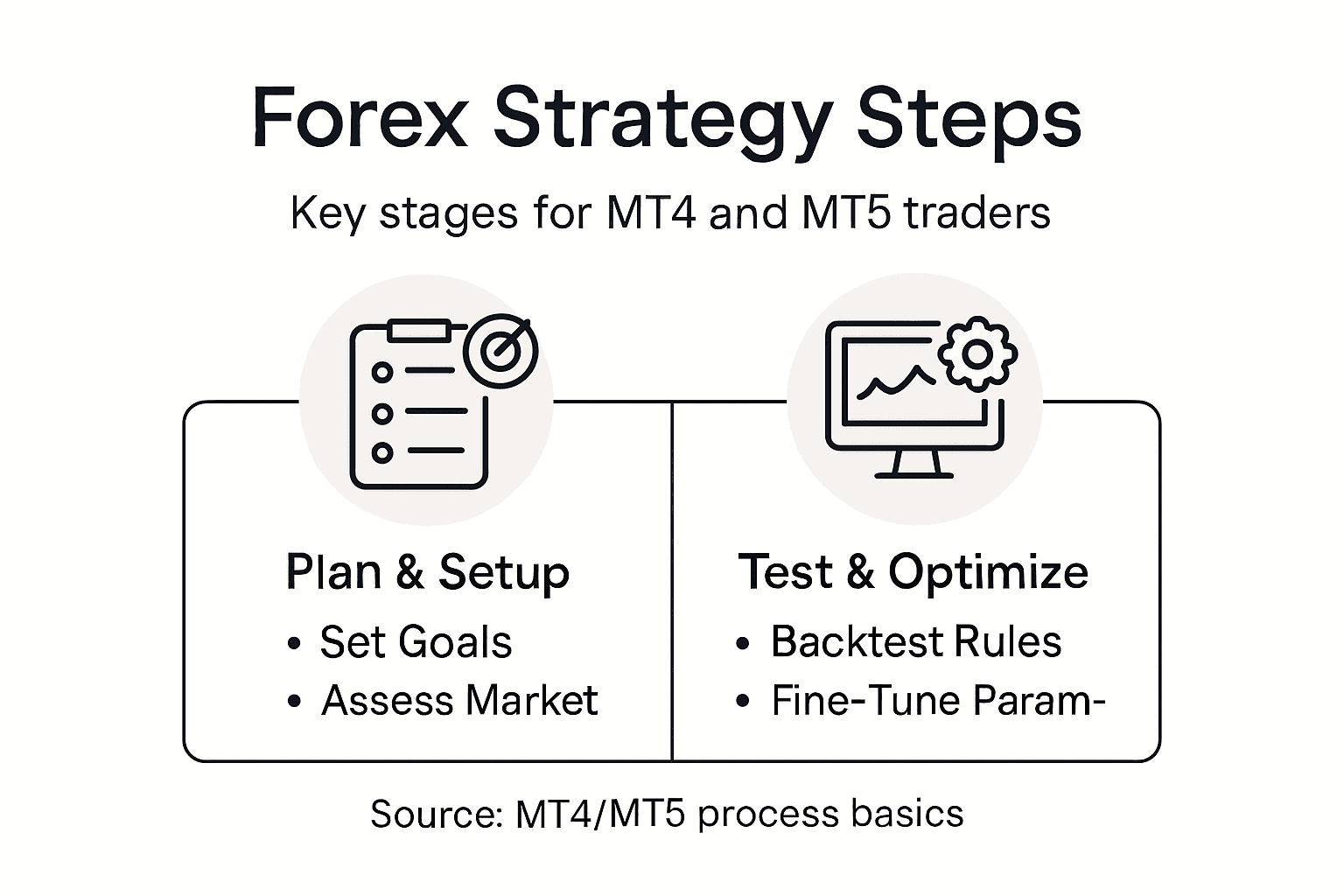
Step 2: Define Key Strategy Rules and Entry Criteria
Developing clear and systematic strategy rules transforms your trading approach from guesswork to a structured, repeatable process. Your entry criteria serve as the foundational decision-making framework that will guide every trading action in your forex strategy.
Trading strategies are more than random market selections. They require precise, objective rules that remove emotional decision-making. Trading strategy components include systematic approaches for asset selection, entry/exit signals, and comprehensive risk management protocols. This means establishing crystal-clear conditions that must be met before executing any trade.
- Define specific price action patterns
- Establish technical indicator confirmation rules
- Create precise entry point criteria
- Determine minimum reward-to-risk ratio
Your entry criteria should include multiple confirmatory signals from different analytical perspectives. This might involve combining price action patterns with technical indicators like moving averages, RSI, or Bollinger Bands. For instance, a long entry might require the price to be above a 200-period moving average, the RSI to show bullish momentum, and a specific candlestick pattern confirming trend direction.
Successful trading strategies transform subjective hunches into objective, measurable decision rules.
Pro tip: Backtest your entry criteria rigorously across multiple market conditions to validate their statistical reliability before implementing them in live trading.
Step 3: Configure MT4 or MT5 Tools and Software
Configuring your trading platform is a critical step in transforming your forex strategy from concept to executable plan. The right software setup can dramatically enhance your ability to implement complex trading rules and manage your portfolio effectively.
Multi-asset trading platforms offer powerful tools for traders seeking advanced strategy execution. MetaTrader 5 provides comprehensive capabilities for creating and managing sophisticated trading systems, including support for custom indicator development and automated strategy implementation. Your configuration process will involve several key technical setup steps.
- Install the latest platform version
- Configure chart and indicator settings
- Set up custom indicator templates
- Establish risk management parameters
- Configure trading terminal preferences
Begin by downloading the official MetaTrader platform directly from your broker’s website to ensure compatibility. Pay special attention to your platform’s network and data connection settings, which can significantly impact real-time trade execution. MT5 trading tools can help optimize your technical configuration for maximum performance.
Effective platform configuration is the bridge between your trading strategy and market execution.
Pro tip: Create multiple template profiles within your trading platform to quickly switch between different strategy configurations without manually readjusting settings each time.
Step 4: Backtest Strategy for Robustness and Accuracy
Backtesting transforms your trading strategy from theoretical concept to statistically validated approach. This critical process allows you to simulate your strategy’s performance using historical market data, revealing potential strengths and weaknesses before risking real capital.
Backtesting libraries provide sophisticated tools for evaluating trading strategies with advanced performance metrics. These sophisticated platforms enable traders to analyze complex parameters like Sharpe ratio, profit factor, and maximum drawdown across different market conditions.
- Collect comprehensive historical price data
- Define precise entry and exit rules
- Set realistic transaction cost parameters
- Run multiple simulation scenarios
- Analyze detailed performance metrics
Implement rigorous statistical testing by running your strategy across different market periods. This means testing during trending markets, ranging markets, and periods of high volatility to ensure your strategy maintains consistent performance. Some traders mistakenly backtest only in favorable market conditions, which can create dangerously misleading results.
A well-designed backtest reveals more about your strategy’s potential weaknesses than its strengths.
Pro tip: Always include a margin of safety in your backtesting parameters and be skeptical of strategies showing unrealistically perfect historical performance.
Step 5: Optimize Parameters for Maximum Performance
Parameter optimization represents the crucial bridge between a promising trading strategy and a truly exceptional automated system. By systematically refining key variables, you can dramatically enhance your strategy’s potential profitability and risk management.
Grid search optimization techniques offer powerful methods for fine-tuning trading parameters across multiple dimensions. These sophisticated approaches allow traders to automatically explore different combinations of critical settings like lot sizes, stop loss levels, and entry/exit triggers to maximize performance metrics.
- Identify critical strategy parameters
- Establish parameter ranges for testing
- Select appropriate optimization algorithms
- Define performance evaluation metrics
- Validate optimized parameter sets
Focus on systematic parameter refinement by testing incremental variations. This might involve adjusting stop loss distances, modifying position sizing rules, or experimenting with different moving average periods. The goal is finding a robust parameter configuration that performs consistently across various market conditions, not just achieving peak performance in a single market scenario.
True optimization balances peak performance with consistent, predictable results.
Pro tip: Always maintain a conservative approach during parameter optimization, prioritizing strategy stability over marginal performance improvements.
Step 6: Validate Strategy with Live or Demo Accounts
Validating your forex trading strategy is the ultimate test of its real-world performance and reliability. This critical step transforms your carefully developed strategy from a theoretical model into a practical trading tool by exposing it to actual market conditions.
Transitioning from demo to real trading requires a methodical and disciplined approach. Begin with demo account validation, which allows you to simulate trading without financial risk. These simulated environments provide a safe space to observe your strategy’s behavior under different market scenarios.
- Start with a demo account for initial testing
- Compare strategy performance across different market conditions
- Track key performance metrics
- Monitor emotional and psychological trading responses
- Gradually introduce small live account positions
Carefully document your strategy’s performance, paying close attention to real-time execution details. Demo accounts offer an invaluable opportunity to refine your approach, identifying potential weaknesses or unexpected behaviors before committing real capital. Some strategies that appear promising in backtesting may reveal critical limitations when exposed to live market dynamics.
Here is a summary comparing different trading strategy validation methods:
| Validation Approach | Risk Involved | Realism | Main Benefit |
|---|---|---|---|
| Backtesting | No financial risk | Historical results | Statistically reliable |
| Demo Trading | No financial risk | Real-time pricing | Real-world practice |
| Live Trading | Financial risk present | Actual execution | Genuine performance |
This table highlights key differences to help traders select the best validation phase.
The goal of validation is not perfection, but consistent and predictable performance.
Pro tip: Maintain detailed trading journals during both demo and initial live trading phases, recording not just financial outcomes but also your decision-making process and emotional responses.
Elevate Your Forex Strategy with Proven Automation Tools
Building a forex strategy for MT4 and MT5 can be complex and time-consuming. From defining precise entry rules to rigorous backtesting and optimization, traders often struggle with consistency, emotional decision-making, and managing multiple technical indicators. This article highlights these challenges and emphasizes the importance of systematic strategy rules and platform configuration to succeed.
FxShop24 offers a comprehensive solution designed to help you overcome these hurdles. Our range of expert advisors, AI-driven trading robots, and premium trading systems are crafted to automate your strategy execution and improve risk management. Whether you are refining your entry criteria or seeking to validate your approach under live market conditions, our prop firm-ready EAs come with lifetime updates and unlimited licenses to power your trading journey.
Unlock automated precision with tools tailored for MetaTrader platforms. Discover how our tested forex and gold trading solutions can complement your strategy development process by visiting FxShop24 main site today.
Take charge of your trading success now. Explore our expertly developed EAs and trading systems to implement your forex strategy faster and with greater confidence. Visit FxShop24, equip yourself with advanced automation tools, and transform your trading goals into reality.
Frequently Asked Questions
How do I assess my trading goals and market conditions before building a Forex strategy?
To assess your trading goals, define your specific objectives regarding expected returns, acceptable drawdown, and trading frequency. Analyze current market conditions by examining key economic indicators and utilizing technical analysis tools to inform your strategy.
What key rules should I define for my Forex strategy entry criteria?
Establish precise entry criteria that include specific price action patterns and confirmation from multiple technical indicators. For instance, you might require the price to be above a certain moving average combined with a bullish signal from the Relative Strength Index (RSI).
How can I configure MetaTrader 4 or MetaTrader 5 for my Forex strategy?
Begin by downloading the latest version of your trading platform and customizing your chart and indicator settings. Set up templates and establish risk management parameters to streamline your trading process and ensure you are ready for effective execution.
What is the importance of backtesting my Forex strategy?
Backtesting is essential as it allows you to simulate your strategy using historical data, revealing its strengths and weaknesses. Perform rigorous statistical testing across various market conditions to validate your strategy’s effectiveness before trading with real capital.
How do I optimize parameters for my Forex trading strategy?
Optimize your strategy by systematically adjusting key parameters such as stop loss levels and position sizes. Use grid search techniques to explore different combinations and find the most effective settings that deliver consistent performance across multiple market scenarios.
What steps should I take to validate my Forex strategy with live or demo accounts?
Start with a demo account to test your strategy in real-time without risking actual money. Document performance metrics and emotional responses during trading to refine your approach, and consider transitioning to live trading gradually to assess genuine performance.
Recommended
- Defining MT5 Trading: Powering Automated Forex Success
- MetaTrader 5 Explained: Powering Automated Forex Success
- What Is Trading Strategy And Why It Matters
- Most Profitable Expert Advisor: How To Choose The Right EA For Your Strategy | FxShop24 Marketplace
- Crypto Trading Strategy Optimization for Profitable Automation