

7
Jan
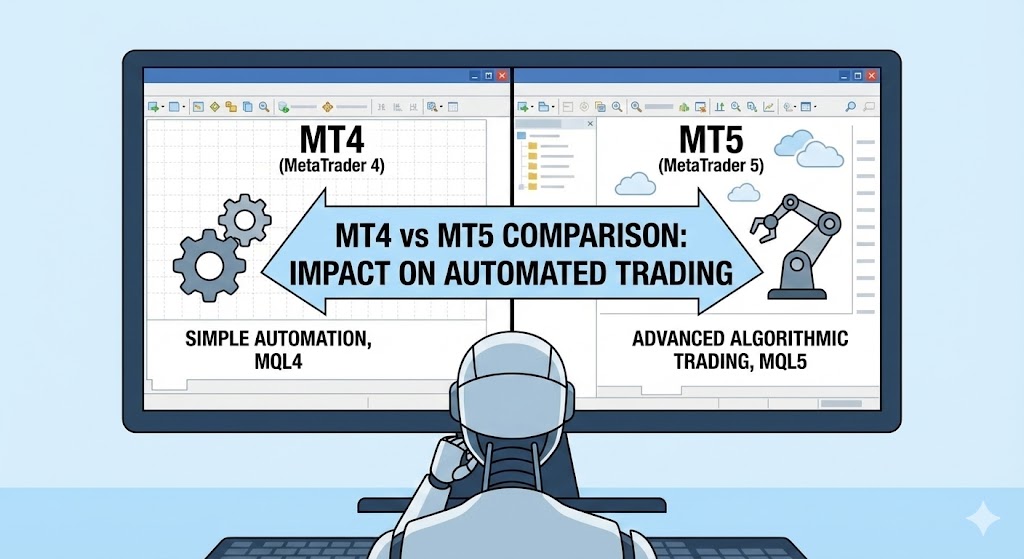
MT4 vs MT5 Comparison: Impact on Automated Trading
Every American trader faces the challenge of choosing between powerful automated platforms like MetaTrader 4 and MetaTrader 5. With over 80 percent of global forex trading volume processed by these systems, understanding the differences is essential for anyone aiming to maximize strategy performance. Whether you focus on forex or multi-asset trading, this overview helps you compare the platform features and find the solution that best aligns with your trading goals.
Table of Contents
- Defining MT4 And MT5 Trading Platforms
- Core Architecture And Programming Differences
- Automated Trading Features And EA Compatibility
- Performance For Forex, Gold, And Multi-Asset Trading
- Factors Influencing Platform Selection
- Risks, Limitations, And Common Mistakes
Key Takeaways
| Point | Details |
|---|---|
| MT4 Specialization | MetaTrader 4 is optimized for forex trading with user-friendly features and a vast library of Expert Advisors (EAs). |
| MT5 Multi-Asset Support | MetaTrader 5 expands capabilities to include stocks, futures, options, and commodities, accommodating diverse trading strategies. |
| Architectural Strengths | MT5’s 64-bit multi-threaded architecture improves processing efficiency and backtesting capabilities compared to MT4’s 32-bit design. |
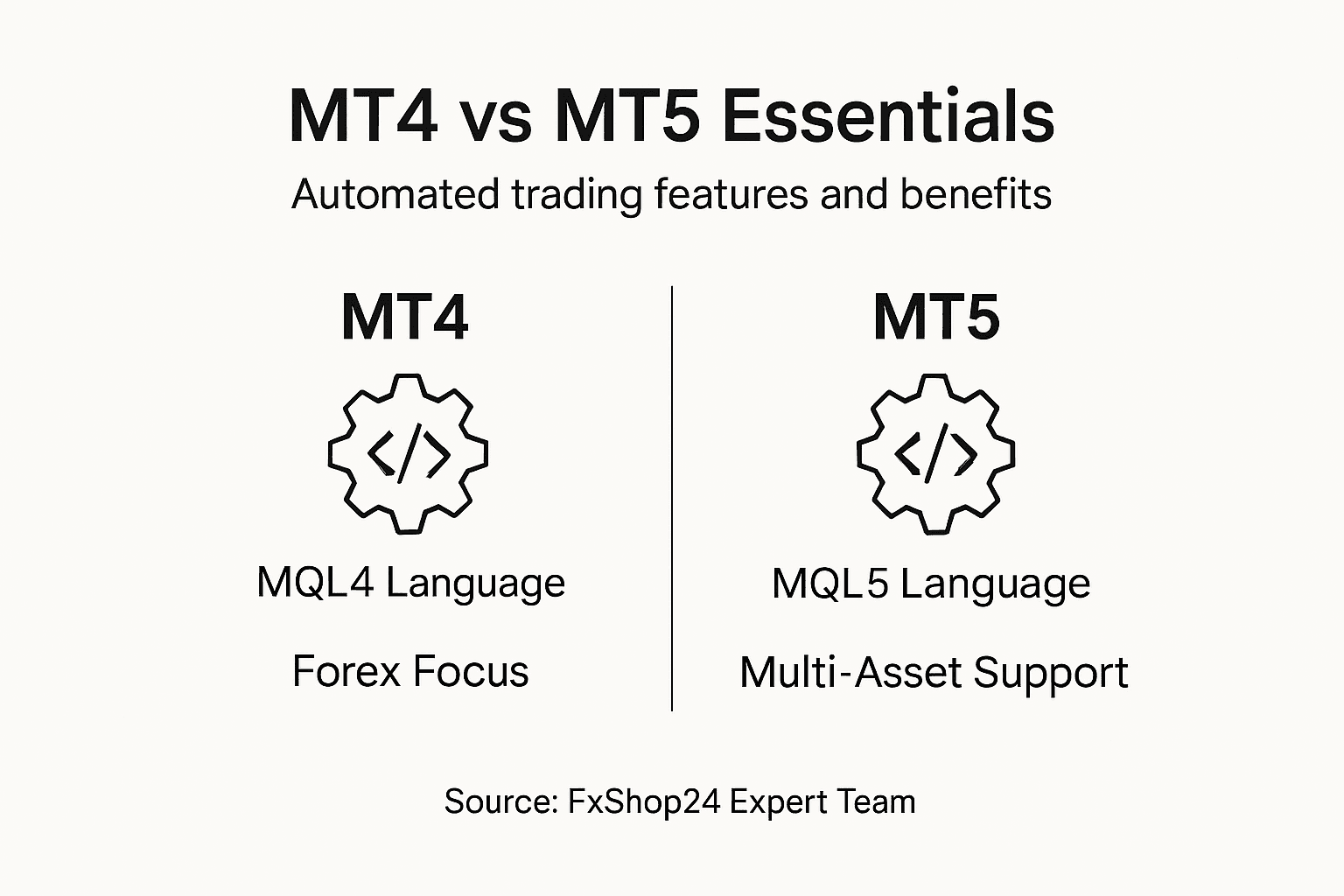
| Programming Evolution | MT4 uses the simpler MQL4 language, while MT5 features the object-oriented MQL5, allowing for more advanced trading algorithms. |
Defining MT4 and MT5 Trading Platforms
Trading platforms MetaTrader 4 (MT4) and MetaTrader 5 (MT5) represent two significant technological generations in automated forex and financial market trading. Developed by MetaQuotes Software Corporation, these platforms have transformed how traders analyze markets, execute trades, and implement sophisticated trading strategies.
MT4, launched in 2005, emerged as a specialized forex trading platform with a user-friendly interface designed specifically for currency market participants. Its architecture supports automated trading through Expert Advisors (EAs), enabling traders to develop custom algorithmic strategies using MQL4 programming language. The platform offers 30+ technical indicators, nine standard timeframes, and robust charting capabilities that became industry standard for forex traders worldwide.
In contrast, MetaTrader 5 represents an expanded trading ecosystem launched in 2010, targeting a broader range of financial instruments beyond forex. MT5 introduces advanced features like multi-asset trading capabilities, supporting stocks, futures, options, and commodities. Its architectural improvements include a 64-bit multithreaded system, 38+ technical indicators, additional timeframes, and a sophisticated Depth of Market view that provides deeper market insights for professional traders.
Pro tip: When selecting between MT4 and MT5, carefully evaluate your specific trading requirements, asset preferences, and strategy complexity to choose the most suitable platform.
Here’s a concise comparison of MT4 and MT5 core features and their practical impact:
| Aspect | MetaTrader 4 | MetaTrader 5 | Business Impact |
|---|---|---|---|
| Initial Release Year | 2005 | 2010 | Determines platform maturity |
| Supported Markets | Forex, CFDs | Forex, stocks, futures | Expands trading opportunities |
| Architecture | 32-bit, single-thread | 64-bit, multithreaded | Influences speed and scalability |
| Programming Language | MQL4 (procedural) | MQL5 (object-oriented) | Impacts algorithm complexity |
| Technical Indicators | 30+ | 38+ | Enhances depth of market analysis |
| Order Types | Standard types | Advanced, more variety | Enables sophisticated trading strategies |
Core Architecture and Programming Differences
The fundamental architectural distinctions between MetaTrader 4 and MetaTrader 5 represent critical considerations for traders seeking optimal automated trading performance. Architectural design differences fundamentally impact processing capabilities, programming flexibility, and overall trading strategy implementation.

MT4’s 32-bit single-threaded architecture constrains computational resources, limiting RAM usage to 4GB and processing tasks to sequential execution. This design ensures stable performance but restricts the platform’s ability to handle complex, resource-intensive trading algorithms. In contrast, MT5 introduces a revolutionary 64-bit multi-threaded architecture that enables parallel processing, unlimited RAM allocation, and dramatically improved computational efficiency. These architectural advancements translate to faster backtesting, more sophisticated strategy development, and enhanced overall trading system performance.
Programming language evolution represents another significant differentiator between these platforms. MT4 utilizes MQL4, a procedural programming language characterized by its simplicity and straightforward implementation. MQL5, MT5’s programming language, represents a substantial leap forward with its object-oriented approach, enabling traders to develop more complex, modular, and sophisticated trading algorithms. This transition allows for more advanced strategy design, improved code organization, and greater flexibility in creating intricate automated trading systems that can adapt to increasingly complex market dynamics.
Pro tip: When developing trading algorithms, leverage MT5’s object-oriented MQL5 language to create more modular and scalable automated trading strategies.
Automated Trading Features and EA Compatibility
Automated trading represents a critical technological advancement in financial markets, with Expert Advisors (EAs) serving as the primary mechanism for algorithmic strategy implementation. Both MetaTrader 4 and MetaTrader 5 offer robust platforms for developing trading bots, but their approaches to automated trading differ significantly in complexity and capabilities.
MT4 established the foundational framework for automated trading, introducing Expert Advisors as programmable trading robots capable of executing predefined strategies without human intervention. Its MQL4 scripting language allows traders to create relatively straightforward algorithmic strategies, typically focused on forex markets. Traders can develop EAs that monitor market conditions, execute trades, manage risk, and implement complex trading logic through a procedural programming approach. The platform supports basic automated trading functions like entry and exit signals, position sizing, and fundamental trade management strategies.
MetaTrader 5 dramatically expands the automated trading ecosystem by offering more advanced EA development capabilities. The object-oriented MQL5 programming language provides traders with enhanced flexibility, enabling more sophisticated and complex algorithmic trading systems. MT5’s EAs can handle multi-asset trading, support more advanced order types, and integrate more comprehensive market analysis tools. The platform’s improved architecture allows for more intricate backtesting, strategy optimization, and parallel processing of trading algorithms, making it particularly attractive for traders seeking to develop more nuanced and adaptable automated trading solutions.
Pro tip: When developing Expert Advisors, prioritize modular code design and comprehensive error handling to create more robust and reliable automated trading strategies.
Performance for Forex, Gold, and Multi-Asset Trading
Trading platform performance varies significantly across different markets, with MetaTrader 4 and MetaTrader 5 offering distinct capabilities for forex, gold, and multi-asset trading strategies. Optimizing trading platform selection requires understanding the nuanced capabilities of each platform across different asset classes.
MetaTrader 4 remains the gold standard for forex traders, providing a robust and streamlined environment specifically designed for currency market trading. Its architecture is particularly well-suited for forex and gold trading, offering sufficient analytical tools, efficient execution, and a lightweight system that minimizes computational overhead. Traders focusing exclusively on forex and gold markets will find MT4’s specialized design, comprehensive indicator set, and stable performance highly attractive. The platform’s optimization for currency pairs ensures rapid trade execution, minimal latency, and reliable strategy implementation, especially for traders operating in the forex and precious metals markets.
MetaTrader 5 represents a significant evolution in trading platform technology, expanding beyond forex to support a comprehensive multi-asset trading ecosystem. Its advanced architecture enables traders to simultaneously trade stocks, commodities, futures, options, and forex with unprecedented flexibility. The platform’s 64-bit multithreaded system provides faster execution speeds, more sophisticated market analysis tools, and enhanced backtesting capabilities. For traders seeking diversification, MT5’s Depth of Market (DOM) feature and advanced order types make it an ideal choice for developing complex, multi-asset trading strategies that extend beyond traditional forex and gold trading approaches.
Pro tip: Select your trading platform based on your specific market focus, considering whether you need forex-specific optimization or multi-asset trading capabilities.
Factors Influencing Platform Selection
Selecting the right trading platform requires careful consideration of multiple critical factors that extend beyond basic functionality. Comprehensive platform evaluation involves analyzing technical capabilities, trading objectives, and individual market requirements.
Traders must first assess their primary trading goals and market focus. For forex specialists concentrating exclusively on currency pairs, MetaTrader 4 offers an optimized environment with streamlined performance, extensive broker compatibility, and a massive repository of existing Expert Advisors (EAs). The platform’s simplicity, robust forex-specific tools, and widespread adoption make it an excellent choice for traders prioritizing currency market strategies. Its lightweight architecture ensures minimal computational demands, faster execution speeds, and compatibility with a wide range of trading systems and brokers.
In contrast, MetaTrader 5 caters to traders seeking broader market exposure and more sophisticated trading capabilities. Its multi-asset architecture supports simultaneous trading across stocks, commodities, futures, options, and forex, making it ideal for diversified investment strategies. Advanced features like the Depth of Market (DOM), enhanced order types, and a 64-bit multithreaded system provide traders with more comprehensive analytical tools and greater flexibility. Professional traders and those looking to expand beyond traditional forex trading will find MT5’s advanced technological infrastructure more aligned with complex, multi-dimensional trading approaches.
Pro tip: Evaluate your trading platform selection based on your specific market focus, computational resources, and long-term trading strategy complexity.
Below is a summary of key factors that influence trading platform selection:
| Decision Factor | MT4 Suitability | MT5 Suitability | Practical Consideration |
|---|---|---|---|
| Market Focus | Forex-centric | Multi-asset support | Choose based on target assets |
| Complexity of Strategy | Simple to moderate | Advanced, complex | Match platform to strategy needs |
| Broker Compatibility | Widely available | Increasing, variable | Ensure platform is supported |
| Automated Trading | Extensive EA library | Fewer legacy EAs | Evaluate development and support options |
| Learning Curve | Easier for beginners | Steeper for new users | Consider user experience and training |
Risks, Limitations, and Common Mistakes
Navigating the complexities of MetaTrader platforms requires a nuanced understanding of their inherent limitations and potential pitfalls. Critical platform selection challenges demand careful evaluation of technical constraints and strategic compatibility.
MetaTrader 4 presents several significant constraints that traders must carefully consider. Its primary limitation lies in its narrow market focus, predominantly supporting forex and CFD trading with minimal flexibility for broader asset classes. The platform’s single-threaded architecture restricts computational efficiency, resulting in slower backtesting and reduced performance for complex trading algorithms. Traders relying exclusively on MT4 may find themselves constrained by limited order types, reduced analytical tools, and a programming environment that struggles with sophisticated, multi-dimensional trading strategies. The platform’s older MQL4 scripting language further compounds these challenges, offering less sophisticated programming capabilities compared to modern trading platforms.
MetaTrader 5 addresses many MT4 limitations but introduces its own set of challenges. While offering advanced multi-asset trading capabilities and a more robust 64-bit architecture, MT5 confronts traders with a steeper learning curve and reduced ecosystem support. The transition to MQL5 programming language means fewer existing Expert Advisors, potential compatibility issues with legacy systems, and a more complex development environment. Some brokers may also restrict certain advanced features like hedging, creating additional barriers for traders seeking comprehensive trading solutions. The platform’s enhanced capabilities come at the cost of increased complexity, potentially overwhelming traders who prefer streamlined, straightforward trading interfaces.
Pro tip: Thoroughly research platform limitations and conduct comprehensive testing before fully committing to either MT4 or MT5 to ensure alignment with your specific trading requirements.
Unlock the Full Potential of MT4 and MT5 with Proven Automated Trading Tools
Choosing between MetaTrader 4 and MetaTrader 5 presents challenges like understanding architectural differences, programming languages, and suitable market assets. Many traders struggle with selecting the right platform to harness automated trading effectively while avoiding pitfalls such as limited strategy complexity or compatibility issues. This article highlights critical insights on MT4 and MT5 that can help you align your trading goals with the best tools.
At FxShop24, we specialize in providing expertly crafted Expert Advisors (EAs) and AI-powered trading systems designed to maximize your trading performance on both MT4 and MT5 platforms. Whether you want streamlined forex and gold automation perfect for MT4’s strengths or multi-asset capabilities leveraging MT5’s advanced architecture, our products come with lifetime updates, unlimited licenses, and prop firm compatibility. Explore our offerings at FxShop24 to upgrade your automated trading game with solutions tested for real-world performance.
Ready to stop guessing which platform suits your strategy and start trading with confidence? Visit FxShop24 now to discover premium automated trading software tailored for MT4 and MT5 users. Take advantage of instant digital delivery and multiple payment options to boost your trading results today.
Frequently Asked Questions
What are the main differences between MT4 and MT5?
MT4 is primarily a forex trading platform with a user-friendly interface, while MT5 supports a broader range of financial instruments, including stocks, futures, options, and commodities. MT5 features a 64-bit architecture, enabling faster processing and more advanced trading capabilities compared to MT4’s 32-bit system.
Which programming language is used for automated trading in MT4 and MT5?
MT4 uses MQL4, a procedural programming language, which is simpler and suitable for less complex automated strategies. MT5 utilizes MQL5, an object-oriented programming language, allowing for more complex and modular algorithmic trading strategies.
How do automated trading features differ between MT4 and MT5?
MT4 established the foundation for automated trading with Expert Advisors (EAs) but is limited in complexity. MT5, on the other hand, offers advanced EA capabilities, supporting multi-asset trading and sophisticated order types, making it ideal for more nuanced automated strategies.
What should I consider when choosing between MT4 and MT5 for trading?
When selecting a platform, evaluate your trading goals, market focus, and strategy complexity. If you specialize in forex, MT4 could be suitable. However, if you plan to trade multiple assets or require advanced analytical tools, MT5 would be a better choice.