

20
Sep
What is VWAP?
What is VWAP? Discover how this institutional benchmark improves EA entries, risk management, and prop firm execution for smarter Forex trading.
Ever stared at your MT4 screen wondering if that "perfect" entry was actually terrible timing? You're watching price bounce around, your Expert Advisor is firing signals, but something feels off about your execution quality. Here's the uncomfortable truth: most retail traders completely ignore the one indicator that institutional money managers use to benchmark every single trade.
Volume Weighted Average Price (VWAP) isn't just another line on your chart: it's the hidden scorecard that separates amateur hour from professional execution. While you're obsessing over RSI divergences and moving average crossovers, the smart money is using VWAP to determine fair value and time their massive orders with surgical precision.
What Actually Is VWAP?
VWAP combines price and volume data to show you the true average price that all market participants paid during a specific time period. Unlike simple moving averages that treat a 1-lot trade the same as a 100-lot institutional block, VWAP gives heavier weight to high-volume trades.
Think of it this way: if someone bought 1 million shares of Apple at $150, and someone else bought 1,000 shares at $151, which price better represents where the stock actually traded? VWAP answers that question by factoring in volume, giving you the real average price weighted by actual trading activity.
The mathematical formula is straightforward:
VWAP = Σ(Price × Volume) / Σ(Volume)
This calculation runs continuously throughout the trading session, resetting each day to provide an intraday benchmark. Every new trade updates the VWAP line, creating a dynamic reference point that reflects evolving market conditions.
Why Institutional Traders Live By VWAP
Here's where it gets interesting for anyone running Expert Advisors or trading prop firm accounts. Institutional traders use VWAP as their primary execution benchmark because it tells them whether they're getting ripped off.
When Goldman Sachs needs to buy $50 million worth of EUR/USD, they can't just market buy and hope for the best. Their algorithms are programmed to execute that massive order as close to VWAP as possible, minimizing market impact and ensuring they don't move price against themselves.
This is why VWAP often acts like a magnet for price action. Big money is constantly trying to trade near VWAP levels, creating natural support and resistance zones that your technical analysis might be missing.
The first VWAP-based execution algorithm was implemented in 1984 for Ford Motor Company, and now virtually every major institution uses VWAP-targeted strategies. When you understand this context, those mysterious price reactions around certain levels start making perfect sense.
Reading VWAP Like A Pro
VWAP interpretation follows some reliable patterns that can dramatically improve your trade timing:
Price Above VWAP = Bullish Bias
When price trades above the VWAP line, buyers are in control. The market is paying more than the day's average price, indicating strong demand and potential continuation upward.
Price Below VWAP = Bearish Bias
Price below VWAP suggests sellers have the upper hand. Market participants are accepting prices below the day's weighted average, signaling potential downward pressure.
VWAP as Dynamic Support/Resistance
Watch how price reacts when it touches the VWAP line. In trending markets, VWAP often provides reliable support in uptrends and resistance in downtrends. Price tends to bounce off VWAP before continuing in the primary direction.
VWAP Slope Indicates Trend Strength
An upward-sloping VWAP confirms strong bullish momentum, while a downward-sloping VWAP validates bearish conditions. Flat VWAP suggests choppy, range-bound action where mean reversion strategies might work better.
Strategic Applications For Automated Trading
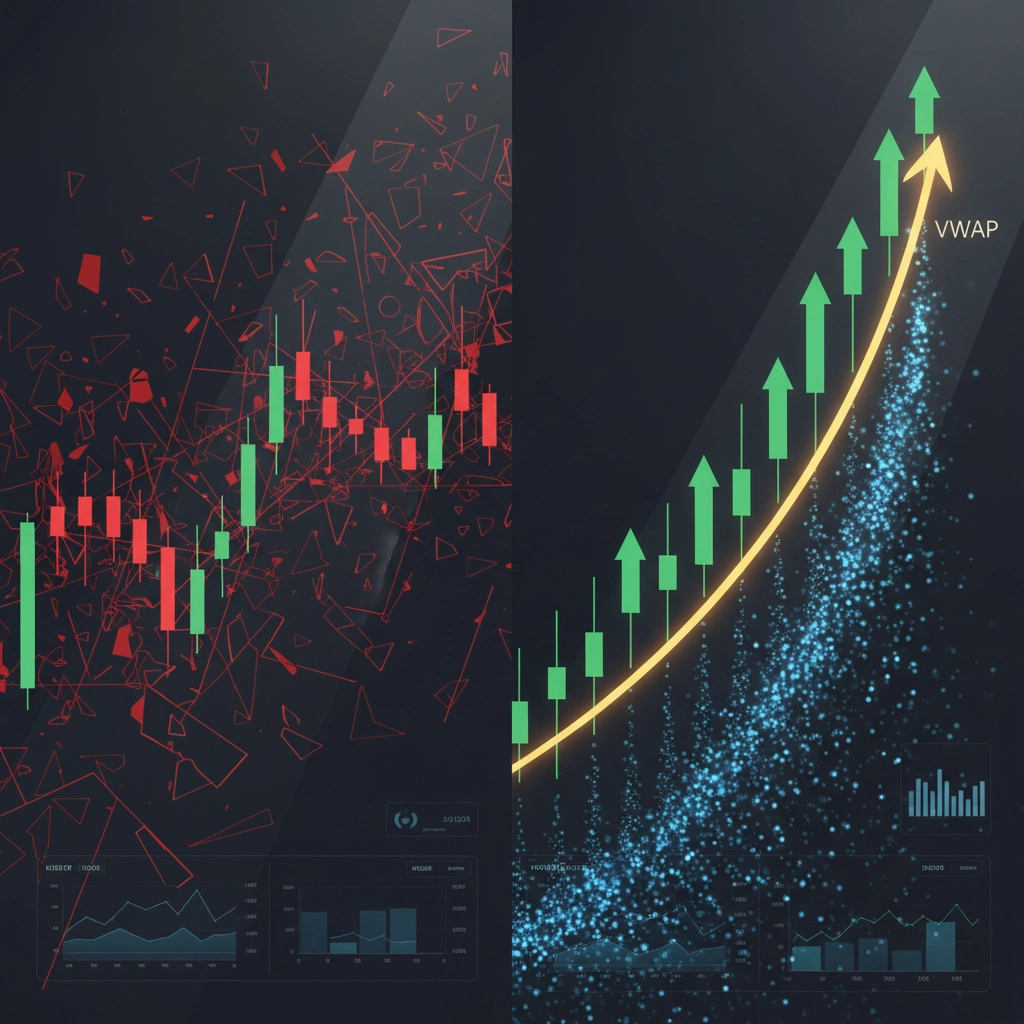
If you're running EAs or trying to pass prop firm challenges, VWAP can revolutionize your approach to market timing and risk management.
Entry Timing Optimization
Instead of blindly following your EA's signals, use VWAP to improve entry quality. For long positions, wait for price to establish above VWAP, then look for pullbacks toward the VWAP line for optimal entries. This ensures you're buying in sync with institutional flow rather than fighting it.
For short positions, wait for price to break below VWAP, then use rallies back toward VWAP as high-probability entry zones. You're essentially fading weak buyers who are paying above fair value.
Risk Management Enhancement
VWAP provides excellent reference points for stop loss placement. If you're long above VWAP, consider placing stops below recent VWAP lows. If you're short below VWAP, use recent VWAP highs as logical stop levels.
This approach aligns your risk management with actual market structure rather than arbitrary technical levels that might not hold under pressure.
Performance Benchmarking
Track whether your trades are executed above or below VWAP to measure execution quality. Consistently buying above VWAP or selling below VWAP indicates poor timing that's costing you money over time.

VWAP Across Different Timeframes
While VWAP is primarily designed for intraday analysis, you can adapt it for different trading styles:
Scalping (1-5 minute charts): Use VWAP as immediate support/resistance for quick entries and exits. Price often respects VWAP on lower timeframes due to algorithmic trading activity.
Day Trading (15-30 minute charts): VWAP becomes your primary trend filter. Only trade long when price is above VWAP and short when below, using VWAP touches as entry triggers.
Swing Trading (1-4 hour charts): Weekly or monthly VWAP can help identify longer-term value areas and potential reversal zones for position trades.
Common VWAP Mistakes That Kill Profits
Mistake #1: Ignoring Volume Context
VWAP without volume analysis is like driving with your eyes closed. Low volume VWAP breaks often fail, while high volume breaks tend to sustain. Always check if volume supports your VWAP-based trade thesis.
Mistake #2: Using VWAP in Choppy Markets
VWAP works best in trending conditions. During range-bound sessions, VWAP provides less reliable signals as institutional flow becomes more random and unpredictable.
Mistake #3: Forgetting About Market Sessions
Asian, London, and New York sessions have different institutional participation patterns. VWAP signals during London open carry more weight than late Asian session VWAP touches due to volume differences.
Advanced VWAP Strategies
VWAP Deviation Bands: Some platforms offer VWAP with standard deviation bands, similar to Bollinger Bands. Price touching the outer bands often signals overextension and potential reversion opportunities.
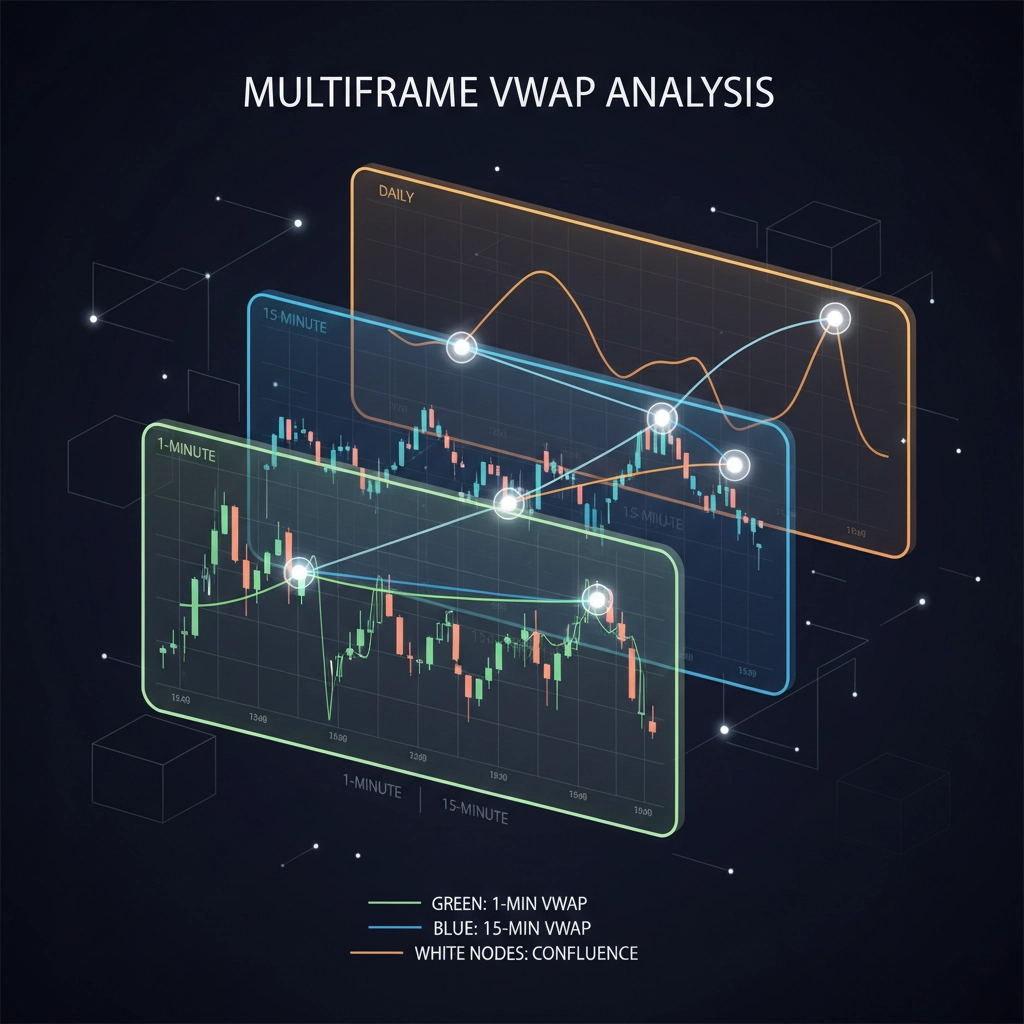
Multiple Timeframe VWAP: Overlay daily, weekly, and monthly VWAP on your charts to identify confluence zones where multiple timeframes agree on fair value.
VWAP Anchoring: Anchor VWAP to specific events like earnings releases, Fed announcements, or major news events to track how price evolves relative to those catalysts.
Integration With Your Current Setup
VWAP doesn't replace your existing strategy: it enhances it. If you're running Fort Knox EA or AI Gold Sniper EA, consider adding VWAP as an additional filter to improve entry timing and reduce false signals.
The key is finding the balance between your EA's logic and VWAP's institutional perspective. You want to trade with the smart money, not against it.
Most prop firms and institutional trading desks include VWAP analysis in their daily market preparation. Understanding this indicator puts you on the same playing field as professional traders who move serious money.
Start incorporating VWAP into your analysis today. Your execution quality: and your account balance( will thank you for it.)