


18
Oct
How do I even start learning Forex as a complete noob?
Ever stare at those currency charts with all their lines and numbers, feeling like you're trying to decode ancient hieroglyphics? You're not alone. Every successful forex trader started exactly where you are right now: completely clueless but curious enough to learn.
The forex market trades over $7.5 trillion daily, making it the world's largest financial market. That sounds intimidating, but here's the truth: you don't need a finance degree or years of experience to start learning. You just need the right roadmap.
Start With What Forex Actually Is
Forex trading is essentially buying one currency while simultaneously selling another. When you see EUR/USD at 1.0850, you're looking at how many US dollars it takes to buy one Euro. If you believe the Euro will strengthen against the dollar, you buy the pair. If it rises to 1.0950, you profit from that 100-pip move.
Think of it like exchanging money for a vacation, except you're doing it to profit from currency fluctuations. The Bank for International Settlements reports that major currency pairs like EUR/USD, GBP/USD, and USD/JPY dominate trading volume: these are your training wheels.
Currency pairs always show two prices: the bid (what buyers will pay) and the ask (what sellers want). The difference is the spread, which represents your broker's profit. Understanding this basic structure prevents confusion when you start trading.
Master the Language Before the Strategy
Every forex trader speaks in pips, lots, and leverage. A pip is the smallest price movement: typically the fourth decimal place for most pairs. One standard lot equals 100,000 units of the base currency, but you can trade micro lots (1,000 units) as a beginner.
Leverage amplifies your buying power. With 1:100 leverage, you control $10,000 worth of currency with just $100. This magnifies both profits and losses, making it crucial to understand before risking real money.
Support and resistance levels are where price historically bounces or breaks through. These levels become your roadmap for entry and exit points. When EUR/USD consistently bounces off 1.0800, that's support. When it repeatedly fails to break above 1.0900, that's resistance.

Your Demo Account Is Your Best Friend
Demo trading isn't just practice: it's your laboratory. Every major broker offers demo accounts with virtual money in real market conditions. This lets you experience actual market movements without financial risk.
Use your demo account to test different timeframes. Some traders prefer 5-minute charts for quick profits, while others analyze daily charts for longer-term trends. Discover what matches your schedule and temperament.
Practice placing different order types: market orders execute immediately at current prices, while limit orders only execute when price reaches your specified level. Stop-loss orders automatically close losing trades to limit damage. Master these tools in demo mode before going live.
Choosing Your Trading Platform and Broker
Your broker is your gateway to the forex market. Regulatory oversight matters: look for brokers regulated by the FCA, ASIC, or CFTC. These agencies ensure your funds stay protected and trading conditions remain fair.
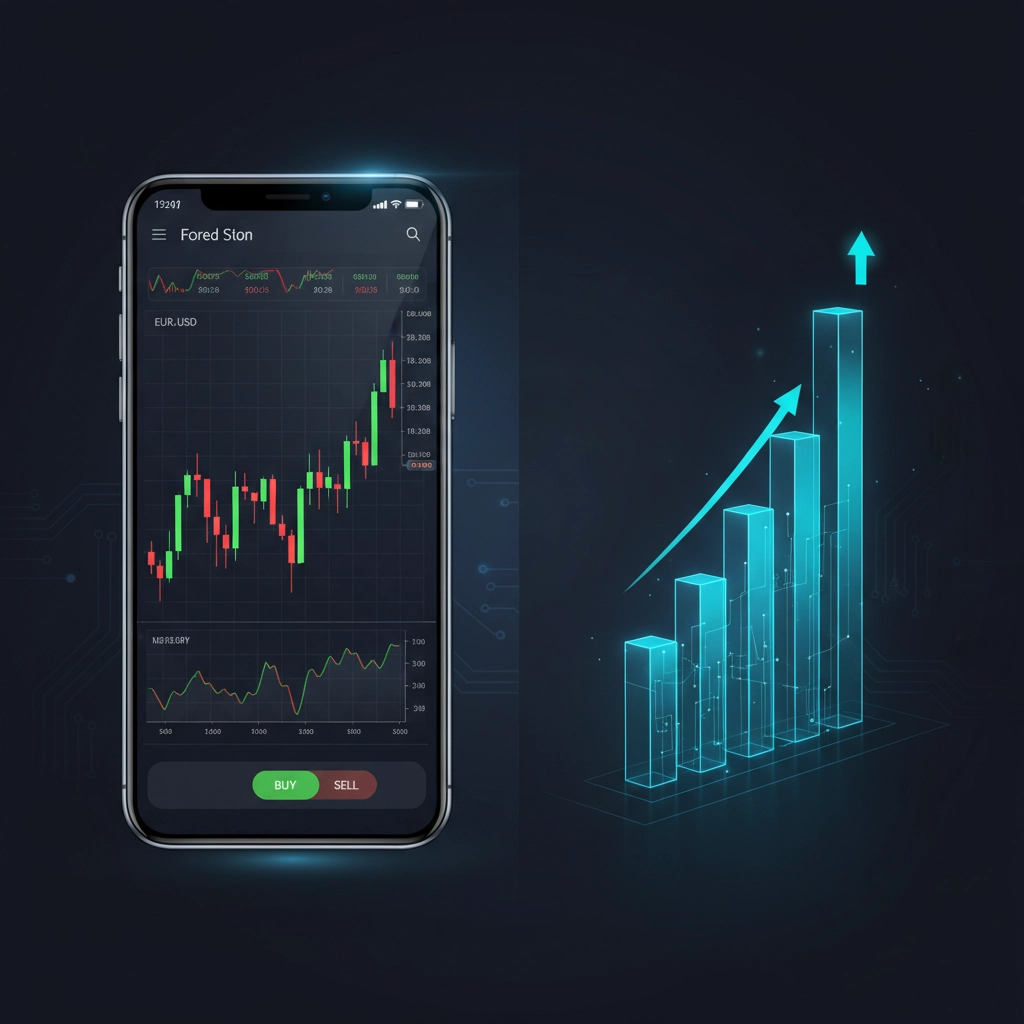
MetaTrader 4 and MetaTrader 5 dominate retail forex trading platforms. MT4 focuses purely on forex with robust technical analysis tools. MT5 adds stocks, commodities, and advanced order types. Both offer automated trading through Expert Advisors (EAs).
Compare spreads across different brokers. A broker offering 1-pip spreads on EUR/USD versus another charging 3 pips makes a significant difference over time. However, don't chase the tightest spreads if it means sacrificing regulation or execution quality.
Starting Small When Money Gets Real
Your first live trade feels completely different from demo trading. Real money triggers emotions that virtual trading can't replicate. Start with micro lots or nano lots to minimize financial impact while you adapt to this psychological shift.
Risk management becomes paramount with real money. Never risk more than 1-2% of your account on a single trade. If you have $1,000, limit your maximum loss per trade to $20. This ensures you survive inevitable losing streaks while learning.
Position sizing determines your success more than your entry and exit points. Calculate your position size based on your stop-loss distance and risk percentage. If your stop-loss sits 50 pips away and you're risking $20, trade 0.04 lots ($4 per pip × 5 pips = $20 risk).
Building Your First Trading Strategy
Trend following offers the highest probability setups for beginners. Identify the overall trend using moving averages: when the 50-period moving average stays above the 200-period average, the trend is up. Trade in the direction of this trend for better success rates.
Price action trading focuses on reading charts without indicators. Look for obvious patterns like higher highs and higher lows in uptrends, or lower highs and lower lows in downtrends. These patterns reveal market sentiment more clearly than complex indicators.
Economic news drives major currency movements. The Non-Farm Payrolls report moves USD pairs significantly. Interest rate decisions from central banks create volatility across affected currencies. Learn the economic calendar and avoid trading major news events until you understand their impact.
Common Beginner Mistakes to Avoid
Overtrading kills more accounts than bad analysis. Quality over quantity applies directly to forex trading. Three well-analyzed trades weekly outperform twenty random trades. Patience pays more than activity.
Revenge trading occurs when you immediately try to recover from a loss with a bigger trade. This emotional response destroys accounts quickly. Accept losses as business expenses and stick to your predetermined risk levels.
Moving stop-losses in the wrong direction turns small losses into account killers. If your analysis was wrong, accept the loss and move on. Don't compound the error by hoping for a reversal.
Ignoring market sessions impacts your trading success. The London-New York overlap (8 AM - 12 PM EST) offers the highest liquidity and tightest spreads for EUR/USD and GBP/USD. Asian session favors JPY pairs. Trading during low-volume periods increases spreads and unpredictable price movements.

Your Path Forward
Forex mastery requires months, not days. Set realistic expectations: aim to become consistently profitable within six months to a year of dedicated practice. Focus on preserving capital while you learn rather than chasing quick profits.
Join forex communities and forums where experienced traders share insights. However, verify everything through your own analysis and demo testing. What works for others might not suit your risk tolerance or schedule.
Consider taking formal forex education courses after you've grasped the basics. Advanced concepts like correlation trading, carry trades, and algorithmic trading become relevant once you've mastered fundamental analysis and risk management.
Track your progress through detailed trading journals. Record not just your wins and losses, but your emotional state, market conditions, and lessons learned. This data becomes invaluable for identifying your strengths and weaknesses.
Your forex education never truly ends: market conditions evolve, central bank policies shift, and new trading technologies emerge. Embrace continuous learning while building on the solid foundation you're creating now.
The journey from complete beginner to profitable trader demands patience, discipline, and consistent effort. Start with demo trading, master the basics, and gradually transition to live trading with proper risk management. Your future trading success begins with the foundation you build today.